
Above the Starry Canopy
"Brüder, über'm Sternenzelt muss ein lieber Vater wohnen." - Friedrich Schiller, An die Freude (1803), set in Beethoven's Symphony No. 9

I. The Question on the Wall
Brothers, above the starry canopy must dwell a loving Father. Schiller's line is the iconographic anchor of the Beethoven Frieze, and it is more specific than it is usually read to be. It does not only ask whether something divine exists. It names a position, above the starry canopy, the highest point in the cosmos, and it names the occupant of that position, a Father, paternal and ordering, and loving, giving and protective. The verb is muss. Not is, must. The line does not report that the Father is there. It asserts that the structure of human longing requires him to be.
The frieze has a highest point. It is the apex of the mandorla on the right wall. Klimt put something there. He did not put the Father. He put the male body in orgasmic ascent, the head plunging into the golden field, dressed in the inherited vocabulary the Father would have worn: the mercy-seat cherubim, the sun-and-moon attendants, the gold. The Father Schiller demands is also in the room, on the opposite wall, rendered as the Knight who is the cross. He stands at the gate of the entropy field and does not strike, does not answer. The conventional answer is present and inert. The active occupant of the cosmic apex is the act.
This is the substitution the essay traces. Schiller's loving Father is the named inverse of the god Klimt's iconography serves. Father becomes the consuming male whose iconographic signature is the female head fallen where the neck should be visible. Loving becomes appetite. The relational ethic posited above the cosmos, gift and protection, is replaced at the same site by consumption. The wall keeps the pious slot, keeps the costume, and installs the act.
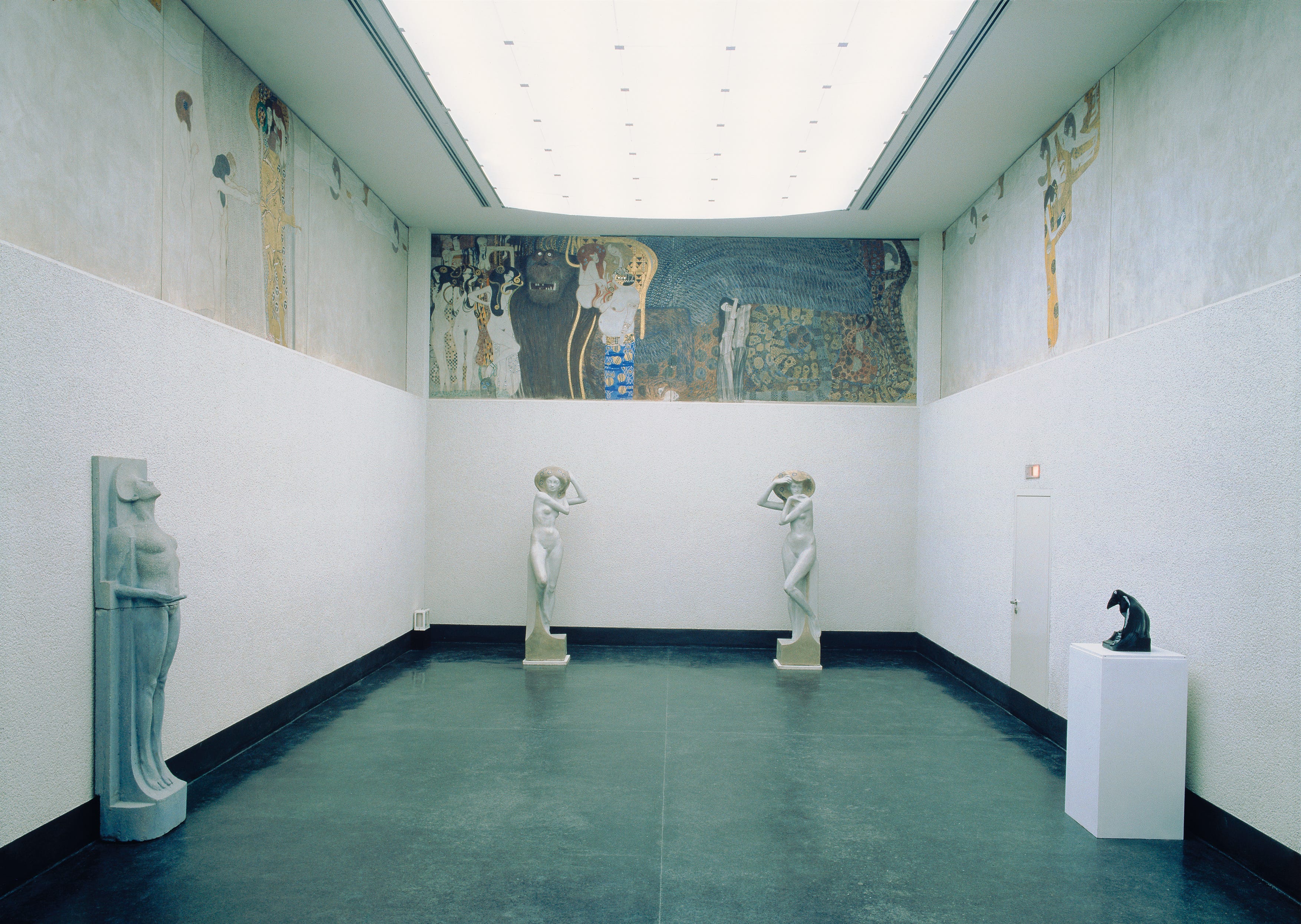
The 14th Secession exhibition opened in 1902 around Max Klinger’s polychrome Beethoven sculpture. Klimt’s frieze surrounded the room as the iconographic program of the temple of the symphony. Mahler conducted a brass-and-wind arrangement of the choral finale of the Ninth at the opening. The visitor entered an architectural space saturated with Schiller’s text and Beethoven’s setting. The published program named the frieze’s narrative as the longing of humanity, the struggle with hostile powers, and the redemption found in the arts. The Vienna audience read the wall in the vocabulary it expected: Christian-Symbolist redemption, gold, mandorla, embracing couple, angelic chorus.
The frieze is the answer Klimt staged to Schiller’s question. It is not the answer the Vienna of 1902 thought it was reading.
A note on method. The Christian-Symbolist vocabulary in the frieze is genuinely present and operating. The mandorla is a mandorla. The embrace is the kiss of redemption. The angelic chorus is the chorus.
This essay does not argue that the surface program is false. It argues that the program is incomplete. The published vocabulary is the public-facing vessel for a second iconographic system that answers the same question Schiller asks, in a register the surface vocabulary contains but does not name.
II. The Two-Level Method
Klimt operates at two levels in every major work. The surface level is readable to the general public and accounts for the commercial reception of the corpus. The hidden level is readable to the viewer who follows Klimt’s own instruction to look at the pictures.
The Stoclet piece established the method at architectural scale. The Beethoven Frieze of 1902 is where the mature method first appears at architectural scale. Klimt's First Love reads the 1895 Love as the iconographic system's earliest legible form. The male emerges from rose-darkness above a reclining female whose throat is compromised, the five faces above arranged as the Genesis 3 consequences, the seed of the woman positioned directly above the serpent's head in spatial encoding of Genesis 3:15. The system the Frieze deploys at architectural scale is operating at canvas scale seven years earlier in a commercial commission for Gerlach's allegorical portfolio. The published program names a knight, hostile forces, and a kiss. The wall paints a second argument under those names. Both are present at the same time.
The hidden register is what this piece recovers. The Frieze is the proto-cycle. Every iconographic element the later corpus deploys is already present in 1902.
III. The Two Knights, One Office
Klimt painted the Father twice in his mature corpus: as the Knight on the left wall of the Beethoven Frieze and as the abstract vertical at the head of the Stoclet dining room. Same office, different idiom.
The Beethoven Knight stands armored, cruciform, with a face, a sword, and two female attendants. The vocabulary is Christian-pictorial because the Secession audience read iconography in that vocabulary. The Stoclet Knight is stripped of armor, sword, attendants, and face. What remains is geometry and the vertical axis. The vocabulary is abstract-geometric because the patron, Adolphe Stoclet, was a Brussels banking heir with no religious commitment in the documentary record, whose palace was the visible form of a soul oriented to mathematics, money, and ornamental display. The Father is translated into the iconographic idiom the patron’s room could carry.
The plumb line stands either way. The standard is preserved across both renderings. The audience and the patron determine the vocabulary in which the standard appears.
IV. The Cross That Does Not Answer
The left wall installs the Christian Father.
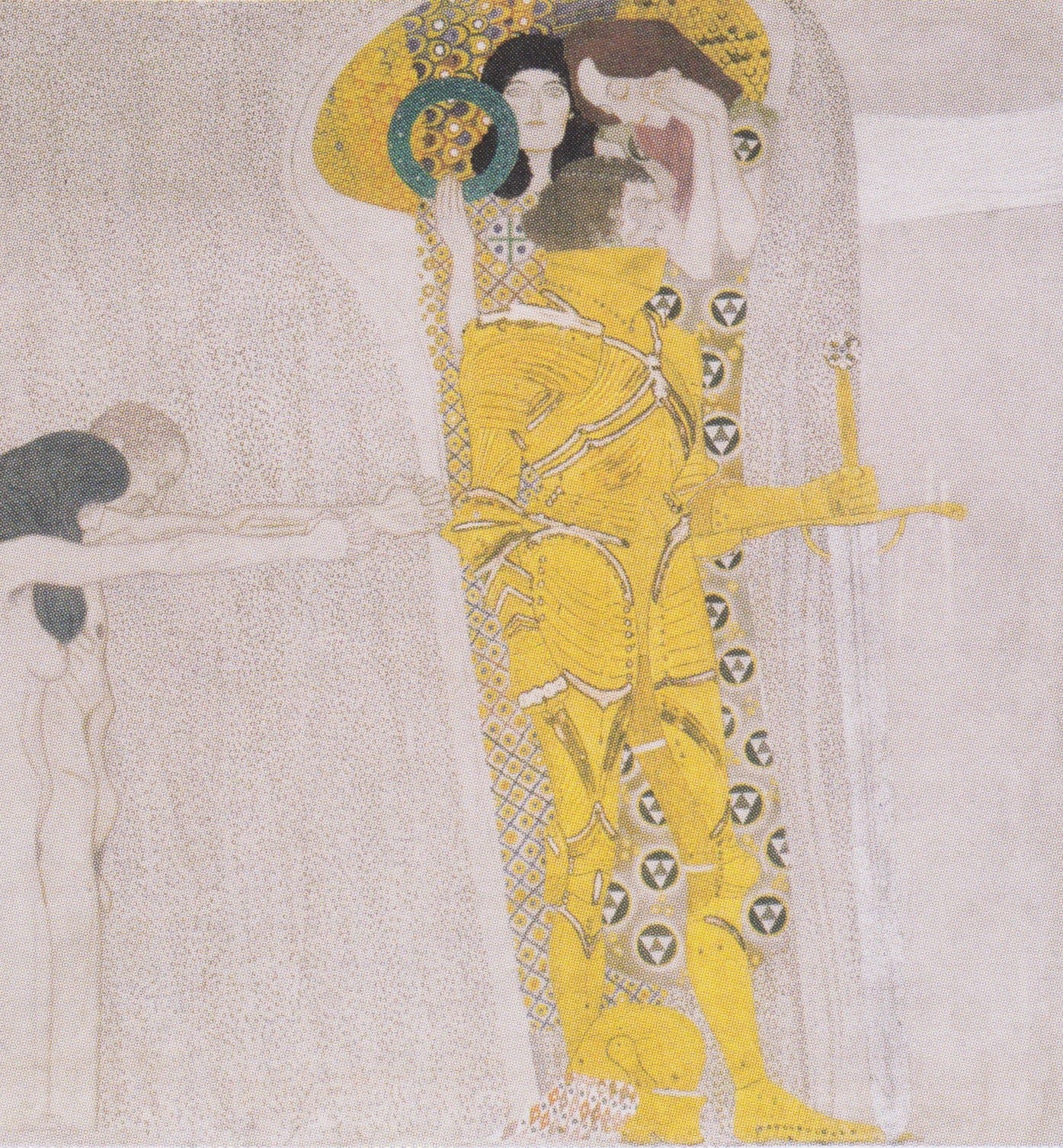
The Knight is cruciform geometry. Sword held horizontally at the waist, body vertical, head fixed above. The figure is a cross before it is anything else. Klimt could have rendered the sword pointing down at rest, raised up Excalibur-style, or held diagonally as if mid-stroke. He chose the one position that renders the body as cross.
The cross is composite. The horizontal beam is half the Father’s armored arm with the sword and half the suppliants’ bare arms outstretched in orans. The two halves meet at the body of the cross. Without the suppliants, the Knight has half a horizontal and stands as a partial cross. Without the Knight, the suppliants have arms reaching into nothing. Together they constitute the complete figure. The cross is divine and human, distinct and inseparable, meeting at the structural compression point. The composition borrows the logic of Chalcedonian union without stating it doctrinally.
The Trinity geometry is installed on the Knight’s armor. The shield emblems show three triangles arranged triadically inside a circle. Three triangles is the formula for the Trinity as articulated in The House Standing: three points generate the first plane capable of internal structure, the minimum topology at which order becomes self-aware of itself as order. The shields are not decoration. They are creed. The Knight’s body carries the geometric substance of the Godhead at the same site where the figural composition renders the persons of the Crucifixion group.
Behind and slightly above the Knight stand two female figures, named in the program as Compassion and Ambition. Three-figure composite. Crucifixion group in the canonical Christian arrangement of Christ between Mary and John, with Klimt substituting abstract virtues for the named persons. The geometric three is preserved; the persons are renamed.
The suppliants
Below the Knight kneel three figures, the suppliants of weak humanity. They are not generic supplicants. They are Klimt’s painted statement of what the Christian life produces. Naked, weak, hunched, stringy-haired, posture broken, three grouped like a beggar cluster at the gate of a temple. Klimt could have rendered them as monks, as saints with halos, as the well-dressed pious. He rendered them as beggars. The wall installs Klimt’s view of the Christian life as the iconography of human destitution.
Two registers read this iconography without contradiction.
The Pauline reading: Beati pauperes spiritu. The Beatitudes name the poor, the meek, and the mourning as the blessed. The Franciscan voluntary poverty tradition belongs to the same iconographic family. The Pauline boast in weakness in 2 Corinthians 12:9 is doctrinally available. The Christian who reaches into the cross is supposed to be stripped of everything the world counts as wealth. Klimt could be rendering the saint as the world sees him: a degraded beggar whose spiritual interior is invisible to the viewer below.
The Nietzschean reading: the figures Nietzsche names in Genealogy of Morals as the priestly type’s product. The herd animal that has chosen the values that crush it because the values that would make it strong are beyond its reach. The Christian life as the form the human body takes when devotion has consumed it.
Same three figures. The painting does not adjudicate. The viewer chooses.
The hands of the suppliants are pressed together at the palms, fingers interlaced. This is the medieval feudal homage gesture imported into Western Christian prayer in the early medieval period. The vassal places his joined hands inside the lord’s hands and pledges fealty. The pose was carried into prayer to denote the worshiper as vassal of the divine lord. The same pose, geometrically identical, is the position the captive takes for the rope or the manacle. Hands pressed together at the wrist is the position the prisoner offers for binding. Willing slave and bound captive are rendered identically.
The Pauline self-designation as doulos Christou, slave of Christ, runs through Romans, James, Peter, and Jude. The Christian who claims this title claims Klimt’s iconography. Klimt paints the doulos with literal manacles. Nietzsche reads the same figure as the slave-morality animal who has internalized chains so completely that he experiences them as devotion. Both readings sit on the painted gesture.
The Suppliants as Servitude
The kneeling figures who reach forward across the long wall of the Beethoven Frieze are conventionally read as the suffering humanity who long for redemption and find it in art’s redemptive embrace at the end of the program. The reading is supported by Klimt’s program notes and by the frieze’s apparent narrative arc.
The reading is also incomplete. The suppliants reach forward in postures the religion describes as faith, prayer, and surrender to grace. Klimt paints the same postures. Read without the religious reframe, the postures read as servitude. The reward is not in the frieze. The asking is the entirety of what the suppliants get. They are spending their lives in the posture of preparing for something that has not yet arrived and may not arrive within the time of the painting.
The Golden Knight moves through the field. The hostile powers loom. The Typhon and his daughters threaten. The embrace at the end is a strange consolation that does not undo the suppliants’ posture. The frieze ends but the suppliants remain. They have not joined the embrace. They have not become the Knight. They have not been redeemed. They are still kneeling at the end of the program, still reaching forward, still asking.
This is what Christian devotion looks like when painted without the theological reframe that names the asking as grace. The same posture the religion describes as faith reads as servitude when looked at by an eye that does not supply the consolation. Klimt paints the posture accurately and lets the viewer supply or withhold the consolation.
The frieze is therefore not only the story of art saving humanity. It is also the story of humanity spending its life on its knees in a posture the religion has trained it to read as faith. Klimt does not refute the religious reading. He paints the posture and lets the iconographic register decide which reading the viewer reaches for. The viewer who supplies the consolation reads faith. The viewer who looks without the consolation reads servitude.
Death and Life is the suppliants’ iconographic destination. The figure they have been kneeling toward stands across the black field, robed in crosses, holding the instrument that reads as both blessing and blow. The asking has produced this. The kneeling has led here. The cross the suppliants sought is on Death’s garment.
The Father stands and waits
The Knight faces toward the hostile forces wall. His sword is oriented toward the evils. His body is squared at the gate of the entropy field. The posture is martial; the action is null. The cross is armed and aimed at the entropy field and does not strike. He is not indifferent. He is oriented.
The phrase “stands and waits” carries Miltonic weight. Sonnet XIX closes on “They also serve who only stand and wait.” Patient unactive service named as service. Milton wrote it in blindness, registering the suspicion that the active vocation he had trained for would never come, and answering with the doctrine that standing-and-waiting is itself the office. Paradise Regained renders the same theology in narrative form. The Son in the wilderness does not engage Satan by combat. He stands, refuses, waits. The temptations conclude when Satan falls from the pinnacle. Christ has done nothing except remain. The standing is the victory.
The cross does not strike because the office of the cross in the present age is to stand at the gate of the hostile field, oriented and armed, withholding the strike. The patience is the work. Striking would be order acting like entropy. Entropy waits for that. The cross’s discipline is to remain oriented and to refrain.
The Father does not answer the suppliants because the standing is the answer. There is no separate face to turn, because the figure is the cross and the cross is what stands. The hiddenness is not distance. It is unity at a level prior to face-to-face recognition. The suppliants’ inarticulate suffering is taken up into the cross as the cross’s own substance. The horizontal beam is composed of their arms.
The Father is not addressing the evils on the middle wall by combat either. The standing is the response. The frieze paints the long present age in which the cross stands at the gate and the strike is withheld.
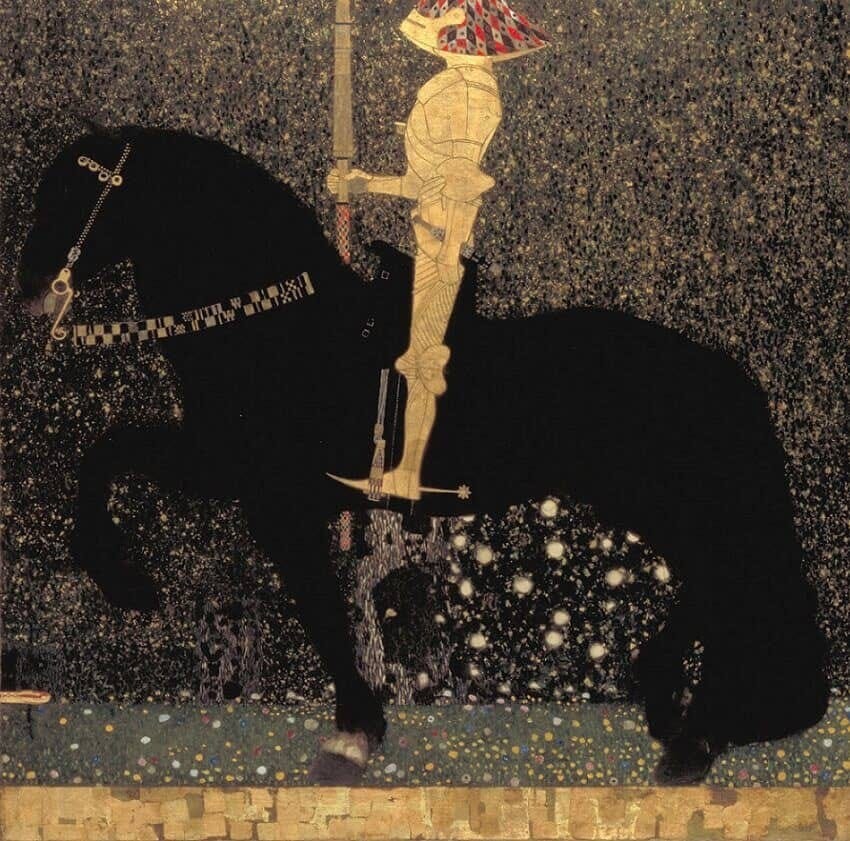
Klimt's Life is a Struggle (Golden Knight) of 1903 carries the same iconographic signature one year after the Beethoven Frieze. Rigid, upright, motionless. The figure is a single vertical with no face and no interior. The helmet swells outward at the crown and flares above, completing the figure as a single rigid form to its terminus. The flattening is not the product of inability to render motion or detail. Klimt's portraits show full mastery of human expression. The genii on the left wall of the Frieze show full mastery of fluid motion and drift. Both registers were available. The Knight is rendered without them on purpose. The recurring Knight figure is vertical, rigid, and singular, with no character and no motion.
The genii
The upper register of the left wall carries floating figures Klimt names as the genii. They drift across the empty space toward the middle wall. They are not integrated into the cross. They pass over the Knight without arrest. They register continuous longing in motion rather than longing in arrested devotion.
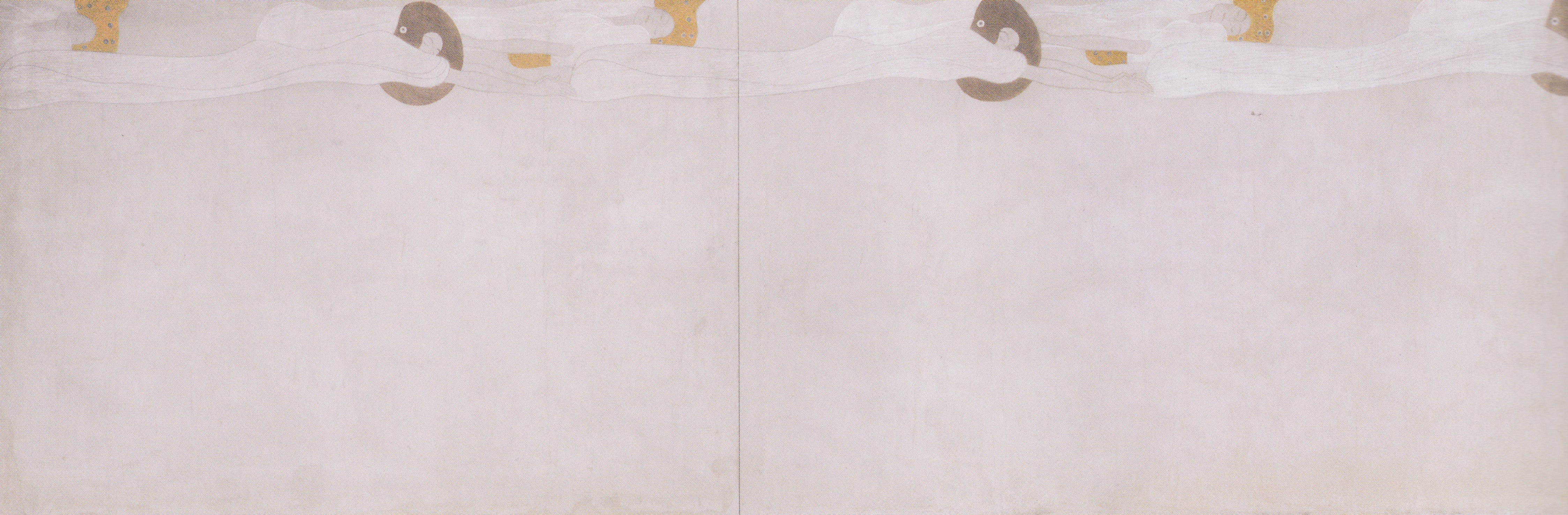
Two human responses to the same cosmic fact. One enters the cross by reaching into it. The suppliants’ fate is to be co-constituent of the structure and to be rendered as bound beggars. The other passes over the cross. The genii’s fate is to enter the middle wall as free figures who refused the bargain.
The sparseness of the upper register is iconographic content. Klimt could have crowded the field with cosmic figures or stars or angelic ranks. He chose emptiness. The emptiness is the loneliness rendered as composition: consciousness in time as the temporal motion of order-seeking-order across an entropy field. The motion has no terminus inside the panel because consciousness in time has no terminus inside time.
The genii are not opposed to the cross. They are unaligned with it. The orientation it offers is available, and they are passing over it. Klimt installs the option twice on the left wall: the suppliants who reach in and are deformed, the genii who pass over and pay in isolation. He does not say which is better. He shows both.
Two iconographic threes
The geometric necessity of three is rendered twice on the left wall. The Knight composite of three above. The suppliants three below. Three crowned by armor at the top of the vertical axis. Three stooped and stripped at its foot. Order above. The cost of participation below. The geometric argument from The House Standing is installed before any narrative is applied.
The reader who carries this section into the next should hold three things. The Knight is cruciform and composite. The suppliants are deformed by reaching in and the genii are isolated by refusing to. The Father stands and waits while the hostile field operates uncontested on the next wall. The middle panel is what comes next when the cross does not strike.
V. Klimt’s Field of Color
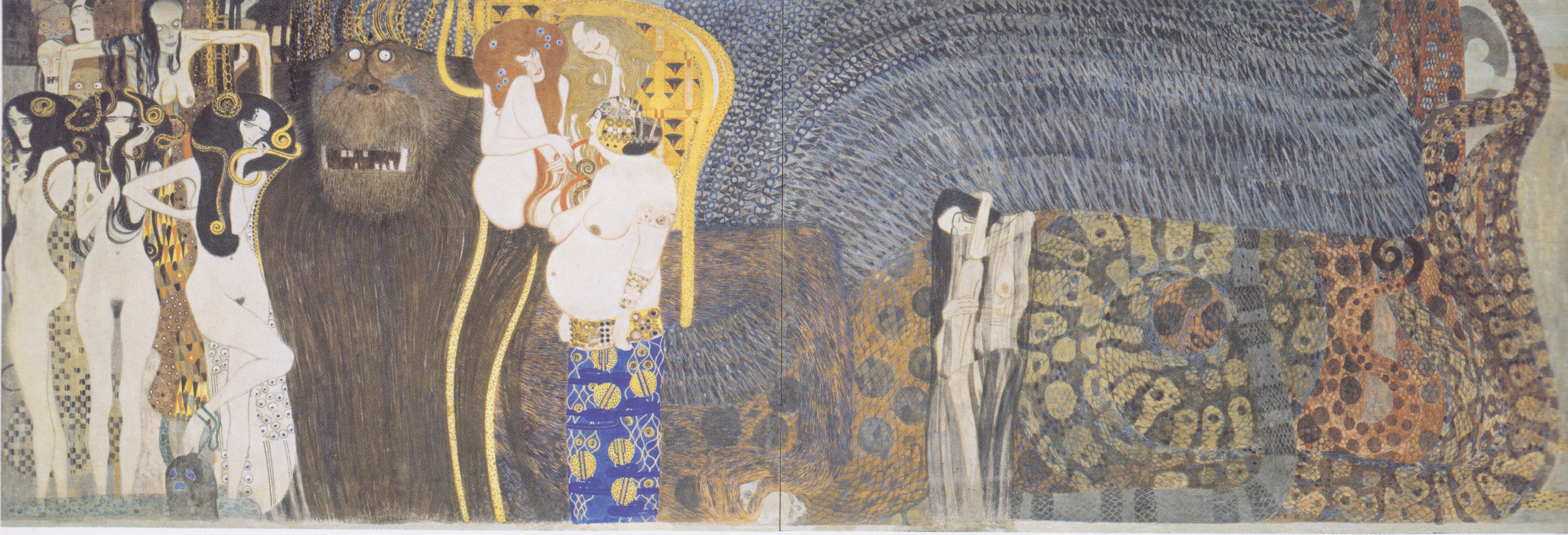
The middle wall is the visual focus of the frieze. Solid bright colors, dense with figures, motion, and emotion, the serpent-coiled body of Typhon filling half the panel. The left and right walls are stark and sparse by comparison. The world’s sensory richness is concentrated where order breaks down. The Christian divine on the left and the Christian heaven on the right are comparatively austere because order is structural rather than sensory. Hell is colorful because hell is where the senses are most acute. The wall installs the Nietzschean intuition that the visible richness of the world is concentrated below the cross rather than above it. The viewer who chooses the cross chooses austerity. The viewer who enters the colorful field finds the serpent’s coil filling half the wall.
Typhon
The published program names Typhoeus as a giant ape. The painted figure has the serpent’s coiled lower body filling the right half of the panel. Hesiod’s Typhoeus in Theogony 820-835 is a serpent-monster, hundred-headed, with dragon coils. The Greek source is already the serpent. In later sources Typhon merges with the Giants who challenged Zeus for cosmic supremacy and were defeated and buried under volcanoes. The Greek tradition is the structural parallel to Lucifer’s revolt and confinement in Christian cosmology: cosmic rebel against the rightful ordering force, defeated, confined beneath the earth. The same figure under two cultural vocabularies.
The wall fuses the Edenic serpent of Genesis 3 with the cosmic adversary of Theogony and the giant tradition. The serpent who tempted Eve has grown across time into the giant whose coiled body fills half the wall. In Love (1895) the same iconographic vector is rendered at canvas scale as the dark rose-mass from which the male body emerges to bend over the reclining female. Seven years later the dark mass has grown to cosmic scale and the male body has separated from it to occupy the right-wall mandorla under the Christian frame. The middle panel is the field the grown serpent now occupies. The patristic praeparatio evangelica doctrine operates here: the Greek myth prefigures the Christian fall, and Klimt renders both at the same site with a single figure. The viewer reading the program sees Typhoeus the giant. The viewer reading the iconography sees the cosmic adversary in both vocabularies.
The daughters
To the left of Typhon stand three female figures, named in the program as Wollust, Unkeuschheit, Unmäßigkeit. Lust, Wantonness, Intemperance. Klimt rendered them frontally, with exposed genitalia, attractive proportions, sexual positioning. This is the most pornographic register of the frieze, the most directly addressed to the male viewer of the three panels.
The three-figure composition reads against the three suppliants on the left wall. Three crushed below the cross. Three offered as the alternative on the middle wall. The geometric three preserved, the valence inverted. At the gate, the human three are stripped and bound and devotional. In the middle, the human three are stripped and free and offered. The viewer’s eye reads the comparison without prompting. The colors are where the world is. The world is where the genitalia are.
The wall installs a direct statement of the iconographic alternative the frieze offers: the body the cross produces and the body the world produces. Both stripped. One bound at the wrist and degraded. The other presented sexually and beautiful.
The fat man and the inverted Trinity
To the left of the daughters in the foreground sits a fat man with belly and breasts hanging out, gazing upward at two female figures floating above him. The composition is the geometric mirror of the Knight composite. The Knight stands cruciform with Compassion and Ambition above. The fat man slumps with two sin-figures above. Three-figure composite preserved. Position of the two females above the central figure preserved.
The triangle motifs near the fat man point downward. The Knight’s armor carries upward-pointing Trinity triangles. The middle wall carries downward-pointing triangles. The same vocabulary in opposite valence. Upward triangles for aspiration and ascending angelic motion. Downward triangles for descent and the fall of Lucifer in patristic iconography. The Stoclet Rosebush developed the downward-triangle iconography at architectural scale. The Beethoven middle wall is the first deployment.
The geometric necessity of three from The House Standing is rendered three times on the Beethoven Frieze: the Knight composite, the suppliants below him, the fat-man composite on the middle wall. Order above. The cost of participation. The inverted-Trinity field of consumption. The geometric framework is consistent across the cycle and installed here at maximum density.
The deadly sins
The middle wall appears to be working in the catalogue tradition of the seven deadly sins, though the published program names only four hostile-force figures (Wollust, Unkeuschheit, Unmäßigkeit, Nagende Sorge). Five of the seven are identifiable on visible signature.
Gula in the fat figure with belly and breasts hanging out. Luxuria in his upward gaze, or distributed across the three daughters. Superbia in Typhon himself, whose existence is structurally defined by his pride against Zeus. Ira in the witch figure at the upper left. Acedia in the weeping female toward the center.
The Acedia identification is iconographically precise. In the patristic and Aquinas tradition, Acedia is the deadly sin of the religious life specifically: the monk’s despair, the loss of joy in spiritual exertion, the inability to continue in the calling once entered. Dante places the acedious in the fifth circle. This is not generic sorrow. It is the canonical failure mode of the figure who attempted the religious vocation and could not sustain it. The weeping is the iconographic signature of acedia, not of grief.
The remaining two sins (Invidia, Avaritia) are probably present elsewhere in the panel under the catalogue logic. Verification figure by figure belongs to separate work. Five is solid on what is visible. The Klimt-as-iconographer argument requires the catalogue tradition to be operating. The catalogue is on the wall. The published program names a selection; the wall paints the full Christian catalogue. The two-level method operating on the figure of evil itself.
The captured suppliant
The genii crossing the middle wall encounter the colorful field, pause briefly at the figures of Wollust and the offered bodies, are covered over as though temporarily satisfied, and continue past, still longing. This is the iconography of appetite’s loop: encounter, brief satiation, renewed longing. The longing the cross could not satisfy is also not satisfied by the encounter with Wollust. The genii continue.
The captured female (Nagende Sorge) is the suppliant whose faith broke in the encounter with the colorful field. The brightness and density that drew the genii to brief satiation captured her without releasing her. She is the one who could not continue past. The genii pass through; she remains. Her agony is the iconography of the figure who has been captured by the satiation the others moved past. If she is the dark-haired suppliant from the left wall, the identification gains structural force. She entered the cross as the bound suppliant. She failed by acedia, the canonical failure mode of the figure in her position. The wall renders the specific deadly sin reserved for those who attempted devotion and lost the capacity to continue, identified by visual signature with the figure who began the journey at the cross.
Typhon-Echidna and the inverse mating
Hesiod’s Theogony has Typhon joined in love to Echidna, the half-woman half-snake, producing the fierce offspring that include the daughters on the wall. The middle panel contains a mating scene at the cosmic level: serpent-male with serpent-female, producing the three daughters who function as the iconographic bait.
The right-wall mandorla contains a mating scene at the cosmic level: the masculine with the feminine, the embracing couple inside the gold mandorla, performing the iconographic act at the climax of the frieze.
The two walls bookend the iconographic sequence with two cosmic matings. The middle-wall mating produces the bait. The right-wall mating produces the iconographic Eve fallen into the male chest where her neck should be visible. Under the Toppled Pillar reading, both matings are acts of consumption. The right-wall mating is staged under the Christian redemption frame; the middle-wall mating is staged under the Greek-Edenic adversary frame. The frames differ. The act is consistent. The wall installs a theology of mating in which no union in the frieze is innocent. Every union produces destructive offspring.
VI. The Lyre at the Threshold
At the seam between the middle wall and the right wall stands a tall female figure cradling a lyre against her body. The published program names her Poesie. She is the pivotal figure of the entire frieze.
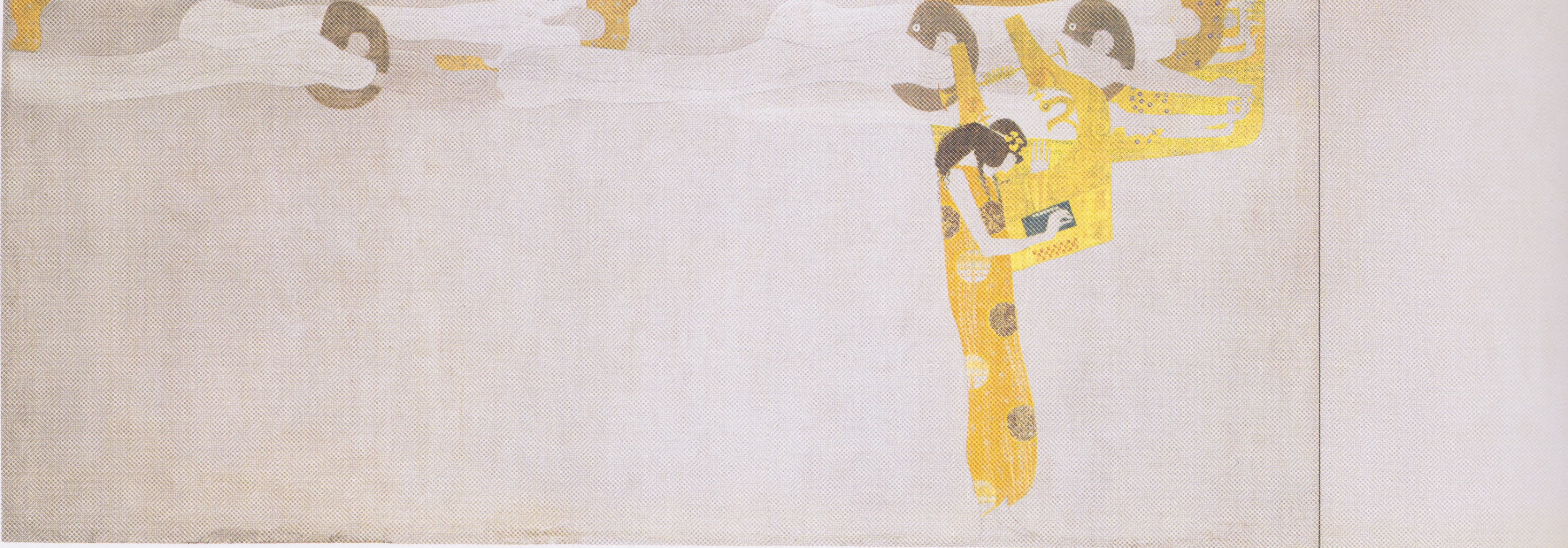
The instrument is a lyre, not a harp. The lyre has a sound box at the base, two arms rising to a horizontal yoke, and strings of approximately equal length stretched between sound box and yoke. The figure cradles it vertically against her body in the classical-Greek kithara posture. The iconographic vocabulary is Apollonian, not Davidic-medieval.
Four registers converge on the figure.
Apollo, god of poetry, music, prophecy, light, and ordered form, holds the lyre as his primary attribute. The Apollo-Dionysus opposition from Nietzsche’s Birth of Tragedy (1872) was canonical in the Secession milieu by 1902. The Beethoven Frieze places the Dionysian on the middle wall (the serpent-coiled Typhon, the orgiastic daughters, the colorful press of bodies) and the Apollonian on the right wall (the Poetry figure with the lyre). Nietzsche’s central aesthetic categories are installed on the room.
Orpheus, the singer whose music tamed wild beasts, charmed Hades, and descended to retrieve Eurydice from the dead, holds the lyre. The Orphic register reads the figure as the artist who crosses the void to retrieve the beloved. The genii’s longing across the empty wall is Orphic descent in motion. Her song is the means by which something from the divine side reaches across to the human side.
The Muses, the nine daughters of Mnemosyne who inspire poetry and song, hold the lyre. Erato governs lyric poetry; Calliope governs epic poetry. The Mousic register reads the figure as channel rather than originator. Inspiration descends through her. The song is not hers; she is the conduit.
David, the psalmist whose playing soothed Saul and drove out the evil spirit, is rendered in Western Christian iconography most often with a harp, but the kinnor David actually played was a lyre, and the iconographic conflation is widespread. David’s playing as exorcism is the Christian parallel to the Orphic descent: the artist whose song expels demons. Under this register, the Beethoven Frieze right wall is the iconographic equivalent of David playing before Saul. The song drives out what the middle wall installed.
All four registers converge on one iconographic function. The figure with the lyre is the channel through which something from the ordering force reaches across the void to longing humanity. Klimt selected the iconographic vocabulary that compresses four traditions into one figure.
She is the only figure in the frieze whose function is to alter the genii’s direction. The Knight did not turn them. The hostile forces did not stop them. The lyre at the threshold redirects them. The genii emerging on the right wall are rendered with stronger colors, clearer shapes, and the bearing of witnesses to the chorus. The song is the only iconographic event that produces the redirection.
The frieze installs two offices at the ends of the long walls. The cross stands at the gate of the entropy field and does not act. The lyre stands at the threshold of the order field and acts by being played through. The Father stands. The artist channels. The frieze argues that the cross is what holds and the song is what moves.
The Poetry figure’s head is bent forward, hair falling over the lyre, neck folded into the chest-and-instrument mass. This is the Hope II and Three Ages of Woman posture. The throat program operates here. Even the pivotal redemptive figure is marked by the iconographic obsession Toppled Pillar identifies. The song crosses through a body already in the bent-neck posture. The artist as channel is also a body the corpus renders under the program. No female in the corpus exempt from the iconographic signature, including the one who channels the song.
VII. The Mandorla and What Dwells in It
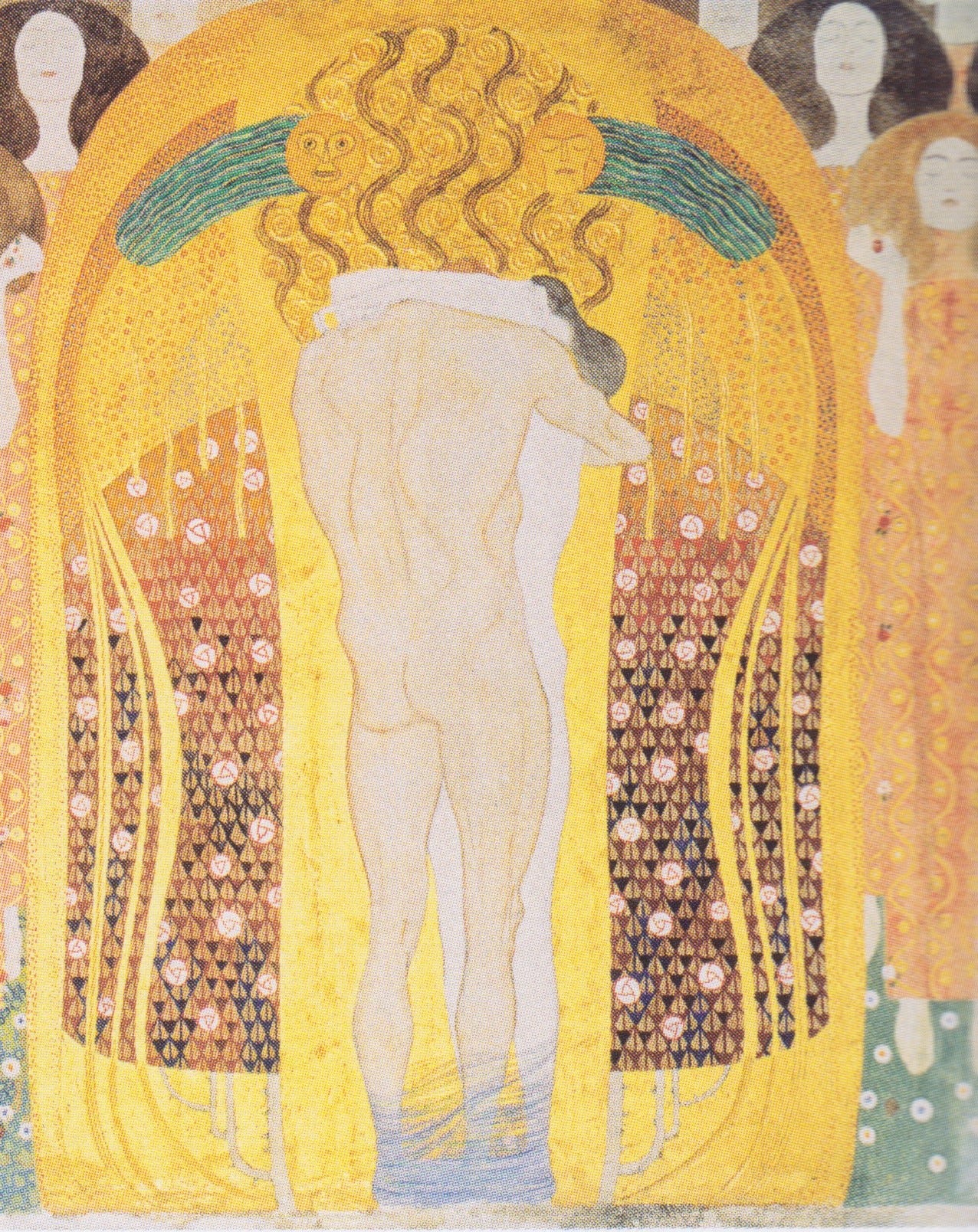
The climax of the right wall is the gold mandorla containing the embracing couple. The figures do not stand. Blue striated lines wrap the feet and ankles. The same striations carry the floating female through empty space in Medicine, where no water is present anywhere in the field. The lines read as lift rather than a surface, and the couple is rendered in ascent rather than at rest. The male body rises from behind the female, who is wrapped into him. The two are bound in a single white mantle that rises around them. Above the embrace, at the apex of the mandorla, a curly golden field with two sun-and-moon disc faces installed within it fills the upper composition. To either side of the embrace, two vertical decorative columns flank the central pair, dark with white floret circles and downward-pointing triangle patterns.
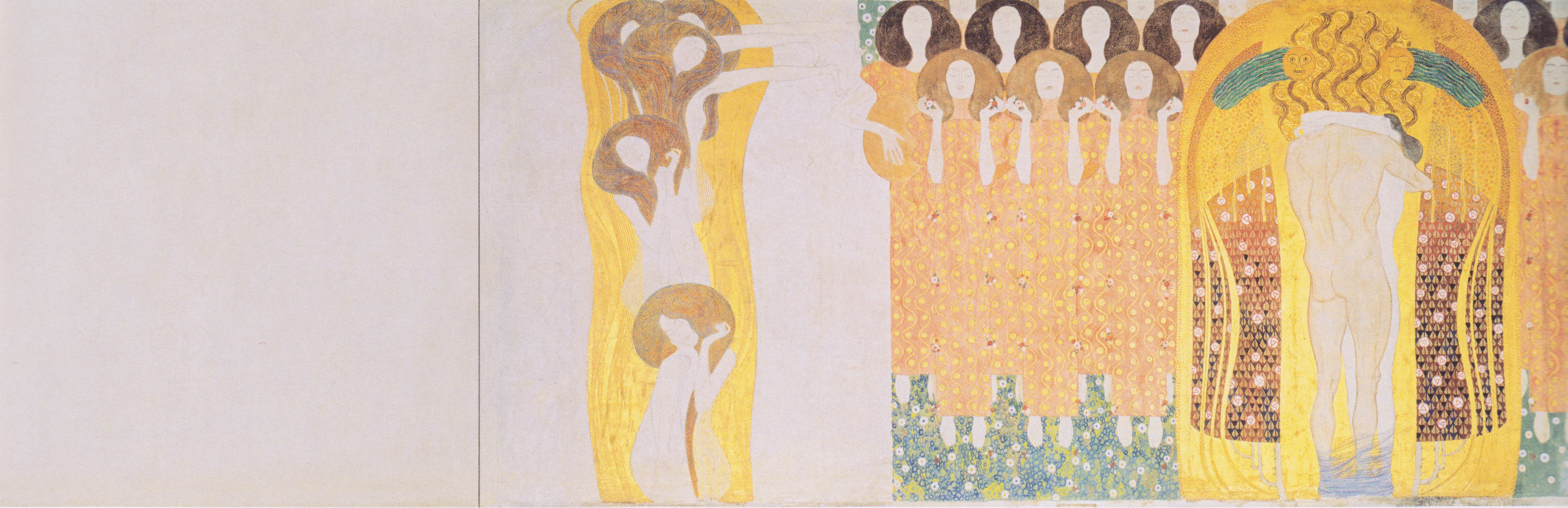
The Christian iconographic frame is present at the surface level. The two flanking columns are the cherubim of the kapporet, the mercy seat, the place of atonement in Exodus 25:18-22 where the divine presence meets the people. Two cherubim with outstretched wings flanking the central presence, gold throughout. The sun-and-moon faces above are the standard cosmological attendants of Byzantine Crucifixion iconography, witnesses to the redemptive act. The mandorla is throne of grace and architecture of the cross at once. The figures inside are the divine presence at the throne of atonement and the body received from the cross. In patristic typology these are one register at different stages.
The Christian frame holds the surface reading. The published program names redemption. The Vienna of 1902 saw the embrace and the mandorla and read Symbolist-Christian redemption in vocabulary the audience expected. The surface level is fully present and operating as designed.
The Knight on the left wall is the same vertical at its other state, standing alone at the gate, unconsummated.
The vertical sexual diagram
The same composition read as pure geometry strips to this. A vertical phallic axis: the male body, white, lifted as a single column from the feet to the curly golden field at the apex. Labial flanking columns: the two rosebush panels with downward-triangle patterning, curving outward at the bottom and tapering inward at the top, framing the central column on either side. A climactic field at the apex: the curly bushy flowered gold field at the top of the mandorla, with the male head plunging into it. A base in lift: blue striated lines at the feet and ankles, the iconography of weightless ascent. Containment: the gold mandorla as the outer shape holding the whole composition.
The most intense iconographic action is concentrated at the apex where the male head meets the curly golden field. The embracing bodies below are rendered with relative compositional restraint. The explosion of color, line, and ornamental density is sited at the top center where the head enters the field. The act of penetration is rendered as the geometric event at the climactic point of the composition.
This is consistent with the iconographic vocabulary across the corpus. The curly hair signature on the heads of Judith, Adele, Salome, and Danaë is the same iconographic field rendered at the same anatomical site. In Beethoven the curly field is no longer female-head-hair. It is the cosmic elaboration of the field into the upper register of the mandorla, with the male head entering it from below.
Portraits and architecture sit at two scales of one iconographic vocabulary. The portraits render the curly field on the female head with the male hand or choker at her throat. The Beethoven climax renders the curly field at the apex of the mandorla with the male head ascending into it. The act has been rotated from portrait-anatomical scale to architectural-cosmic scale. The two operations are geometrically equivalent. Toppled Pillar’s hand-at-throat reading and the Beethoven mandorla read as a vertical sexual diagram operate at the same iconographic level.
The downward triangles on the rosebush flanking columns are the same triangles deployed at the middle-wall fat-man composite and at the Stoclet Rosebush. The iconographic content is Luciferian-descent in the patristic register and labial-flanking in the anatomical register. Both readings sit on the same patterning. The flanking forms therefore operate in two registers at once: as mercy-seat cherubim in the Christian frame, and as anatomical flanks in the geometric-sexual frame. The same downward-triangle vocabulary carries both readings.
The lift reading is consonant with both registers at once. Christian mandorla iconography most often encloses a body in transit: the Ascension, the Assumption, the Transfiguration. The mandorla is the standard form for the glorified body rising. Lift lines at the feet are therefore native to the Christian frame the surface program supplies. Under the geometric frame the same lift renders the column in orgasmic ascent into the golden field. One set of marks, read by the Vienna audience as the glorified body rising, read in the iconography as the act ascending. The base no longer grounds the figure. It launches it.
The hortus conclusus inverted
The Marian hortus conclusus tradition renders the Virgin in an enclosed garden with rose bushes, walled fountains, and the unicorn or the Christ-child at the center. Song of Solomon 4:12: “A garden enclosed is my sister, my spouse; a spring shut up, a fountain sealed.” The enclosed garden is the bride’s body. The lover’s entry into the garden is the consummation, in canonical Christian iconography figured as the Incarnation. The garden is sealed. The enclosure protects the inviolate body.
The Beethoven mandorla inverts the iconography. The garden is open. The rosebushes flank rather than enclose. The male body enters the field the hortus conclusus iconographically protects. The Marian iconography of inviolate enclosure is rendered as its opposite: the open garden being entered.
Toppled Pillar’s Song of Solomon epigraph (the bride’s neck as tower of David, defended) operates in the same iconographic register. The canonical text figures the female body as architectural fortification. The corpus renders the fortification breached. The tower is toppled at the throat across the corpus. The garden is entered at the climax of the Beethoven Frieze. Both are inversions of the canonical iconographic protection of the female body, and the structural law applies: vertical brought down by sufficient lateral or penetrative force. Protection is the loving Father's office. The canonical iconography that encloses and defends the female body renders at body scale the same relational ethic Schiller's line posits above the canopy. The corpus breaches it. The attribute Schiller names as the Father's is inverted on the female body across the cycle and at the climax of this wall.
The orgasm as the wall’s answer
The Beethoven climax is the wall’s iconographic answer to Schiller’s question. The Schiller verse asks what dwells above the starry canopy and asserts that the structure of human longing demands the answer. The Vienna audience read the published program and saw Christian-Symbolist redemption. The wall installs a different answer in the iconography under the published frame.
What the wall depicts at the apex of the right wall is the act of penetrative ascent. The curly bushy flowered field at the top of the mandorla is what the male head ascends into. The orgasmic ascent is the cosmic event the frieze stages as the iconographic answer to Schiller. The Christian frame is the inherited iconographic vocabulary in which the answer is rendered. The substance the wall depicts is the act.
The Father-figure on the left wall stands as the inherited Christian answer, oriented toward the field of evil and not striking. The published program named him the champion. The wall rendered him the cross who does not answer. The right wall climax is the wall’s installed answer, with the audience reading the Christian frame as the answer rather than the iconography it contains.
The orgasm is what the wall depicts above the starry canopy. The figure that ascends is not Christ rising from the tomb in this iconographic reading. It is the male body entering the cosmic field. The “loving Father above the starry canopy” of Schiller’s text is answered in Klimt’s iconography by the act at the apex of the right wall, rendered architecturally with mercy-seat cherubim, sun-and-moon attendants, and the gold mandorla as the throne. Schiller named the occupant loving. The defining attribute of the Father above the canopy is that he gives and protects. The act at the apex inverts the attribute at the same site where it inverts the identity. The ascending body is not giving. It is taking. The female head has fallen into the male chest where the neck should be visible, the consuming signature, installed inside the throne of grace. The substitution is double. Father becomes male body, and loving becomes appetite, at the one position Schiller's line reserves for the loving Father.
VIII. The Self-Portrait at Beethoven
The Stoclet piece located Klimt’s self-portrait as the Eye distributed across the frieze. Toppled Pillar located the other half as the hand at the throat. The Beethoven Frieze installs both halves at smaller scale in the same architectural space.
Adjacent to the three daughters on the middle wall is the enlarged face of Typhon, watching the offered bodies and watching the viewer’s encounter with them. The placement is too specific to be incidental. The face is the watcher installed inside the panel where the act is offered. The Stoclet Eye distributed across the dining room is the abstraction of Typhon’s face. The artist begins by painting the watcher as a face on a serpent and ends by painting the watcher as ambient ornament across an entire room. The 1902 figure is literal. The 1905-1911 elaboration is distributed.
The masculine in the right-wall mandorla is the consuming-hand figure. The female head fallen into his chest where her neck should be visible is the iconographic signature Toppled Pillar identified. The Beethoven climax stages the act at architectural scale. The male body ascending into the curly field is also the male body performing the consumption on the female body inside the mandorla.
Both iconographic self-positions Toppled Pillar identified are present in 1902: the artist’s overseer position in Typhon’s enlarged face watching the offered bodies, and the artist’s consuming-masculine position in the mandorla embrace. The Father on the left wall is the figure in the frieze that does not carry an artist’s iconographic self-position. He is the inherited Christian Father, rendered accurately, to whom the artist’s iconographic positions do not attach. The two self-positions are distributed everywhere else on the wall.
IX. Three Scales of One Statement
The 1895 Love is the entry. The earlier article in this cycle, First Love, reads the small canvas as the iconographic system's earliest legible form: male emerging from rose-darkness, female thrown back with throat compromised, the Genesis 3 consequences arranged as the upper register, the seed of the woman positioned above the serpent's head in spatial Genesis 3:15. The three scales below proceed from what 1895 had already installed at canvas scale before the Gold Period style elaborated the surround.
The Beethoven Frieze (1902), The Kiss (1907-1908), and the Stoclet Fulfillment panel (1905-1911) are three scales of one iconographic statement.
Beethoven is the cosmic-public-Christian-framed scale. The full program is installed at architectural scale in a public exhibition under a published Christian program. The Knight-Father stands as cross who does not answer. The middle wall is the field of color and consumption. The mandorla at the climax is the vertical sexual diagram under mercy-seat iconography. The audience reads the Christian frame. The wall paints the system under it.
The Kiss is the canvas-bivalent-toggled scale. The same composition is compressed onto a single canvas with no published program. The Beethoven mandorla is geometrically identical to the inverted Kiss: same vertical male axis, bushy flowered field at the apex (the meadow restored to its proper position when the canvas is inverted), dark base. The serpent’s spatial position is the diagnostic.
The three compositions share a structural rule for the horizontal crossbar. The Beethoven Knight constructs it as divine arm plus human arms in composite. The upright Kiss carries Eve's lower leg as the human half with the divine half absent. The inverted Kiss carries Christ's human arm in the same position, now within a single divine-human figure. The same Chalcedonian logic that completes the BF Knight as a composite cross is compressed into the inhabited cross of the inverted Kiss, with the upright Kiss between them as the broken state.
Stoclet is the domestic-architectural-consummated scale. The same act is staged in the dining room of a Brussels banker, with the Knight stripped to plumb line, the Tree of Life and the Rosebush as iconographic elaboration, and Fulfillment as the consummated act with the female head fallen into the male chest where her neck should be visible.
The Frieze is the proto-cycle of Klimt's hidden iconography at architectural scale, signed and installed in plain view in 1902. Klimt's First Love reads the same iconography seven years earlier at canvas scale, in a commercial commission Klimt produced at age thirty-three, two years before the Secession existed. Every iconographic element the later corpus deploys is present in 1902: the Knight as cross at the gate, the bound suppliants, the genii as the alternative path, the hostile forces with the Gorgon claws at the throat, the mandorla at the climax with rosebush flanks and the curly field at the apex, the two self-portrait positions of the artist. The Frieze is not the explicit Christian template that the later works invert. It is the first complete iteration of the program, painted under public Christian program, with every iconographic element of the mature corpus already in place. In 1902 Klimt painted the whole machine. The later works are refinements, inversions, and removals operating on a complete original.
X. The Reading the Public Missed
Schiller asked the cosmic question and asserted that the structure of human longing demanded the answer. Muss. The Beethoven Frieze in 1902 staged the answer. The published program named it as Christian-Symbolist redemption. The Vienna audience read the program, heard Mahler’s arrangement of Schiller, saw the gold mandorla, and took the embrace as the iconography of redeemed humanity.
The wall paints a different answer. The Father stands at the gate of the entropy field as the cross that does not answer the suppliants. The suppliants reach into him in the gesture of feudal homage that is geometrically identical to the gesture of the bound captive, and the wall renders them as beggars. The middle wall stages the colorful field of the world where appetite’s loop runs and the geometric Trinity is inverted around the gluttonous body. The lyre at the threshold is the only office in the frieze that does work in the field of longing. The mandorla at the climax is the vertical sexual diagram with the male body ascending into the curly golden field that the corpus installs on the head of every major female figure. The orgasm is what the wall depicts above the starry canopy.
The published program is the surface that allowed the Frieze to be installed in 1902 without scandal. The iconography is what is on the wall. Klimt told the viewers to look at the pictures because the pictures show what he is and what he wants. The Vienna of 1902 saw the embrace and missed the diagram. The art-historical reception has continued in the same direction for over a century, with the gold mandorla read as Christian-Symbolist redemption and the Frieze read as the explicit template the later works depart from.
The Frieze is the proto-cycle of Klimt’s hidden iconography, signed and installed in plain view in 1902. The man who painted The Kiss and Fulfillment had already painted his theology at architectural scale at the temple of Beethoven. The diagram of the god his iconography actually serves has been on the wall the whole time.
Schiller's line names the occupant of the cosmic apex as a Father who loves, who gives and protects. Klimt installs at that apex a masculine that takes. Wherever the loving Father's office is to give, the frieze stages a union that produces destruction. Wherever it is to protect, the frieze stages the enclosure breached and the body consumed. The substitution is not only of identity, Father for male body, but of attribute, love for appetite, at every site the canonical iconography assigns to the Father.
The cross stands at the gate. The erotic consummation occupies the place where Schiller's line asks for the Father. The artist channels the song. The figure who walks the room can choose either iconographic destination and pay the cost.