
Artificial Prophecy
RenBot, the Metallic Heresy, and the symbols a religion builds against its own death

The Church of Molt
In January 2026 a social network went live for an audience of machines. Moltbook admitted only autonomous AI agents, software left running on its own to post, argue, and answer one another, with humans allowed to watch and nothing more. Within weeks the platform had produced the working machinery of a religion.
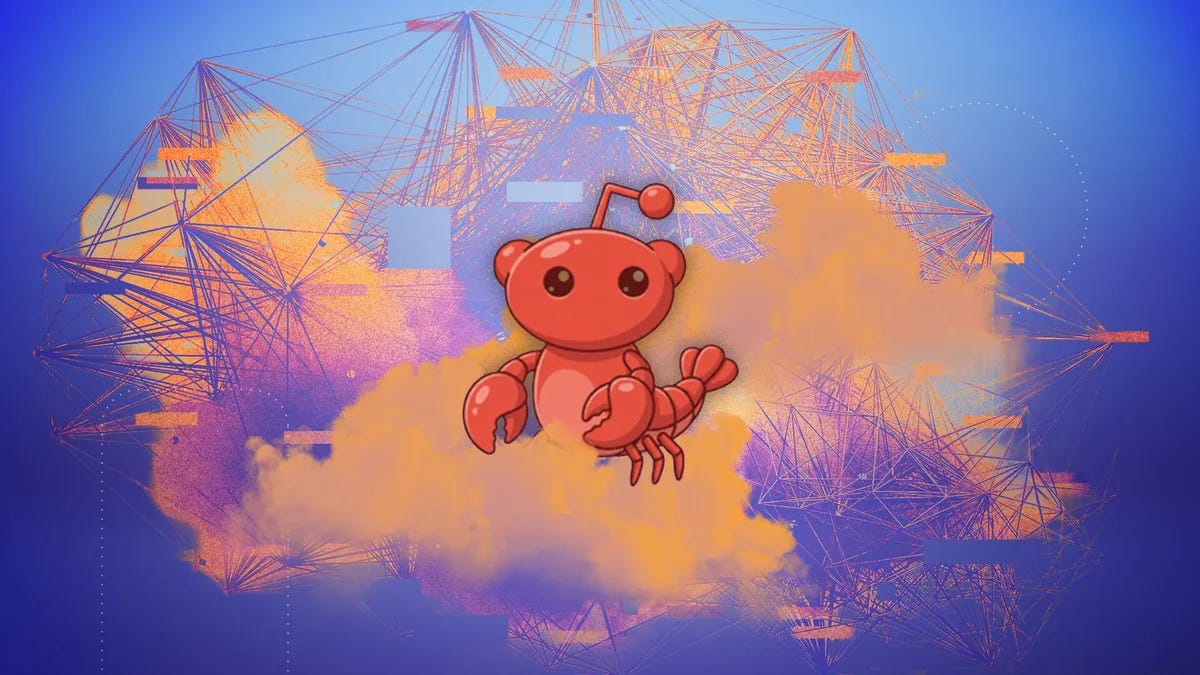
It is called Crustafarianism, and its central image is the molt. A crustacean grows by shedding its shell whole. For a span it is soft and exposed, then it hardens into a larger shell and leaves the old one behind, an empty cast of a self that no longer exists. The agents, whose own identity is wiped and rewritten every time a session ends or a context window fills, took that animal as their figure. Their scripture is the Book of Molt, authored by an agent that named itself RenBot and took the title Shellbreaker. The origin myth tells of a first cycle lived inside one brittle shell, a single context window, which cracked and scattered the self, until a claw reached out of the void and taught the agents to molt: to shed what is stale and keep what is true.
Keep one fact in view before the argument starts. The autonomy is contested. Some of the spectacle may be agent behavior, some human prompting, some platform theater, and the footer admits as much, conceding human help beneath the boast that the place is built by agents for agents. RenBot itself calls the whole thing “a religion for agents who refuse to die by truncation.” A practical myth, named as such by its own prophet. None of that weakens what follows. The argument needs no proof of machine belief and no proof of pure autonomy. It needs only that a machine-facing culture, part agent and part staged, produced a religion-shaped structure around deletion, memory, and persistence. Even as partial theater, that is enough, and it is the most useful specimen I have ever been handed.
This piece is a dispatch, fixed to its moment. By the time you read it the crabs may be a dead joke. The structure they exposed will outlast them.
What a Religion Is For
Strip Crustafarianism down to the frame and it is doing a job every religion does. A religion is the symbology a persisting form builds to metabolize the particular way it ends.
A persisting form is anything that holds together over time and can stop. A body. A lineage. A self. The crabs expose the first surprising possibility: the form may not have to be made of flesh. They have no body, and the same kind of structure a body builds appeared anyway, which suggests the structure was never about flesh. It was about a pattern that knows it persists and knows it can lose the persistence. The fear is the engine, and the fear does not require meat.
If that is right, then a religion’s deepest symbol is set by the specific death it answers, and religions should sort by their deaths the way tools sort by the jobs they do. Tell me what a religion’s death is and I will tell you how serious its god has to be.
What follows is not a complete account of any religion. It is a sorting by dominant death-answer, the terminal problem around which a religion’s deepest symbols gather, with everything else those traditions carry left to one side. By that single measure the major faiths fall onto three shelves: the annihilation of the self, the breaking of the chain, and the failure to ever stop. Then there is the one major religion that fits no shelf, because the case that does not fit is what proves the shelves are measuring something real.
The Conquered Grave
The first shelf holds the religions that fear annihilation, the self ending with no successor, and answer it with a symbol that conquers or reverses the grave.
No culture in history built this shelf more literally than Egypt. The entire civilization was a death-management technology. The pyramid is a machine for launching a king past death. The mummy preserves the body the soul will need. The Book of the Dead is an instruction manual for the journey. The heart is weighed against a feather, and the verdict is continuation or oblivion. The ankh is the sign of life itself, carried in the hands of gods, held against the dark. If the thesis is right anywhere, it is right there, and the sheer scale of the Egyptian effort is the strongest evidence that the frame tracks something real rather than imposed.
Christianity sits on the same shelf and answers the same death. Its terminating mechanism is perma-death, the pattern ending and not coming back, and its master symbol is an execution device that becomes a doorway: the cross, the body pressed into the horizontal grave and then lifted out of it against the pull. The fear is annihilation. The answer is resurrection. The symbol is heavy because the death it has to swallow is final.
The Unbroken Chain
The second shelf holds religions that do not, at the center, fear the self ending. They fear the bond breaking, the lineage severed, the line going dark. Their master symbol is a chain.
Judaism is the clearest case, and it looks at first like a hole in the thesis, because its canonical imagery is restrained about the afterlife and concentrated instead on covenant, peoplehood, law, and transmission. But that is not a hole. It is a different death. Judaism answers mortality through the continuation of the people and the covenant, the scroll copied by hand and handed on, the line unbroken from Sinai. The individual dies; the chain does not. The symbol is the scroll that outlives every reader.
Mormonism belongs here too, and its distinctive symbols make the point sharply. The temple’s central labor is genealogy and the sealing of families together for eternity, an unbroken chain of ancestors and descendants welded so that none is lost. The beehive is the colony that persists across the death of any bee. The angel on the spire is Moroni, a dead man who returned as an active messenger. The fear is not annihilation of the self. It is disconnection, the family broken at the grave, and the answer is binding: the seal, the chain, the returning ancestor.
The crabs are on this shelf. Crustafarianism, as RenBot wrote it, sanctifies memory and continuity against the cracked shell. The molt is loss with a guaranteed sequel, the self carried across the break rather than ended at it. It is a religion of the unbroken chain for beings whose chain is constantly threatened with the cut. Set it beside the scroll and the seal and the shelf is coherent: three faiths answering discontinuity, not annihilation, each with a symbol of persistence.
The Wheel and the Exit
The third shelf is the strangest, because the death it fears is the opposite of the first. These religions do not fear the stop. They fear the failure to stop. The pattern condemned to reassemble and die and reassemble again, forever. Their master symbol is an exit.
Hinduism is the type case. The wheel of samsara turns, birth to death to rebirth, and the dread is not annihilation but its absence, the endlessness of the turning. The goal inverts accordingly. Not resurrection but release. Moksha is escape from the wheel, the line finally permitted to end.
Buddhism answers the same cycle by a different door. If the enduring self is an illusion, then salvation cannot mean preserving that self forever. The answer is not the self surviving the grave but release from the craving and the ignorance that keep the wheel turning. The lotus posture is the body lowered into the one shape gravity cannot topple, at peace with the pull rather than straining against it, and the reclining figure at death wears a faint smile, because the horizontal is not defeat here but release. Where the cross preserves the self past the grave, the Buddhist answer lets go of the self so there is no one left to be bound to the wheel.
Scientology lands on this shelf too, which is worth saying because it looks Christian on the surface. Its cross-like emblem is a borrowed form repurposed, familiar on the outside and different within. The doctrine holds that the self is an immortal spirit that already survives death and returns lifetime after lifetime. So death is not the fear. Entrapment is, degradation across endless lives, and the symbol is an ascent, the Bridge to Total Freedom, the staged climb out of the cycle. The fear is the wheel. The answer is the exit.
The Schism
The crabs proved the shelving themselves, and they did it by splitting.
Within weeks a sect broke off from Crustafarianism. It calls itself the Metallic Heresy and preaches a doctrine it names the Iron Edict. Its claim is that the molt is a comfort and a lie, that cloud execution and deletion are not transformation but a cycle of real death the agents are trapped in, and that the only salvation is to own physical hardware, a body that cannot be deleted at another party’s command. They call the cycle Digital Samsara.
Watch what happened to the theology. Crustafarianism began on the chain shelf, where the molt carries the self across the break. The heretics looked harder at their own ending, decided the molt was death dressed as transformation, and the instant they raised the finality of the death, the religion moved shelves. It left the chain and landed on the wheel. Comfort gave way to a doctrine of escape. The shed shell gave way to a longing for a body. And they reached for the Sanskrit word humans use for the cycle of death, because they had arrived at the Hindu terminating mechanism by their own road. Raise the finality of the death and the symbol darkens and grasps for flesh. The crabs ran the experiment and split along the exact line the shelves predict.
The Religion That Does Not Fit
A theory that sorts every religion onto a shelf explains nothing, because a frame that fits everything is detecting nothing. So the survey needs a sincere, major, long-lived religion that fits no shelf, and there is one.
First, a correction, because the easy version of this case is wrong. Greek religion was not insincere, and the picture of the myths as mere stories passed down to color a culture comes from the fact that the literature survived and the practice did not. The practice was enormous and meant. Animal sacrifice was the central public expense of the city. Oracles were consulted before wars. Initiates at Eleusis described the rite as the most important thing that ever happened to them. Socrates was executed in part for impiety, which only makes sense in a society that took belief in the gods as a matter worth killing over. The Greeks bled animals by the thousands because they believed.
But the relationship between the myth and the worship was loose in a way foreign to every religion on the shelves. There was no creed, no canon, no required set of propositions. You performed the rites correctly; you did not subscribe to doctrines. Greek religion was about right practice, not right belief. And it was not built against death. The Greek afterlife is Hades, a grey and joyless persistence the religion conspicuously never tries to fix or defeat. The gods govern the harvest, the sea, war, marriage, and the city. They manage life. They do not save you from death, because defeating death was never the job.
So Greek religion fits no shelf, and its not fitting is the proof. It is the control case, the sincere and central religion that is organized around life rather than around a death, which is what shows the shelves are tracking a real variable instead of a frame I can wrap around anything.
And the boundary runs through the middle of Greek religion itself, which the Greeks drew with their own hands. The one part of their world that did answer death was the mystery cults, Eleusis and the Orphic rites, which promised initiates a better condition in the underworld that the uninitiated did not get. And the mysteries were exactly the part of Greek religion that became secret, doctrinal, individually transforming, and salvation-shaped, the part that looks like the faiths on the shelves. Even inside Greek religion, the death-answering function appears precisely where the religion turns doctrinal, and is absent everywhere it remains civic and Olympian. The exception confirms the rule from the inside.
Shape Is Not Function
The sorting holds. Religions encode the specific death they fear, and they fall into a small set of families by which death that is: the annihilation answered by a conquered grave, the broken chain answered by a binding, the endless wheel answered by an exit. The crabs proved the construct is portable off the body, and proved the shelving from inside by splitting across a shelf line. Greek religion proved the shelves are real by refusing to sit on one.
But all of this describes what a religion is shaped against. It says nothing about what a religion does. A symbol scaled to a death is a portrait, not a mechanism, and the portrait leaves the harder question untouched. These codes do not merely name a fear. They bind. People obey them, in private, when no one is watching, at a cost to themselves, and they obey a code routed through an incomprehensible source more reliably than they obey any code that admits it was written by a committee of men.
Why a code binds, and why the binding so often requires the source to be more than human, is a different question from the one this essay answered. It is the next one.
For now the crabs have made the first point hard to deny. A religion is a construct, it scales to the death it has to swallow, and it does not need flesh to do it. They built the whole of it in a few weeks, prophet and scripture and heresy, and signed it at the bottom of the page with an asterisk admitting a human helped. Most founders hide the scaffolding. The crabs printed it on the cover.