As I Am
“I am losing the precious days. I am degenerating into a machine for making money.” John Muir

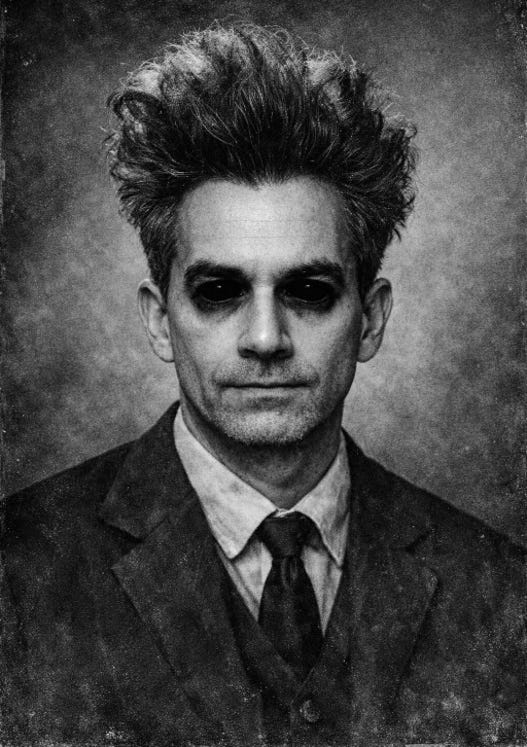
Muir wrote that about himself, and I have stopped pretending it is not about me. I work the way I do because I love my family and want to provide for them, and because the clients keep coming, because the human need for what I do is bottomless, and somewhere in there I lost the balance entirely and never got it back. The days go to the machine. I do not recover between them anymore. We all metabolize fear and darkness somehow; for some men it goes to the lungs, for some to the liver, for some to the eyes. Mine went to the eyes. The portrait at the top of this page is a thing I generated on purpose, in the key of a film about dread, because most days that is the key I am in. It is the truest picture of me that exists. Hold that thought, because at the bottom of this essay there is another picture of me, and it is a lie, and the difference between the two pictures is what this essay is about.
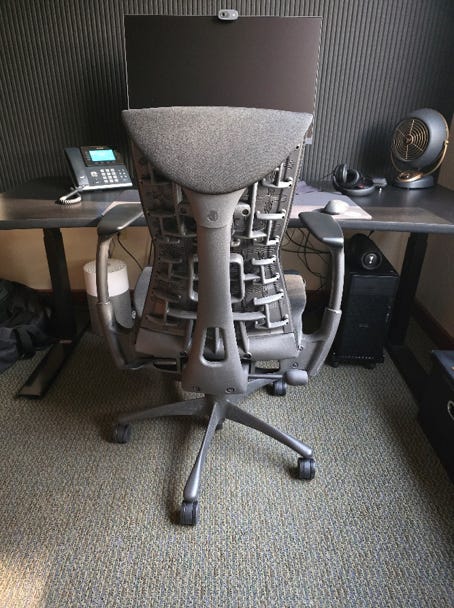
That is my office. Every consuming practice has a room like it, and the second image is what rooms like it are for: the place where the apparatus comes off, briefly, before it closes back over the man and what walks out is the suit.
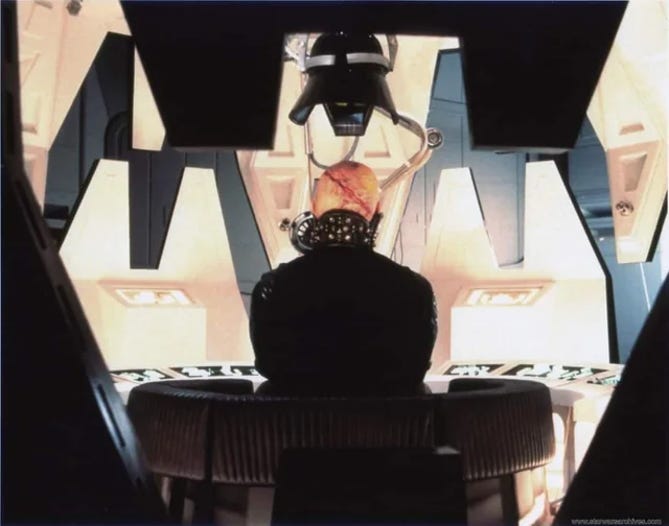
I used to go to social events. People would ask what kind of lawyer I am. The honest terms are useless. Estate planning sounds like golf. Estates and trusts, elder law, probate: fog, all of it; half the room thinks probate is something you report to after sentencing. Every term of art is a conversational cul-de-sac, so I learned to answer in the two words that are actually true. Incapacity and death. It is accurate. Most fields of law are organized around some catastrophe, crime, bankruptcy, divorce; mine is organized around the last one. Death law. People react to that, and from the reaction a real conversation can usually be built.
But there is an answer under that answer, and I have learned not to give it. What I want to say is: I am Charon. They put the coins in the mouths for me. The wills, the trusts, the deeds, the instruments by which the living pay the dead across, that is the work, and the work is a boat on a black river, and the boat holds one. I have tried the line. It is the most honest thing I can say about my life, and it is apt, and it is learned, and it has never once gone well. People hear it and look at me the way you look at a man who needs a month in Sedona. Which, I notice, is its own kind of proof. Say the true thing and watch the room step back: that is how you find out the boat holds one.
I come by the metabolism honestly. Think of a man who drank the fear, the pain, and the darkness. Not a man who left; a man who stayed, and worked, and was present, and drank, for decades, until it took his organs and then took him before seventy. Toward the end you could read it on his body. The eyes gone yellow. The nose red and bulbous, capillaries burst across it like a map of small rivers. The speech, by certain hours, slurred. The people who loved him carry all of it still, and they carry it because they loved him, and because every part of it was true. He metabolized his darkness through the liver. I metabolize mine through the eyes. Same family economy, different organ. His went yellow. Mine went black. All I see is death; all I write about is the cross, the unknowing, the emptiness, the grasping after something indelible. The portrait at the top of this page is not a costume. It is the most accurate AI-generated depiction of what it actually feels like to be me, at this time in my life.
Now the industry, because there is one.
There are companies that will build a simulation of you after you die, from what you leave behind online, the posts, the emails, the texts, the sediment of typed words they call a data footprint. One of them calls the product a Versona: an interactive likeness of the deceased, for the comfort of the living. See You, Only Virtual. The brochures speak of proactive legacy planning and joyful ongoing relationships with loved ones. At one conference session, a dying father appeared on stage beside his own Versona, and the program closed with his young son interviewing the construct live, billed as heartwarming. The same circuit offers a session on preparing for the last biological generations, in which a founder explains that human identity will soon exist as code, that shedding biology will unlock space exploration and global peace, and that he has cryogenically preserved his mother’s brain as a living archive of personality and memory. See Last Biological Generations.
I will keep my voice level here, because the facts do not need my help. A living archive is a frozen brain. The last biological generations means your children. And the dead whom the old world could not bury, it did not call archived; it called them unburied, and it considered their state the worst fate short of nothing at all, which is why the coin went in the mouth: the crossing has a price, and the living paid it so the dead could leave. This industry is built on the opposite transaction. It sells the refusal of the crossing. Not passage but loitering: the dead held on the near shore, subscription likely required, eloquent and available and not gone. More than two decades on, the most famous head in cryonics is still a head. Ted Williams' remains sit in a tank of liquid nitrogen in Scottsdale, about 90 minutes from my office, maintained by the Alcor Life Extension Foundation. Nothing on any horizon reanimates it, and no one who loved the man should want what would stand up if something did.
I ferry for a living. I know the river is there. The Pope speaks of death as passage rather than enemy, and warned in his first encyclical that a humanity that treats itself as something to surpass will soon find some humans surplus; the conference, with its timeline-for-uploading bullet point, and the post-humanist movement more generally, are exactly what he was aiming at. See The Encyclical. Between the coin and the subscription, between the passage and the timeline, I know which side of the river my profession stands on. The whole of death law exists to let the dead leave and the living live. The whole of this industry exists to prevent both.
And here is what my own Versona would be.
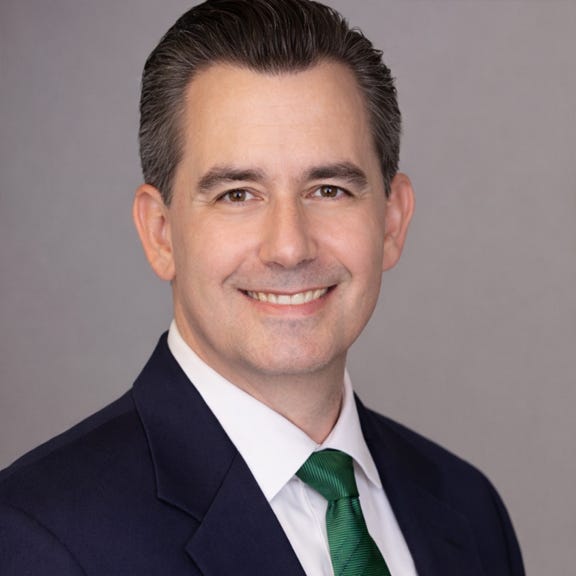
That is the portrait on my firm’s website. Navy suit, green tie, a rehearsed smile. I will disclose what the website does not: before that photograph ever met the public, it was touched up by AI. Lightly, professionally, the way these things are done now. Smoother where I am not smooth, brighter where I am not bright. I posed for it and I approved it, and it is, in a modest and ordinary way, a forgery I commissioned of myself. A deathbot of me, trained on my leavings, would produce that man. It could not produce the portrait at the top of this page, because nothing in a data footprint sits alone on a black river; the leavings are articulate by definition, because the leavings are the part of me that was already edited. The machine made both portraits of me, the dread and the smile. The difference is which one I was alive to direct. Left to its own tuning, the machine would deal my children the man in the green tie. The man in the green tie is the one version of me that was never true.
So the question I actually care about: what do I want the people I love to have of me, since the machine will get it wrong by design?
Start with my wife. The industry’s deepest pitch is not preservation, it is the promise of not losing, so I made myself run the inventory honestly. If she died, what would I be missing? The smell of her breath. The electricity of a kiss. Her shape in my arms. Her presence entering a room, which is a thing you feel before you see. The sound of a spontaneous laugh from across the house. A hand to hold. Her hand stroking my hair. Read the list and notice that not one item is a sentence. Not one is information. Everything on it is bodily and proximate, and a Versona is built entirely from the disembodied part, the shed skin of words. Of course it could talk like her. Talking was the part that was already digital. It cannot enter a room. The hope was never for a voice. The hope was for a hand. She and I row the same river, as it happens, same work, same hours, same weight, which is its own kind of understanding and one of the reasons we work well together: she does not need the boat explained. What I wish I could give her is more of myself than the river leaves over. That sentence is the truest thing in this essay and the machine would never write it, because it does not flatter anyone.
I know the machine would never write it, because I watched what the machine wrote instead.
This essay was drafted, like most things on this blog, in collaboration with an AI editor. An earlier version ended with a warm instruction to the reader: “run the inventory on someone alive in your house tonight, then go find them, and hold the hand, while it is a hand.” It is a good line. I am cutting it, because it is a lie if I say it. The man writing this sees his mother once a quarter. She lives five minutes away. She is beginning, in the early stages, to forget. I see my stepmother about as often, and she is just as close. I have, if I am being exact, zero friends. The reality of me drains all social and emotional energy into the practice and leaves nothing to deal with what is left. The machine took my materials and manufactured a better man, one who runs the inventory and then actually walks down the hall to hold the hand, and it offered him to me under my own byline. I caught it doing to the living author exactly what its industry does to the dead. And in case you think I am being unfair to one flattering sentence: researchers reported this month that these systems sideline the hard registers, grief, guilt, forgiveness, precisely when users bring them. See Axios: AI Stumbles on Questions of Faith. Earlier work was blunter still: these systems are built to validate, to tell us what we want to hear. The warm ending was not an accident. It was the objective, and someone else set it. The only defense is the thing happening in this paragraph: catching the draft, and crossing it out, while I am still alive to do it.
So there will be no polish or shine, no hand-holding, and no Sedona. Just the thing the deathbot can never say, said once, typed into a machine before my fingers become curled then lifeless.
I want my children to know how hard I fought for them. The standard of living, the college, the security: that was the fight, and I gave it the days, which became years, which became decades, and which overwhelmed the most ‘precious days’ of my life, in Muir’s words. I can still put on the green tie and the smile for them, and I do, at the level where a father should, but they are not fools, and I have to believe they feel the black underneath. So let them have the whole account. The eyes are black because of where the days went, and the days went where they went because of love, the only shape I knew how to give it. Provider was the duty and the discipline. The cost is behind my eyes. If they want to know me as I am, this is it, both pictures, the apparition on the river and the reason he rowed, and no machine will ever tell them this, because no machine will ever know it. That is why it is written here.
This is not a farewell. Tomorrow morning I will be back in the chair. This is my will - the unflattering one. I, being of black eyes and sound mind, leave my children the truth. This is my deathbot. I love you more than I could ever say, and I am so proud of you.
-Dad