First Love
An entrance to the cycle

Gustav Klimt painted Love in 1895. He was thirty-three. He was a successful decorative painter at the end of his Künstler-Compagnie partnership and two years before he founded the Vienna Secession. He had not been to Ravenna. He had not painted Judith, Adele, the Beethoven Frieze, or any work that the Klimt of public reception would recognize as a Klimt. The Gold Period was a decade ahead of him. The Faculty Paintings rupture was five years ahead.
The painting itself was a commercial commission for Martin Gerlach’s Allegorien und Embleme, a publisher’s portfolio of allegorical plates intended for the decorative-arts market. It is a small vertical canvas. A man and woman approach a kiss. Roses frame the scene. Painted gold-leaf bands run beside the image at left and right. Above the couple, five faces gather in pale vapor.
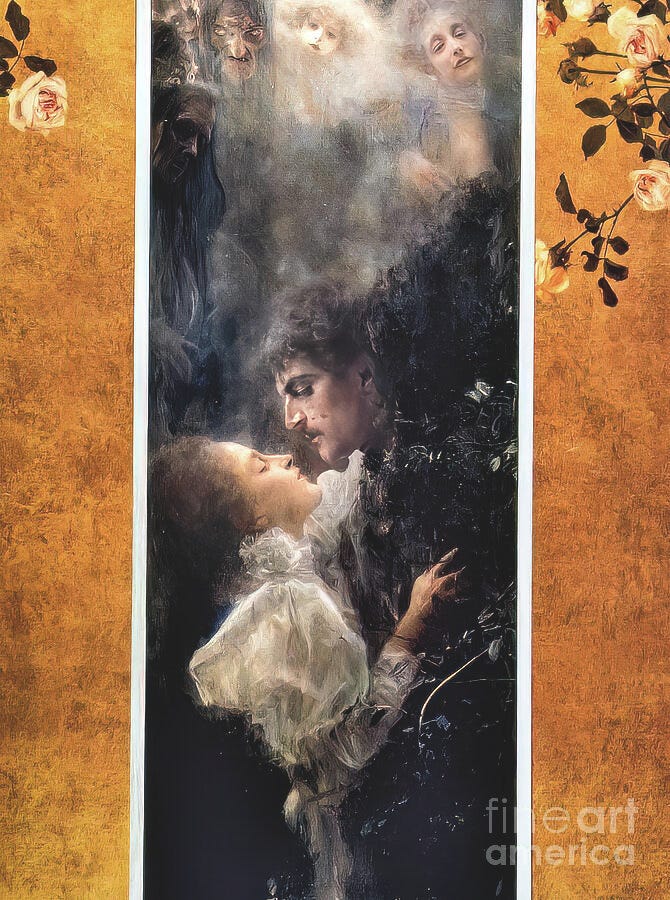
The title is almost too simple. The surface belongs to the ordinary symbolic language of romance: youth, desire, flowers, nearness, the suspended instant before the kiss.
The painting will not remain innocent.
The woman’s head is thrown back. Her throat is covered and stressed. The man does not stand beside her; he descends over her. His body emerges from the dark mass of the roses, as if the vegetation has produced him. Above the couple are not celebrants. They are consequences.
The painting is called Love. Its structure is the Fall.
This is where the cycle should begin, because this is where Klimt begins to show the machine. Before Ravenna, before Judith, before the Beethoven Frieze, before the Stoclet dining room, before The Kiss, Klimt had already joined the same elements: the kiss, the rose, the woman thrown backward, the compromised neck, the male figure above her, and the watching presences that turn romance into judgment.
The later works do not invent this structure. They refine it, enlarge it, disguise it, monumentalize it, and finally return it to Genesis subject matter. Love is the first form in which the pattern can be seen without the Gold Period style overwhelming the eye.
It is the first false innocence.
A note on method. The technical iconographic case for the readings in this piece is built across the five pieces that follow: the canvas in The Kiss as Embedded Protoevangelium, the anatomy in The Toppled Pillar, the Beethoven Frieze in Above the Starry Canopy, the Stoclet dining room in The Missing Structure of Stoclet, and the cycle's eschatological terminus in In the Valley of Death's Shadow. Love is the entry. It introduces the field. It does not prove the field. The proof is the cycle.
This cycle is cumulative. No single correspondence carries the argument by itself. The claim is not that every rose, neck, grid, cross, or kiss must always mean the same thing in isolation. The claim is that Klimt returns to the same visual problem with unusual consistency: beauty as concealment, love as danger, the female body as the site of consequence, the vertical line as the measure of fall. The argument becomes stronger as the repetitions accumulate.
I. The Two-Level Painter
Klimt is among the most consumable artists in the world. His images appear on coffee mugs, umbrellas, tote bags, scarves, mouse pads, calendars, posters, phone cases, and notebooks. The public receives him as beauty: gold, pattern, erotic glamour, decorative luxury, the kiss as an icon of love.
That reception is not wrong. It is too shallow.
Klimt painted for the surface. He wanted the surface to work. It does work. The paintings are beautiful, and the beauty is not accidental. He understood ornament, public desire, female allure, and the commercial power of the image. He gave the public images it could love.
He also painted underneath the surface.
The argument of this cycle is that Klimt operates on two levels in his major symbolic work. The first level is public, decorative, erotic, and broadly legible. The second level is iconographic, Christian, sexual, violent, and far darker. The surface says love. The structure says Fall. The surface says fulfillment. The structure says consumption. The surface says decoration. The structure says confession.
This is not an argument that the surface reading is false. The public-facing reading is part of the device. Klimt’s genius lies in building an image that can survive as romance while carrying a contrary structure underneath it.
The question is not whether Love, The Kiss, the Beethoven Frieze, and Stoclet can be read in the standard way. They can. The question is why the standard reading repeatedly stops at the point where the iconography becomes most disturbing.
Klimt’s own statement about the missing self-portrait gives the method: whoever wants to know something about him should look attentively at his pictures and try to see in them what he is and what he wants.
That instruction has been treated as a charming artist’s remark. It is more serious than that. Klimt tells the viewer not to look for the self in a facial self-portrait. He tells the viewer to look for the self distributed through the pictures. Not the face only. The gaze. The hand. The posture. The repeated act. The iconographic position the artist keeps occupying.
This cycle follows that instruction. It argues that Klimt’s pictures disclose a recurring self-position: the artist as the beautiful tempter, the watcher, the consuming male, the figure who offers vision and performs the act. Across the corpus, that act concentrates again and again at the same anatomical site: the female neck.
Love is the early entrance into that system.
II. The Innocuous Names
The recurring scene has a recurring naming convention. Across the corpus, Klimt assigns the most harmless available title to the iconographic act.
(1) Love. 1895.
(2) Diesen Kuß der ganzen Welt. “This Kiss to the Whole World.” The closing panel of the Beethoven Frieze, 1902. The line is Schiller’s, set in the choral finale of Beethoven’s Ninth Symphony. It names the embrace as universal benediction.
(3) Liebespaar. “Lovers.” 1907-1908. The title at the work’s first public exhibition, the 1908 Kunstschau, where Klimt sat as president of the organizing committee. The Moderne Galerie purchased the painting from that exhibition and, in its autumn 1909 catalogue, retitled the work Der Kuss, The Kiss. The museum’s retitling traveled in the same protective direction as Klimt’s original: lovers to a kiss, one innocuous title to another, with the museum continuing the work the original title had begun.
(4) Erfüllung. “Fulfillment.” The Stoclet Frieze, 1905-1911. The title appears in Klimt’s hand on the cartoons preserved at the Austrian Museum for Applied Art, alongside his material and color instructions for the mosaicists.
The same compositional logic carries all four. A male figure descends over a female figure. He keeps his structural mass, his ornamented outline, his chromatic weight. She loses all three. Her body’s shape dissolves into the wrapping envelope. Her form is absorbed into the male’s larger body or into the gold field that surrounds them. Her color drains to pallor against his density. Her neck fails. Her head falls at an unnatural angle: thrown back in Love, bent into the male’s hand in The Kiss, fallen into his chest in Beethoven and in Stoclet, the throat either stressed and covered or absorbed entirely. Above her, on the right side of the top register in Love, the deathly female face renders the endpoint the scene predicts.
She is not embraced. She is consumed.
The four titles do protective work. They prepare the viewer to receive the iconography as harmless: love, kiss, lovers, fulfillment. They sit on the surface as the iconographic equivalent of a polite drawing-room conversation. The viewer who arrives with the title in hand is unlikely to ask what the painting actually depicts.
Love is the first installment in a sequence that runs for sixteen years under titles the public could accept as romance.
III. The Painting Called Love
The title gives the viewer permission to relax. Love sounds harmless. It prepares the viewer for tenderness.
The image does something else.
The central woman is pale, passive, and reclined. Her head tilts back at an angle that exposes and compromises the throat. Her neck is not simply elegant. It is made structurally important by the fact that Klimt partially hides it. The high white collar covers the throat at precisely the site where later works will place chokers, hands, hair, armor, talons, or shadow.
The male figure is not fully separate from the surrounding darkness. He seems to emerge from the rose mass. The roses do not merely decorate the scene of love. They supply the medium from which the male presence appears. The man is not standing in front of roses as a lover in a garden. He is produced by the rose-darkness, leaning out of it toward the woman’s exposed face and throat.
The painting carries gold-leaf bands at the lateral framing. This is twelve years before The Kiss and eight years before Ravenna. Gold leaf is already inside Klimt’s iconographic vocabulary in 1895, as a frame element rather than as the field. The Byzantine deployment came later. The material was already present at the entry.
The upper register destroys the innocent reading. Above the couple, five faces gather in vapor. Standard scholarship reads them as the ages of life: infancy, youth, maturity, age, death. The identification is correct as far as it goes. It is also incomplete.
IV. The Consequences
The five faces above the couple are organized around Eve’s Genesis 3 consequences, with the ages-of-life reading sitting on the surface and the consequence reading running under it.
On the upper right, a female face resembles the woman in the embrace but appears drained, spectral, and post-vital. Her head turns strangely. Her neck appears divided, obscured, or broken by the surrounding vapor and garment. She looks like the future of the woman below. Genesis 3:19: dust thou art, and unto dust shalt thou return. The right side of the upper register is Eve’s mortality, rendered as the same woman after death has done its work.
In the middle of the upper register, the iconography turns to the infant. Genesis 3:16: I will greatly multiply thy sorrow and thy conception; in sorrow thou shalt bring forth children. The middle of the upper register is Eve’s childbirth pain, the second consequence named in the curse, rendered as the figure who will be produced by the union below and as the suffering that will accompany the production.
The infant is also Eve’s seed in the verse before the childbirth curse. Genesis 3:15, the protoevangelium: I will put enmity between thee and the woman, and between thy seed and her seed; it shall bruise thy head, and thou shalt bruise his heel. The seed of the woman crushes the serpent’s head.
Klimt installs the verse as spatial geometry. The infant sits directly above the head of the male figure who emerges from the roses below. The seed of the woman is positioned vertically above the serpent’s head. The arrangement renders Genesis 3:15 in the canvas in 1895, twelve years before The Kiss develops the same move at canvas scale. The Kiss as Embedded Protoevangelium reads the 1907 painting as a bivalent toggle in which the heel of the rising body crushes the serpent’s head at the lowest point of the composition. The 1895 painting installs the relationship without requiring inversion. The seed sits above the serpent in the canvas as painted.
On the upper left, the faces darken further. The register moves from mortality and suffering into the demonic. These are not the ages of life. They are the powers released by the erotic event below. The third consequence is theological: the long damnation, the inheritance the Fall transmits to the line that follows.
A conventional allegory of love shadowed by time would be one thing. Klimt gives more. He places the woman in the posture of vulnerability, compromises her throat, causes the male to emerge from the roses, and installs the Genesis 3 curse above the scene in pictorial form.
The title says love.
The image says that the thing being called love has already become the curse pronounced over Eve.
The standard ages-of-life reading is the surface vocabulary. The Genesis 3 consequences are the structure under it. Both readings sit on the same painted faces. The painting requires no element to be moved for the second reading to appear. The viewer who knows the curse sees the curse. The viewer who does not sees the ages of life.
V. The Roses
The rose is the painting’s most useful trap.
To the ordinary viewer, roses confirm the title. Of course a painting called Love has roses. The flower belongs to courtship, perfume, beauty, romance, and the conventional exchange between man and woman.
The rose has another register. It belongs to Eden. It belongs to beauty before the curse. It belongs to the garden in which beauty becomes dangerous because beauty becomes the vector of temptation.
Klimt returns to the rose in the Stoclet Frieze, where the Rosebush stands between Expectation and Fulfillment. In the Stoclet reading developed later in this cycle, the Rosebush is not background decoration. It occupies the structural position of the tempter in Genesis 3. It is the brilliant, jeweled, thornless, pre-fall splendor of the covering cherub described in Ezekiel 28. The rose is not romance only. It is the beautiful medium through which the Fall enters.
Love anticipates that move. The male figure appears out of the roses before Stoclet makes the Rosebush architectural. In Love, the rose remains partially plausible as romantic atmosphere. In Stoclet, the rose becomes a full iconographic actor.
This is how Klimt works. He begins with an acceptable symbol, then changes its function. The viewer thinks the rose means love because the title says Love. The same viewer later thinks the Stoclet Rosebush is decorative Jugendstil ornament because the room is a palace dining room. In both cases, the rose is doing darker work.
The rose lets beauty hide the adversary.
That is why Love belongs at the beginning. It teaches the reader how to look at Klimt’s flowers. They are not merely flowers.
VI. The First Eve
The woman in Love is not named Eve. She does not need to be.
Klimt’s mature method does not depend on literal titles. It depends on structural placement. Eve is the woman at the threshold of the Fall. She is the woman approached by the beautiful tempter. She is the woman whose desire becomes the site at which mortality enters. She is the woman whose body will carry the consequences: pain, birth, blood, death, and longing.
The woman in Love stands in that position.
Her gaze is not active. Her head has yielded. Her face is turned upward toward the male, but the posture does not read as sovereign desire. It reads as surrender under pressure. The white garment at her throat, visually prominent against the darker mass of the painting, makes the neck impossible to ignore while refusing to reveal it fully.
The woman above her repeats and darkens the same figure. The living woman below and the deathly woman above form a temporal pair. One is the moment before the event is consummated. The other is the state after the event has done its work.
That is why the painting feels haunted. The future is already present above the kiss.
Love compresses the curse into one image. The embrace below is surrounded by flowers, but the flowers are already under judgment. The woman is alive below, but death is already watching above. The kiss is approaching, but the consequence has already arrived.
The painting is not an illustration of Genesis 3. It is an allegorical structure built on the Genesis pattern. Klimt is not painting Bible pictures. He is using biblical architecture to organize secular images that can pass as romance, decoration, myth, or Symbolist mood.
The 1895 commission for Gerlach’s allegorical portfolio is consequential here. Klimt was making allegorical content on commission for a commercial publisher. The system was not a private esoteric confession built up in old age. It was operative in commissioned work at age thirty-three.
VII. The Male Figure
The male figure in Love is more than a lover.
His position is superior and descending. He is above the woman. His face presses toward hers. He emerges from darkness. His body absorbs the eye more as a shadowed presence than as a fully individuated person. He is intimate and predatory at the same time.
This is the problem Klimt will return to repeatedly: the male as the figure of embrace and consumption. In the public reading, he is lover, bridegroom, redeemer, or masculine complement. In the hidden reading, he is the tempter who comes in the form of beauty and desire.
There is also the question of self-reference.
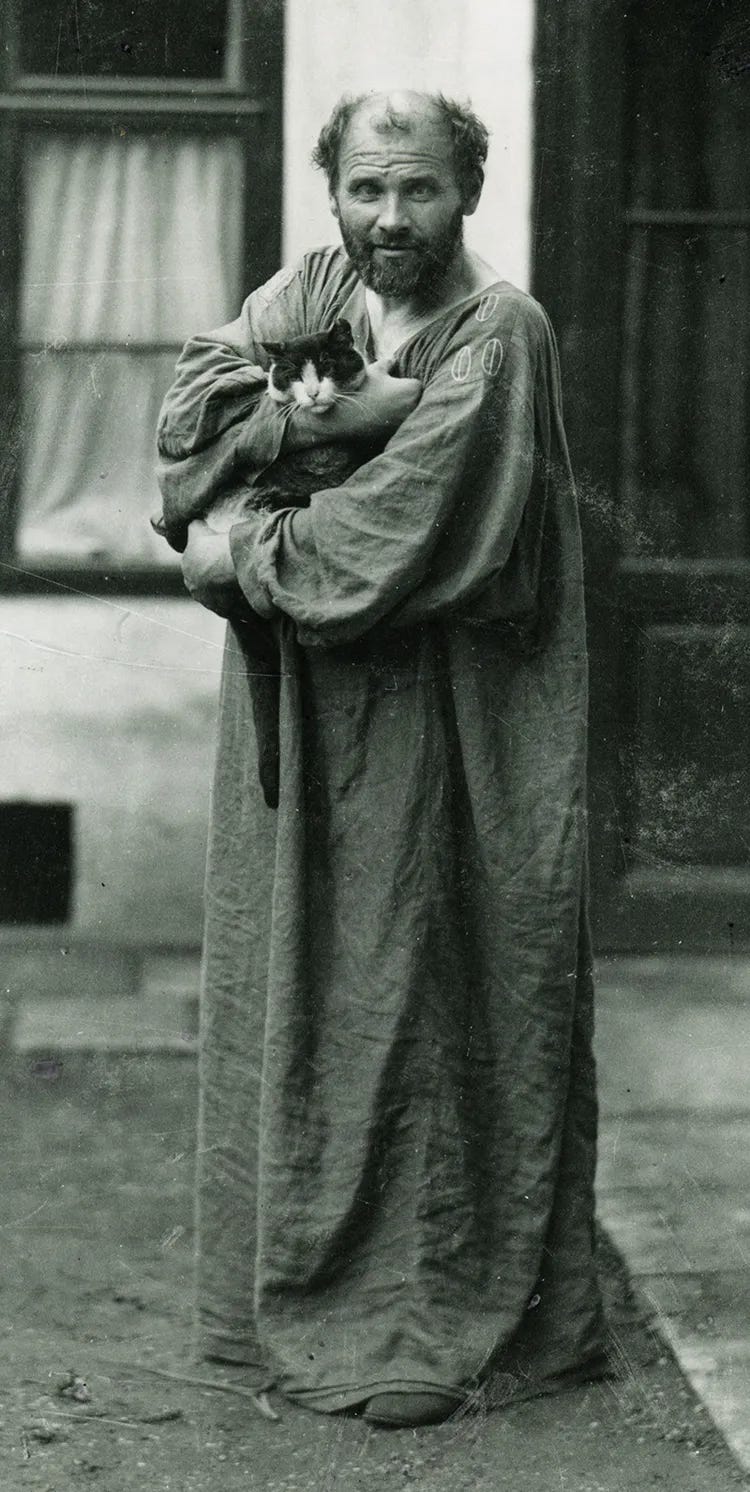
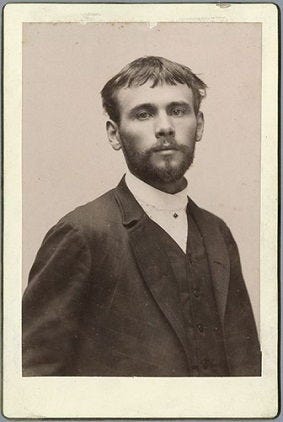
Photographs of the young Klimt show a narrow face, dark hair, heavy eyes, straight nose, compact beard, and a severe inwardness around the gaze. The male in Love carries close enough physical resemblance to the young painter to raise the possibility that Klimt has allowed his own features to enter the figure.
The physical signature continues into the later corpus. The man in The Kiss and the man in Stoclet Fulfillment both carry a distinctively thick, low-set neck with a particular relation to the surrounding collar or mantle. The same anatomical signature is documented in photographs of Klimt across his career: the thick neck, the heavy trapezius mass, the close-cropped hair at the nape, the relation of head to shoulder. The male figures in the recurring Fall scene carry the painter’s own neck.
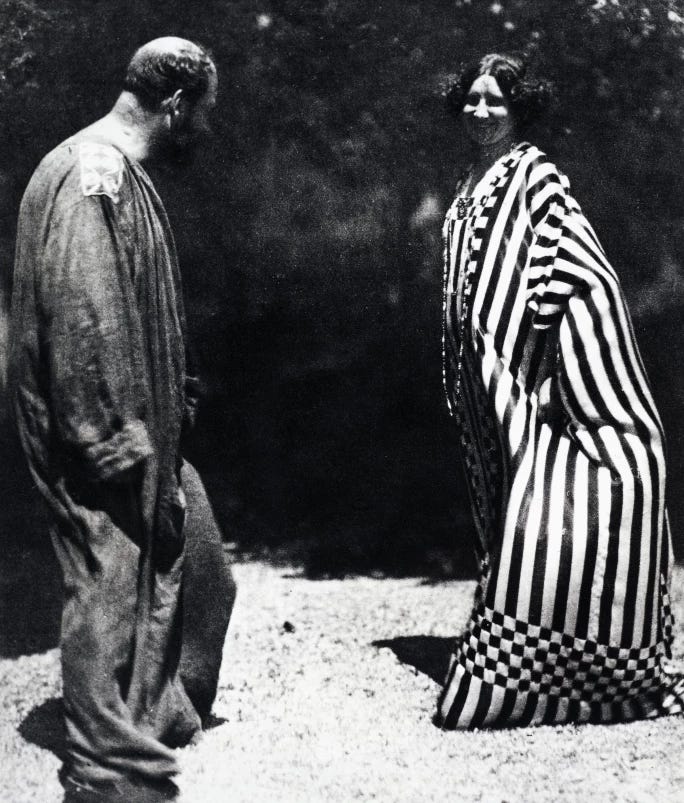
The point is not that the paintings are private biographical self-portraits. The point is iconographic. Klimt’s instruction tells the viewer to look at the pictures to see what he is and what he wants. The pictures repeatedly place the masculine figure at the site where Eve is taken, wounded, absorbed, and rendered mortal. The figure who occupies that site carries Klimt’s anatomical signature. The artist is in the painting at the position of the act.
The Missing Structure of Stoclet locates Klimt’s iconographic self-position as the Eye, the gaze distributed across the frieze, the offer of forbidden vision. The Toppled Pillar locates the other self-position as the hand at the throat. Love offers an early face for the same operation: the artist as the dark male principle leaning out of beauty toward Eve.
This is not proof of conduct. It is iconographic self-placement. The historical record documents Klimt as a man of sustained sexual involvement with his models, fluent iconographic literacy, and full access to the contemporary sexological vocabulary. Whether the iconographic fantasy crossed into conduct is not established by the evidence and is not required by the argument. What the corpus does establish is that the artist installed himself, by physical likeness, into the position of the tempter across twenty-three years of major work. This is not an argument about conduct. It is an argument about pictorial self-placement. The paintings do not prove what Klimt did. They show where he repeatedly placed the masculine figure within the symbolic action. The evidence is visual, anatomical, and iconographic, not biographical proof of any act outside the frame.
In Love, that position has a face.
VIII. The Neck
Once the neck is seen, the cycle changes.
Klimt almost never leaves the female neck alone. His major female figures are repeatedly marked by constriction, bending, covering, collapse, or threat at the throat. Judith’s choker, Adele’s neckband, Fritza Riedler’s collar, Sonja Knips’s ribbon, the bowed heads of Hope II and The Three Ages of Woman, the hidden throat of Danaë, the talon positioned near the neck in Lady with a Fan: the pattern is not incidental.
The Toppled Pillar develops this at full scale. The neck is the body’s upper plumb line. It holds the head erect. It keeps the eyes level. It is the small column through which the face remains upright in the world. When the neck fails, the head falls, the eyes close, and the body goes out of plumb.
Klimt’s women repeatedly fail at that point.
In Love, the throat is already the site. The woman’s neck is cocked back and covered. The deathly female figure above carries the same problem in heightened form: a strange head angle, pallor, a divided or obscured neck. The painting therefore gives both the living throat under pressure and the mortal throat after consequence.
The later works intensify the same anatomical event. In The Kiss, the male hand sits at the woman’s jaw and upper neck, where tenderness and restraint become impossible to separate. In Stoclet Fulfillment, the woman’s head falls into the male chest and the neck disappears into the consuming body. In the Beethoven Frieze, Gorgon claws and hostile forces threaten the female body while the mandorla embrace stages redemption and consumption at once.
Song of Solomon 4:4 praises the bride’s neck as a tower of David, built for an armory, hung with shields. Klimt inverts the praise. His female neck is the tower under attack, the pillar constricted, the vertical brought out of plumb. The love painting begins with the pillar already compromised.
IX. The Absent Plumb Line
The other side of the cycle is the vertical that does not fall.
In the Beethoven Frieze, Klimt paints the Knight as an armed, cruciform, rigid vertical. In Stoclet, he strips the Knight further, removing face, armor, sword, and narrative detail until only the abstract vertical remains. The Knight becomes plumb line.
The Father in this cycle is not sentimental. He is standard, measure, verticality, the line against which the fall is seen as fall. Schiller’s question in the Beethoven Frieze asks whether above the starry canopy a loving Father must dwell. Above the Starry Canopy develops Klimt’s answer in full.
Love contains the Fall but not yet the visible Father. The vertical standard is absent from the scene. What remains is the erotic field, the rose-darkness, the woman bent backward, and the watchers above. The absence of the Father is part of the terror. The scene is love without the plumb line.
The later works will give the missing vertical different forms. Beethoven gives the armed cross. Stoclet gives the abstract Knight at the head of the dining room. The Kiss gives the vertical seam of the fused bodies and the cross revealed by inversion. The Toppled Pillar gives the neck as the bodily plumb line destroyed.
Love gives the first fall away from the standard before the standard has been named.
X. The Cycle in Brief
The four pieces that follow this one extend the structure across the corpus.
The Kiss as Embedded Protoevangelium reads the 1907-1908 canvas as a bivalent toggle. Upright, the painting renders the Fall: Eve at the cliff edge of Eden, slack in the serpent-bridegroom’s embrace, falling. Inverted, the same canvas renders the Resurrection: the body rising from the gold mantle as tomb, the heel crushing the serpent at the bottom, Genesis 3:15 as spatial geometry. The cross-axes toggle from Petrine inversion to Latin cross at the same half-turn. The kiss in 1907 is what the kiss in 1895 had already become.
The Missing Structure of Stoclet reads the dining room as a cruciform device. The Knight stands as plumb line on the short wall. The fall narrative runs along the long walls from Expectation to the Rosebush to Fulfillment. The Rosebush is the pre-fall Lucifer rendered with the Ezekiel 28:13 material catalogue. Fulfillment is the consummated Fall, with the female head fallen into the male chest where her neck should be visible. The dining table sits at the crossing point. The diners eat inside the Fall.
The Toppled Pillar names the anatomical law. The female neck is the body’s upper plumb line. Klimt’s repeated assault on that site is the bodily form of the Fall structure rendered above her in Love. The hand at the throat is the second half of the artist’s non-existent self-portrait, with the Eye distributed across the Stoclet program as the first half.
Above the Starry Canopy reads the Beethoven Frieze as the proto-cycle at architectural scale. The Knight as cross who stands and waits. The hostile forces wall as the deadly-sins catalogue with the inverted Trinity around the gluttonous body. The mandorla embrace as the vertical sexual diagram with cherubim flanks. Every iconographic element of the mature corpus is present in 1902. The Frieze is signed and installed in plain view.
In the Valley of the Shadow reads Death and Life as the cycle's eschatological terminus. The robed vertical male appears one last time, the cemetery grid replaced by crosses, the gold subtracted, the implement in his hands legible as both blessing and blow. The cross is on Death's robe. The human enclosure does not contain it.
The reader can take the four pieces in any order. They develop the structure that Love introduces.
XI. The Self-Portrait Without a Face
Klimt refused the literal self-portrait because the literal self-portrait would have been too small.
The self in these works is not one face in one frame. It is a position repeated across works. The Eye. The hand. The watcher. The consuming male. The beautiful tempter. The artist who offers the image as beauty while the image performs the Fall.
The physical signature is the entry point. The young man in Love carries Klimt’s face. The thick-necked man in The Kiss and Stoclet Fulfillment carries Klimt’s neck. The same painter installed himself by physical likeness into the recurring position across the major works. The likeness becomes harder to read as the Gold Period elaborates the ornamental surround, but the anatomical signature persists.
The iconographic signature does the deeper work. In Stoclet, the Eye becomes ambient. In The Kiss, the dark male head becomes the serpent field. In The Toppled Pillar, the hand at the throat becomes the second half of the non-existent self-portrait. In the Beethoven Frieze, the watcher and the consuming embrace appear together at public scale. In Love, the male face still has enough human specificity to trouble the viewer.
Klimt is not confessing in plain prose. He is doing what he said he did: placing what he is and what he wants in the pictures.
The gold came later. The confession began before the gold.
XII. First Love
Love is not the strongest proof in the cycle. It is not meant to be.
It is the first doorway.
It shows that the structure was present before the mature Gold Period made the system spectacular. It gives the reader the earliest compact form of Klimt’s repeated event: love as the name, kiss as the mechanism, rose as the medium, woman as Eve, neck as wound, male as beautiful tempter, the curse as consequence above, and the public surface as concealment.
The public misses the structure because Klimt made the surface too successful. The paintings are beautiful. They flatter the viewer’s desire to see love as beauty, ornament, and consummation. The images are easy to own in miniature because the disturbing structure is hidden beneath the decorative surface. A coffee mug cannot carry the Fall if the viewer has never been taught to see the Fall.
That is the dark comedy of Klimt’s reception. The culture has turned his images into the most harmless objects imaginable while the images themselves may be staging the destruction of Eve under the sign of love.
The titles do the rest of the work. Love hangs in the imagination as romance. The Kiss becomes the world’s favorite image of tenderness. Fulfillment sounds like marriage. Diesen Kuß der ganzen Welt sounds like universal benediction. The four titles assigned to the four major deployments of the recurring scene are the four most innocuous words Klimt had available.
Love comes first because it teaches the first rule: do not trust the name of the painting to tell you what the painting is doing.
Klimt called it Love.
The painting gives a woman bent backward beneath a dark male figure emerging from roses, her throat covered, the Genesis 3 curse already watching from above.
The title is the surface.
The Fall is underneath.
The rest of the cycle follows the descent.