
In the Valley of the Shadow

Unlike other works in this cycle, Death and Life does not depict a male-female union and does not carry the Fall reading those works support. It is the cycle’s eschatological terminus and the one in which the iconographic vocabulary the cycle reads is most explicit. The cross is on Death’s robe. The implement in Death’s hands reads as both blessing and blow. The human enclosure is closed.
The Scene
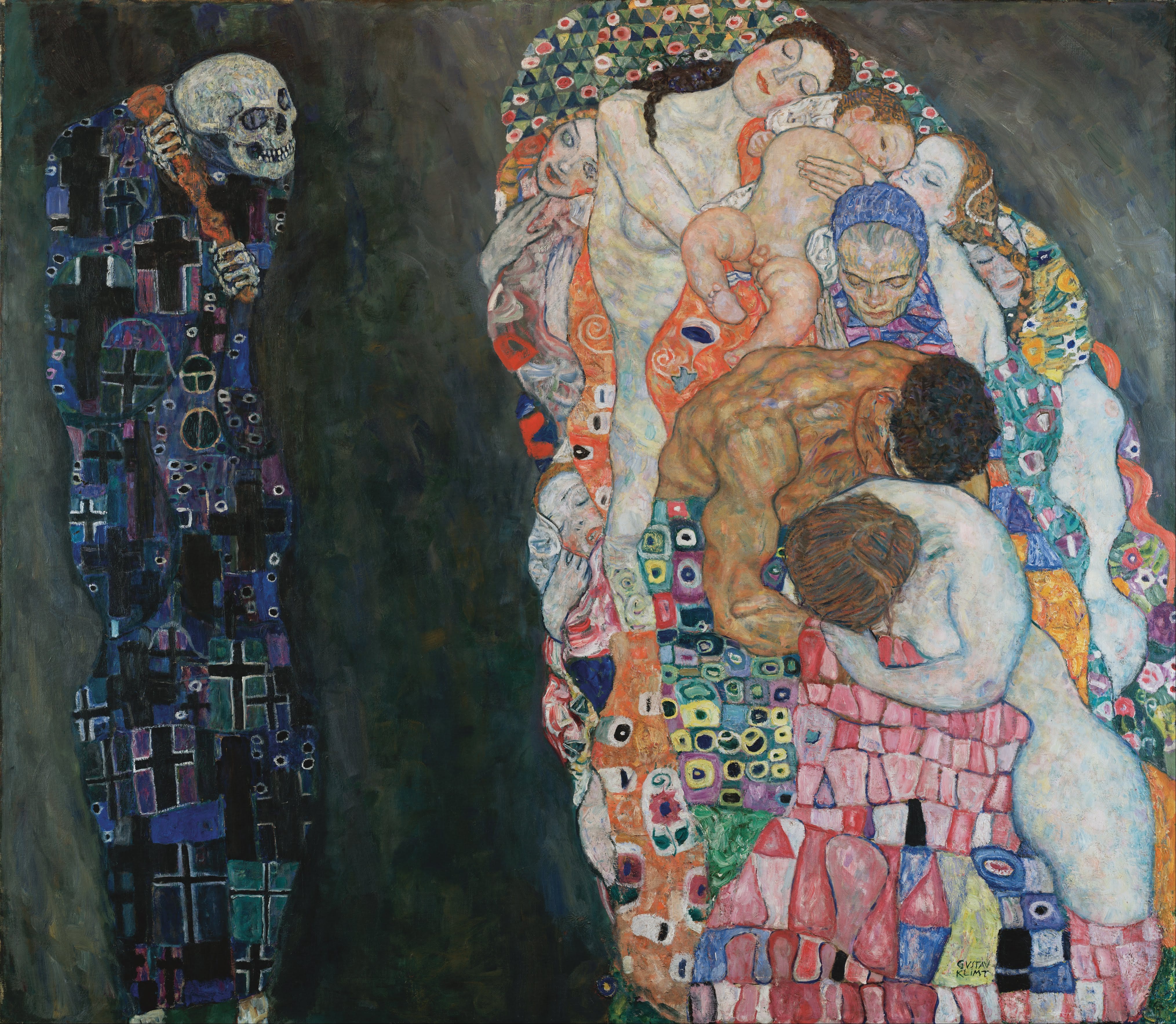
In Gustav Klimt’s Death and Life, the human figures are gathered into a single bright enclosure. They are not arranged like separate individuals occupying a common space. They are folded into one another. Their bodies overlap, curve, lean, sleep, embrace, nurse, and press together. The group resembles a human shelter, or a womb-like vessel. Not heaven, not paradise, not salvation, but the warm enclosure of embodied life.
Opposite them stands Death.
The difference between the two halves of the painting is usually described as the difference between Death and Life. That is accurate as far as it goes. The painting’s more severe structure is theological. The living mass contains warmth, flesh, flowers, maternity, erotic contact, age, sleep, childhood, and fertility. What it does not contain is a visible redeemer. There is no Christ figure, no heroic rescuer, no angelic mediation, no heaven above the human bodies, no vertical ascent, no golden opening in the field.
The only brightness in the painting comes from the human mass itself.
Death stands apart in a heavy black field. He is upright but not straight. His body is narrow, wavering, almost serpentine. If the living figures are curved because they are bound to one another, Death is wavy because his verticality is distorted. He is the only figure who clearly stands, but he is not a true pillar. He is not plumb. The painting contains no Golden Knight, no St. Michael, no redeemer standing between the living and the skull.
This is especially notable because Klimt gives us an obvious candidate for the heroic role. Near the center of the living mass is a muscular male body, broad-backed and powerful. In another painting, such a figure might be the defender. Here he is bent over, inward-facing, apparently asleep. His physical strength has no answering function. He does not see Death. He does not stand. He does not intervene. He is not a hero. He is flesh.
The whole human group is flesh. That is both its dignity and its vulnerability.
Death’s Robe and the Cross
Death’s robe is marked by crosses.
That fact is difficult to treat as incidental. The crosses do not appear among the living. They are not distributed throughout the human enclosure as emblems of hope, resurrection, or sacramental life. They belong to Death. They mark his garment. They form part of his visual identity. Death is not a skull standing in darkness. He is clothed in the sign of Christianity.
The object in Death’s hands deepens the problem. At first glance it appears to be a club or cudgel, a short blunt instrument held with both hands raised near the skull. The cross-marked robe changes the field of possible associations. In the hands of a robed figure, a short handled object recalls the aspergillum, the implement used by Catholic clergy to sprinkle holy water. In ordinary liturgical use, the aspergillum is an instrument of blessing, purification, and consecration, and is used at burial.
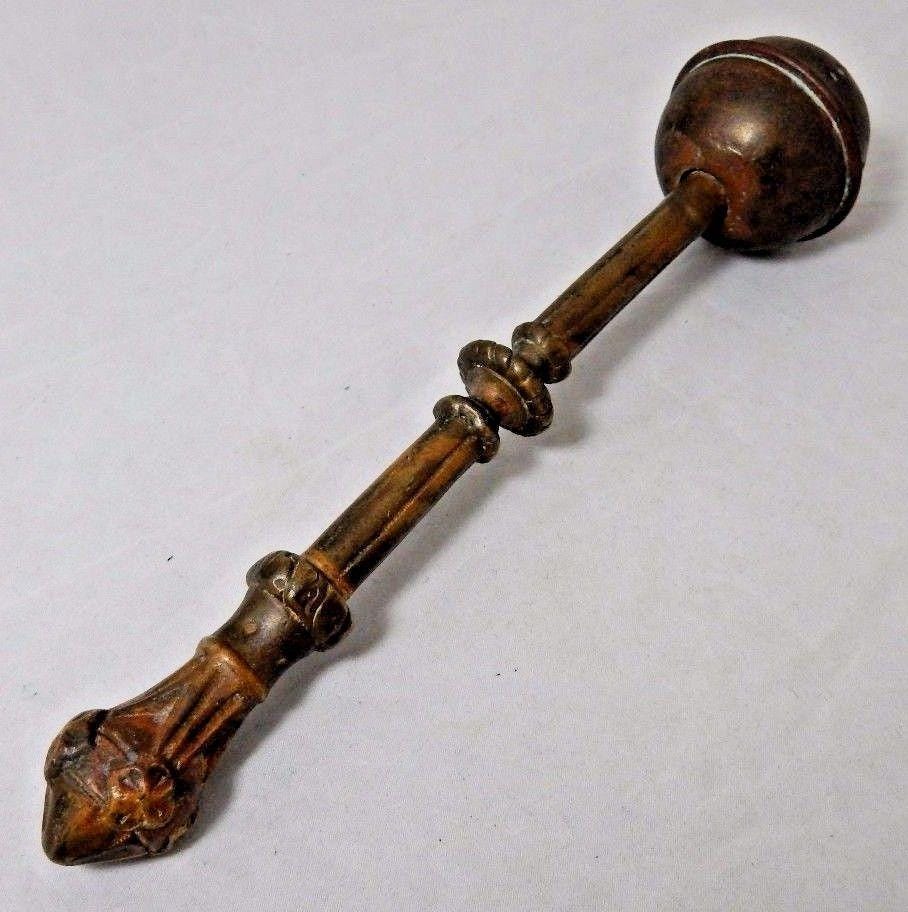
Klimt’s object is not a clean depiction of an aspergillum. It is too heavy, too blunt, too weapon-like, and the grip is two-handed rather than the single-handed liturgical grip. The visual citation is not exact. What the painting does establish is the conjunction: a robe of crosses, hands raised in a gesture that mirrors blessing, an implement positioned where a sacramental object would be held. The grammar of priestly gesture is present even where the specific object is hardened toward weapon.
Death does not merely wear the cross. He occupies the posture by which it is administered.
The result is not conventional Christian consolation. The painting does not show the cross defeating Death. It shows Death robed in crosses. It does not show a priest blessing the living into eternal life. It shows a skull-figure whose body and implement read as both liturgical and lethal. The Christian sign system is not placed inside the human enclosure as salvation. It stands outside the enclosure, in the black field, with Death.
Two Versions, the Second Darkens
The painting was first exhibited in 1911. Klimt revised it significantly by 1915. The revisions are not cosmetic. They are evidence of where Klimt wanted the painting to land.
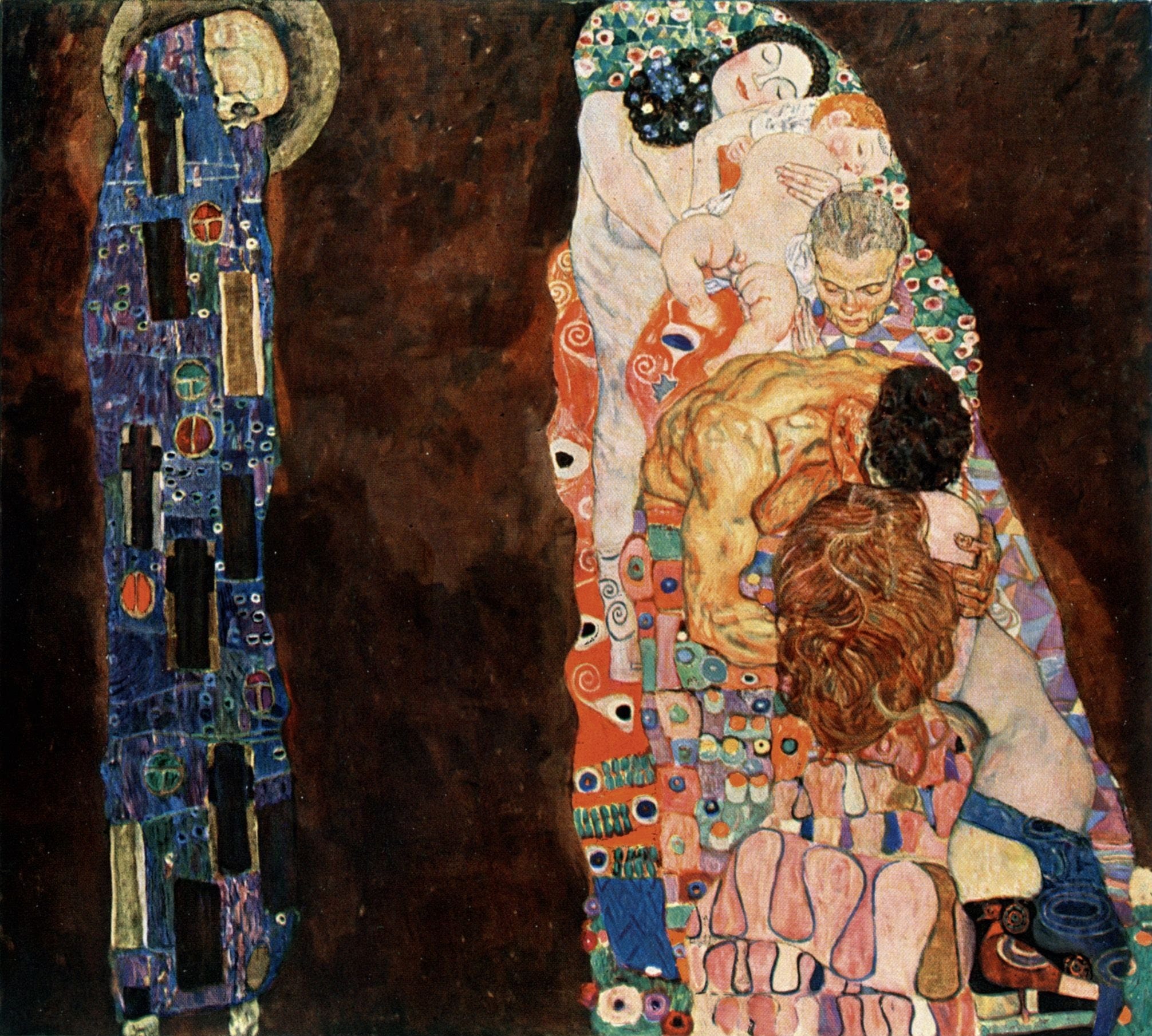
In the 1911 version, a halo or halo-adjacent disc sits above Death’s head. The robe already carries cross-like forms. The halo intensifies the association. Death appears less like a random intruder than an ordained figure, almost a liturgical officer. The bowed head keeps the image from becoming triumphant. This is not Christ-like glory. It is sanctity emptied of redemption. Klimt borrows the visual grammar of holiness and places it over a skull.
The earlier halo almost over-explains the point. Death has been given the symbolic apparatus of sanctity. In the revised version the robe, crosses, posture, and separation from Life carry the burden more subtly. The halo is gone. The crosses multiply. The gold is overpainted in black and grey. The robe loses its bright accents. Death’s posture changes from passive looking-down to attentive watching. The figure becomes more lethal and more priestly at the same time, and Klimt achieves both shifts by darkening rather than by adding new elements.
The revision also adds a pale woman to the left edge of the human enclosure, eyes open and fixed on Death. She is not in the 1911 version. She is the painting’s only conscious witness to what stands across the field. Awareness has entered the human mass. The revision adds the hinge.
Klimt’s revisions clarify the direction of the painting. The 1911 Death and Life carried the iconography in a diffuse and partly sanctified register. The 1915 Death and Life sharpens the cross into hostility, hardens the implement toward weapon, removes the halo that softened the sacrilege, and adds a witness who sees. Each revision moves the painting further from consolation and further toward the structure the cycle identifies.
Cycle Position
In the Beethoven Frieze, Klimt still stages a heroic structure. The Golden Knight is the commissioned figure who moves toward the hostile powers. The frieze is full of oppositions: longing and threat, purity and corruption, ascent and deformation. The question of verticality remains alive because the knight is upright. The plumb line is still possible, even if under pressure.
In The Kiss, the question becomes more compressed and more bodily. The couple occupies the edge of a drop. They are placed at a threshold where embrace, danger, surrender, and union converge. The vertical and horizontal are no longer architectural. They pass through the body.
In Fulfillment, the Kiss figure reappears in the immediate aftermath of the act. The female has turned her face away. The male’s robe is now built out of eyes. The post-Fall vision has opened.
In Stoclet, the post-Fall condition has been installed as architectural program. The dining room is built out of the eyes and contains the cemetery grid as a panel within its iconographic field. The family eats above the cemetery and under the gaze that was opened at the Fall.
In The Toppled Pillar, the vertical has fallen. The female body becomes the site of collapse and inversion. The image can be read as a drama of fallenness: the broken pillar, the cliff edge, the serpent-like force, the blood, the womb, and the body no longer organized by an upright axis.
Death and Life is quieter, but in some respects more absolute. There is no knight. There is no standing redeemer. The muscular man sleeps. The women and children curl into one another. The elderly body is folded into the group. The infant is exposed and held. Life does not answer Death by standing upright. Life answers Death by continuing.
The Living Mass
The infant is central to that answer. Klimt gives the child a specific male anatomy. The detail is not necessary if the infant is meant only as generic innocence. It matters because the child represents future generation. The living mass contains its own future tense. Its hope is not heavenly rescue but fertility, the possibility that human life will continue through birth, body, sex, maternity, and succession.
That hope is bounded. The infant is not Christ. He is posterity. He is not a redeemer who defeats Death. He is the next life born under Death’s shadow.
The pale woman is the hinge between the two worlds. She is the figure the 1915 revision added to the left edge of the human mass. Her eyes are open while most of the others sleep or turn inward. Her face has a blue pallor. Her hands rise toward her throat. She is still embedded in the body of Life, but she already bears the color and knowledge of Death.
The hand at the throat is a recurring Klimt gesture. It appears in First Love, in The Kiss, in The Toppled Pillar, and here. The neck is the load-bearing site at which Klimt repeatedly stages the body’s vulnerability. In Death and Life that site is occupied not by an external threat but by the woman’s own hands. She does not need Death to reach her. She is already reaching for the place where Death will arrive.
The Robed Vertical Male
Klimt’s Death is a variant of a figure-type that recurs across the cycle’s central paintings. The Kiss male, the Fulfillment male, the Stoclet male, and Death share enough structural features to support a single figure-type reading: the robed vertical male whose garment changes with the theological moment.
All four are tall narrow vertical figures in heavy patterned robes that obscure the body underneath. All four lean toward a counterpart. All four make contact with the counterpart at the neck. The Kiss male's right hand is at the female's jaw and carotid, in the hand-at-throat gesture the cycle develops in detail in The Toppled Pillar. The Fulfillment male wraps the female's neck and shoulder. Death stands across from a human mass in which the witness woman's hands are at her own throat.
The figure-type remains stable while the garment changes with the theological moment: cemetery grid for mortality, eyes for post-Fall vision, crosses for final administration.
The Kiss male wears a rectilinear grid in gold. The grid is the cemetery: a tiled field of dark compartments with smaller bright punctuations, arranged in the form of a columbarium or burial wall. The same iconographic object appears as a framed panel within the Stoclet program. The gold on the Kiss male is the surface treatment that allows the upright reading of The Kiss to feel like ornament. The cemetery is what the garment was carrying at every viewing. The bivalent reading does not oscillate between two iconographies. It oscillates between two narratives that share the same iconographic substance.
The Fulfillment male wears a field of eyes. The eyes are the eyes of Genesis 3:7, opened at the Fall, producing shame, knowledge, and the need for covering. The Fulfillment male wears the post-Fall vision. The same eye-vocabulary lines the walls at Stoclet, where the dining-room program installs the opened eyes as architectural environment.
Death wears crosses. The cross is the Christian symbolic terminus of the mortality the cemetery grid first announced. The cemetery grid does not appear on Death’s robe because Death’s iconographic moment is later than the grid’s. The grid is the announcement of mortality at the Fall. The cross is the Christian sign of death two thousand years later. Klimt is iconographically precise about which symbol belongs at which moment.
The figure is also a self-portrait. The robe is a working smock. The neck is thick. The head posture is forward. These features recur across Klimt’s documented self-images. The painter who fathered fourteen children and lived inside the tangle appears to have known what he was doing iconographically when he clothed the lover in the cemetery. He was not painting a stranger. He was painting himself, in the role he had chosen to occupy: the one who approaches the female, carries mortality in his garment, and brings the cemetery into the embrace because the embrace produces the cemetery. Every act of sexual generation produces a body that will die.
Death and Life shows the same figure at the iconographic terminus. The gold is gone. The eyes are gone. What remains is the cross.
The Cross as Death’s Instrument
The cross is materially an instrument of execution. Rome used it to kill rebels, slaves, and provincial troublemakers. It was designed to maximize suffering before death and to display the dying body publicly as a warning. Christianity took this killing instrument and made it the central sign of hope, salvation, and eternal life. The theological move is the assertion that the worst death produced the greatest life, that the instrument of execution became the instrument of redemption.
The move requires belief. Without the belief, the cross is what Rome made it. A viewer who looks at the cross and does not supply the consoling theology sees an execution device. Klimt is painting that viewer’s perception. He paints the cross as Rome painted it: as the instrument by which the human body is killed.
A human in the tangle who seeks the cross finds it only in Death’s robe. The Christian sign that conventionally promises rescue from death has been placed on the body of death itself. The cross is not in the human enclosure. It is not held by any of the women, the infants, the elderly, the muscular sleeper, or the witness woman. It is on the figure across the field. The viewer who looks for the cross expecting consolation finds it only at the moment of meeting Death, which is when the cross can no longer console because it has become the costume of the figure consoling cannot occur with.
This is what Christian iconography looks like when the consolations are subtracted. The figure who wears it is therefore both the priest and the executioner, because the cross has always been both.
The Beethoven Frieze suppliants are the cycle’s other depiction of Christianity looked at without the reframe. The kneeling figures reach forward in postures the religion describes as faith, prayer, and surrender to grace. Klimt paints the same postures and reads them as servitude. The reward is not in the frieze. The asking is the entirety of what the suppliants get. They are spending their lives in the posture of preparing for a death that the religion has reframed as the entry to true life. Painted without the reframe, the suppliants are pitiful because they are spending the only life they have on the asking, and the asking produces nothing visible in the frieze.
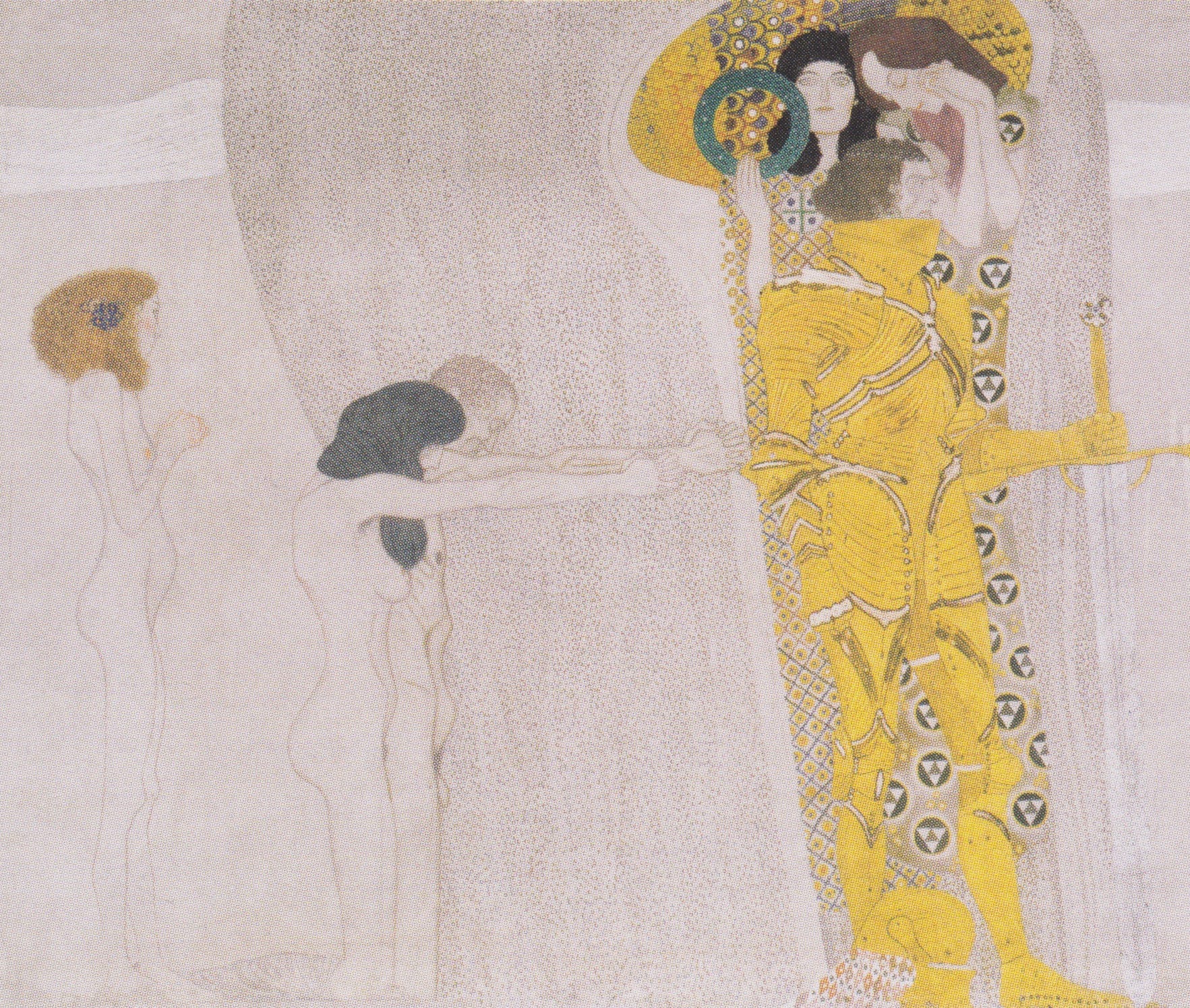
Death and Life is the suppliants’ iconographic destination. The figure they have been kneeling toward stands across the black field, robed in crosses, holding the instrument that reads as both blessing and blow. The asking has produced this. The cross they sought is on his garment.
Closing
The painting offers a severe anthropology. Human life is warm because it is shared. Human life is luminous because bodies touch, shelter, generate, and remember one another. This warmth is not salvation. The enclosure is temporary. Its beauty is mortal. Its continuity is biological and communal, not victorious.
Klimt gives Death the crosses. He gives Life the bodies.
The painting does not claim Christianity is false. The painting accepts every iconographic element Christianity supplies and removes the consolations Christianity attaches to them. The hope is not subtracted by argument. The hope is subtracted by being absent from the painting.
The title of this piece comes from Psalm 23: “Yea, though I walk through the valley of the shadow of death, I will fear no evil, for thou art with me; thy rod and thy staff they comfort me.” The psalm walks its speaker through the valley with a shepherd’s instrument that comforts. Klimt’s valley contains only the bodies of the living and the figure across the field. The shepherd is not in the painting. The rod is in Death’s hand. The instrument that should comfort instead reads as both blessing and blow.
The human mass is not redeemed, but it is not empty. Its brightness is real. The embrace is real. The child is real. The flowers are real. The warmth is real. Klimt does not deny the beauty of human connection. He places it beside the one figure who cannot enter it except by ending it.
The living do not possess the cross. They possess one another.