
What the Pupil Saw
"Ye shall know them by their fruits." Matthew 7:16

The pupil is two things at once. He is Egon Schiele, who entered Klimt’s orbit in 1907 and inherited the master’s visual grammar. He is also the eye, the post-Fall aperture that runs across the Stoclet walls and the Fulfillment robe. The cycle has read those eyes as the opened eyes of Genesis 3:7, the new vision the Fall produced. Schiele is the eye made into a painter. He looked at Klimt with the eyes the Stoclet program installed in its architectural environment, and he painted what he saw.
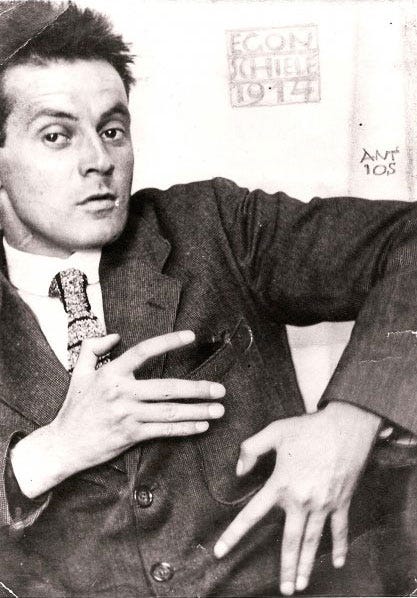
Egon Schiele
The pupil does not merely imitate the teacher. He reveals what he understood the teacher to have taught.
This piece is not another Klimt reading. It is a test of the readings already made.
The Klimt cycle has proposed an iconographic register in which the robed vertical male carries mortality into the embrace, the Christian symbolic vocabulary is retained while its consolations are withheld, and the painter has identified himself with the Fall agent who brings death into the act of love. The readings have been interpretive claims about what Klimt encoded under gold and ornament.
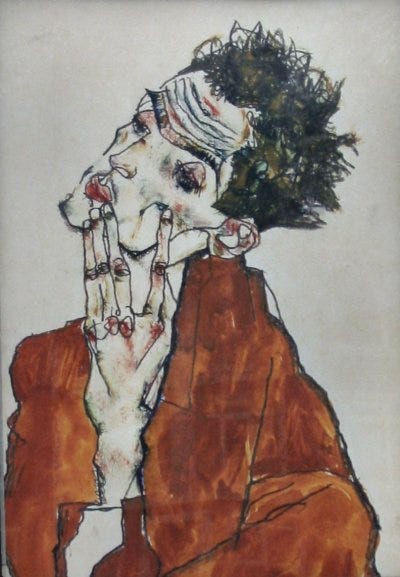
Egon Schiele: Self-Portrait
Schiele is the cycle’s contemporaneous confirmation. Klimt supported him, introduced him to patrons, exchanged drawings with him, and treated him as one of the most important younger artists around him. What Schiele appears to have seen in Klimt’s paintings, he painted himself, with the gold removed and the iconographic identifications made textual. Two of his major works render the cycle’s readings explicitly: Cardinal and Nun (1912) and Death and the Maiden (1915). Both were painted in Vienna while Klimt was active.
The argument moves backward from fruit to tree. The cycle’s reading of Klimt produces a prediction: if the iconographic register is in Klimt’s paintings, the painter closest to Klimt should render the same register when he paints. The prediction is testable. Schiele’s work does not prove every hidden intention behind Klimt’s paintings, but it strongly corroborates the register the cycle has been tracing.
This does not require Schiele to have written the cycle’s argument in prose. Visual inheritance rarely works that way. The point is not that Schiele decoded Klimt as a critic. The point is that he inherited the grammar deeply enough to show what its figures were capable of becoming once the decorative alibi was removed.
Cardinal and Nun
The painting is dated 1912, four years after The Kiss. Two upright figures embrace against a dark field. The male wears the red biretta and red robe of a Catholic Cardinal. The female wears the black habit of a Nun. Their bodies are elongated vertically. Their robes flow downward across the lower half of the canvas. The compositional citation of The Kiss is direct.
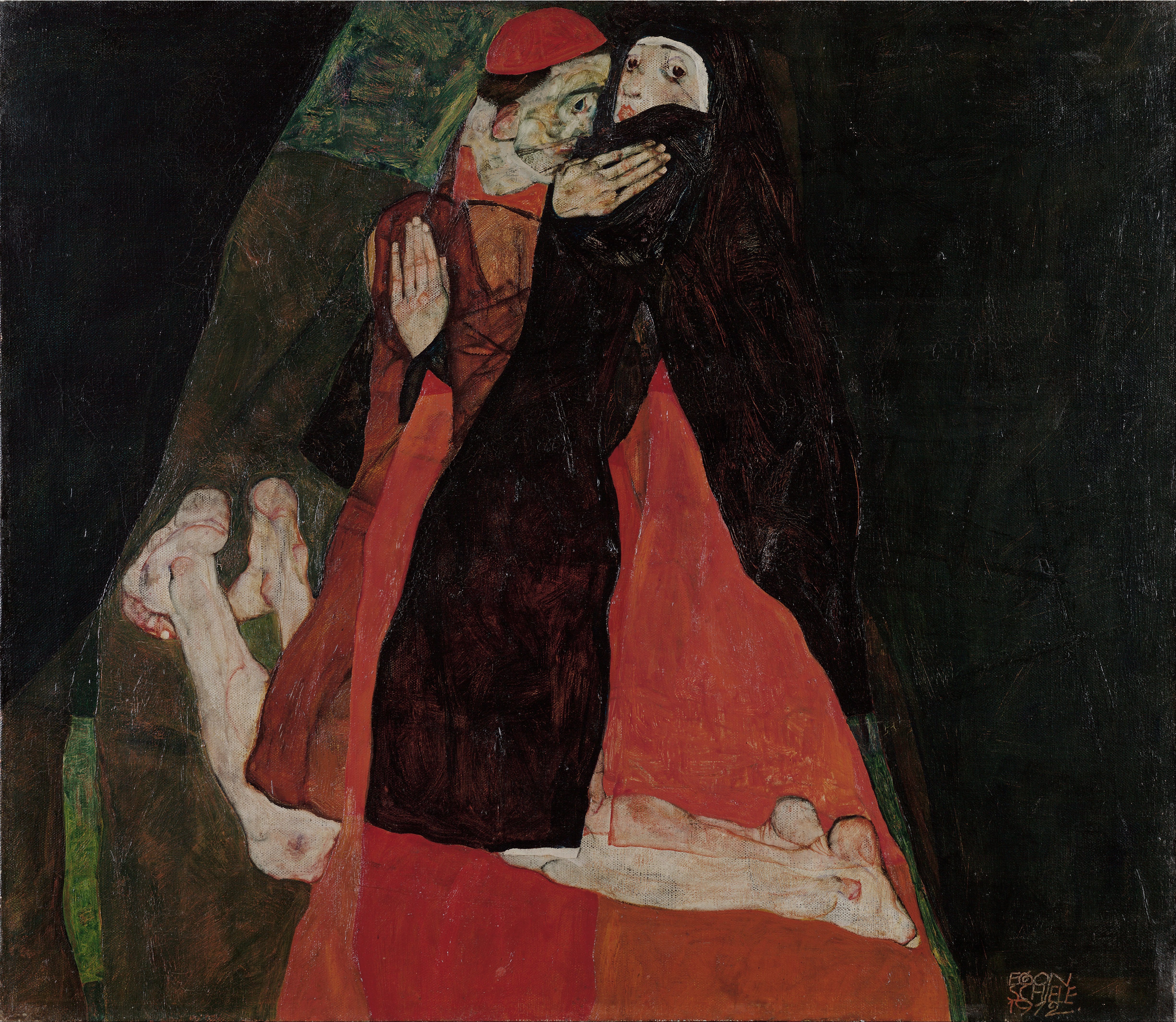
Schiele has done two things to Klimt’s painting. He has removed the gold. He has identified the figures by name.
The gold in The Kiss is the surface treatment that allows the upright reading to feel like consolation. Strip the gold and what remains is the dark robed male and the more colorful female in an embrace at a threshold. Schiele’s painting is The Kiss with the gold stripped. The dark field replaces the flowered ground. The figures are also identified. The male is no longer merely priest-like. He wears the Church’s office. The female is the vowed bride of Christ. The embrace is canonically impossible. The Cardinal cannot embrace the Nun. Schiele has painted the iconographic impossibility and made it the subject.
The cycle’s reading of the Kiss male as the priestly figure who carries mortality into the embrace is here rendered textually. The male in the embrace is a priest. He wears the Church’s office. The act he commits is the act his office forbids. The bivalent religious-erotic reading the cycle proposes for The Kiss is close to what Schiele appears to have seen in Klimt’s painting and made the subject of his own.
The Cardinal’s right hand
The Cardinal’s right hand is below the Nun’s mouth, pointing directly into her throat. Her lips are visible above his hand, pressed tight in a thin line. The hand occupies the throat. It is not merely near her face; it presses into the anatomical site of speech and breath.
His other hand is behind her shoulder, pulling her body in. The two gestures divide the act into its two operative parts: choking and possession. Schiele has painted not an erotic transgression entered into mutually but religious-institutional coercion. The Cardinal’s hand occupies the Nun’s throat with one hand while pulling her into the act his office forbids with the other.
The Nun’s lips are tight. Her eyes look past the Cardinal at the viewer. Her gaze is direct and dark. She is not looking at him. She is looking at us, because she cannot speak. The throat-grip has taken speech before she could cry out. The viewer becomes the only available witness because the female has been silenced at the site of the cry.
This is the upright Kiss reading made textual. In Klimt’s upright Kiss, the male’s right hand is at the female’s jaw and the carotid, in the hand-at-throat gesture the cycle develops in detail in The Toppled Pillar. The gold and flowers and surface treatment soften the gesture so that first-look viewers read the hand as cradling. Schiele’s Cardinal performs the same gesture without the softening. The Cardinal’s hand occupies the Nun’s throat openly. The Kiss male grips Eve’s throat under gold. Same gesture, same orientation, different surface treatment.
The red field beneath the Nun
The Cardinal’s red is not contained to his upper body. The robe flows downward and outward across the lower canvas, extending well beyond his own silhouette. The Nun’s black habit sits within the spreading red field. She is not painted on neutral ground. She is painted on the ground that is the Cardinal’s robe.
The red the Cardinal brings is iconographically loaded. In Catholic visual vocabulary, the Cardinal’s red traditionally signifies readiness to defend the faith even to the shedding of blood. Schiele places that color, that office, and that implied blood beneath the female whose throat the Cardinal’s hand occupies. The blood-color of ecclesiastical office spreads around the body whose throat he holds.
The Nun has no red on her own. Her habit is black. Her face is pale. Her own iconographic vocabulary before this encounter is monochromatic and chaste. The red is what the Cardinal brings to the meeting. The red is what the meeting places beneath her.
Whether the painting depicts this as the visible fact of the Cardinal’s robe (he is robed in red, the robe is large, the red extends), or as the iconographic announcement of what the encounter is producing (the red is spreading because blood is being shed, the field is filling because the act is occurring), Schiele does not resolve. The painting holds both readings and tilts toward the bloodfield reading without committing.
The pale figures at lower left
Bare legs and feet are visible beneath the lower edge of the red robe, partly outside the picture’s main field. These are bodies. The detail should be handled cautiously. The forms are legible as exposed bodily remnants, but their exact narrative status is not clear. What matters for this reading is their placement: pale flesh lies below the robed embrace, at the edge of the pictorial field, within the spreading red field, as if the erotic-sacred action has already produced bodily remainder.
This is structurally consistent with Klimt’s Death and Life: the embrace at the top, the human flesh below, the iconographic substance of mortality in the field. Schiele has compressed the Kiss and Death and Life iconography into one painting.
Death and the Maiden
The painting is dated 1915. Klimt was revising Death and Life in these same years. Both painters were working on the same iconographic problem at the same time.
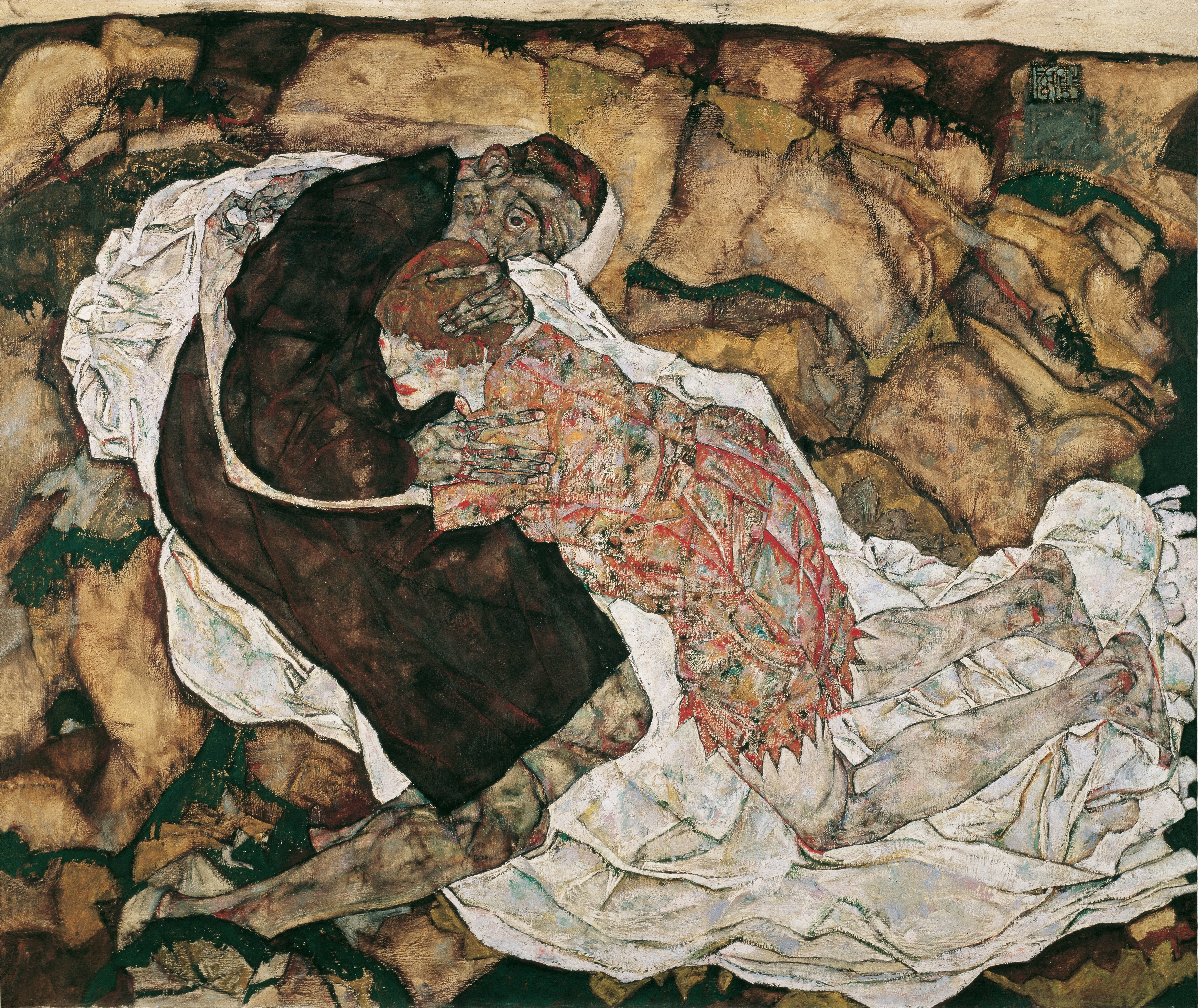
The male figure is identified as Death by the title and by his gaunt face, wide staring eyes, and dark monastic robe. He is also identified as Schiele himself. The face is the documented Schiele self-portrait face. The female is widely identified as Wally Neuzil, Schiele’s lover and model for years, whom he abandoned shortly before painting this in order to marry Edith Harms. The painting is a self-portrait of the painter as Death, embracing the woman he is leaving.
This is the precise iconographic move the cycle attributes to Klimt in The Kiss. Schiele has done it without the surface treatment. He has painted the male figure as Death, identified the painter with Death, and depicted the embrace as the moment of separation that the embrace itself produces.
Every embrace ends. Schiele’s painting makes that ordinary fact brutal: the male figure who embraces is also the figure who separates, abandons, consumes, or takes away. Klimt’s own biography may intensify the problem, but the argument does not depend on biography. The paintings themselves repeatedly place the male artist-figure inside the embrace as the bearer of mortality.
Death’s mouth on the Maiden’s head
The mouth is close enough to the crown of her head to make the kiss unstable. It can be read as a kiss. It also begins to read as a bite. Schiele leaves the gesture at the point where consolation and consumption become hard to separate. The face is pressed against her hair. The eyes stare past her into the middle distance.
This extends the cycle’s iconographic vocabulary. Klimt’s Death in Death and Life holds an instrument that reads as both blessing and blow. Schiele’s Death holds the Maiden in a posture that reads as both consummation and consumption. Same iconographic technique. Same bivalence. The instrument and the bite are the same iconographic gesture in two registers.
The Maiden’s body
She clings to him. Her face is pressed into his chest. Her hands grip his shoulders. Her cling does not resolve the painting into mutual tenderness. It reads as dependence after resistance has failed, or as the terrible intimacy of a body holding the figure that is also taking it. Her posture is collapsing rather than embracing. The body is going down into the embrace, the strength failing, the legs no longer holding her upright.
Her wrap is densely marked with red slashes. The painting does not resolve whether the marks are the dress’s design or whether the dress is white and the marks are blood from lacerations through the cloth. No alternative dress pattern is visible underneath the red. The viewer can read the marks either way.
What the painting does establish: her knees and ankles are red on the skin, at the joints that contact the ground. The localization at the contact points reads as wounds from kneeling, falling, struggling, or being dragged. Once some of the red on the figure is read as wounding, the rest becomes harder to read as decoration. The Maiden’s body suggests a body that has been hurt. Whether her collapse into Death’s arms is from fatigue, blood loss, injury, or some combination, the painting does not say. It suggests all of them and resolves none.
The Kiss female’s garment carries red blood cell forms as ornament. The Maiden’s wrap carries red marks the painting will not let the viewer disambiguate. Klimt makes the wound reading available only to careful viewers. Schiele makes the ornamental reading available only to viewers who insist on it. Both painters render the same iconographic substance through the same bivalent structure. Schiele has tilted the balance toward the wound reading without committing to it.
The bed-shroud surface
The figures lie on a white sheet that reads as either bed or shroud. Schiele has placed the embrace on the surface that holds the body during sex and during the laying-out of the corpse. The bivalence the cycle identifies in Klimt’s iconography is here rendered as the surface beneath the figures. The white sheet either catches a body sinking from exhaustion or catches a body sinking from blood loss. The painting does not say which. Both readings deliver the same descent.
The landscape is desolate, brown, organic-but-dead. No flowered ground. No architectural frame. This is what Klimt’s Kiss looks like after the gold is stripped and the flowers die and the cliff edge gives way.
The Shared Iconographic Vocabulary
Klimt and Schiele are painting the same register. The vocabulary is consistent across both painters.
The robed vertical male appears in Klimt across The Kiss, Fulfillment, the Stoclet program, and Death and Life. He appears in Schiele as the Cardinal and as Death. Both painters dress the figure in religious or quasi-religious garments. Both have the figure carrying mortality into the embrace.
The female counterpart is Klimt’s kneeling woman in The Kiss, the recipient in Fulfillment, the Stoclet bride, and the human witness in Death and Life; in Schiele she becomes the Nun and the Maiden. Both painters render her as the figure being approached, controlled, silenced, or consumed.
The neck as load-bearing site. Klimt stages the body’s vulnerability at the neck across First Love, The Kiss, The Toppled Pillar, and Death and Life. Schiele renders the same site openly. The Cardinal’s hand occupies the Nun’s throat. The Klimt male’s hand is at Eve’s throat under gold. Same anatomical site, same gesture, same orientation, different surface treatment.
The religious garment on the figure of mortality. Klimt’s Death wears the cross-marked robe. Schiele’s Death wears the monastic black. The Cardinal wears the Church’s red. Both paintings ask the viewer to look at the Christian symbolic vocabulary and notice that it is on the body of death rather than in the hands of the living.
The painter as the figure of death. Klimt’s robed male has the thick neck, forward head posture, and working smock of Klimt himself. Schiele’s Death has the documented Schiele self-portrait face. Both painters have identified themselves with the male figure who carries mortality into the embrace.
The withheld consolation. The Cardinal wears the Church’s robes and occupies the Nun’s throat. Death wears the monastic robe over the body he is consuming. The robe is intact. The vow is broken. The promise is absent.
The Color Argument
Klimt and Schiele operate at opposite ends of the color spectrum and produce opposite alibi structures.
Klimt’s gold contains and conceals. The gold field around the Kiss couple, the gold robe of the male, the gold of Adele Bloch-Bauer’s portrait, the gold halo over the 1911 Death: all are the iconographic alibi that softens what the painting is doing. The gold absorbs the iconographic substance and presents it as ornament. The throat-grip reads as cradling. The cemetery grid reads as decoration. The red blood cells on the Kiss female’s garment read as patterned design. The viewer who accepts the gold accepts the consolation.
Schiele’s red carries and exposes. The Cardinal’s red field surrounds the Nun he is gripping. The Maiden’s red slashes mark her wrap. The bed-shroud surface receives what the encounter produces. Schiele’s red is the iconographic admission of what Klimt’s gold conceals. The alibi structure remains: the Cardinal is just wearing his office, the Maiden’s dress is just decorated. But the alibi is thin. The red dominates the canvas in a way Klimt’s red never does. The viewer who accepts the alibi must work to hold the iconographic substance at bay.
Across the three paintings the alibi gets progressively thinner. Klimt’s gold-and-flowers makes the red almost invisible as iconographic content. The Cardinal’s red field makes the red dominant but officially explained. The Maiden’s wrap makes the red dominant and almost unexplained. The painters operate the same iconographic technique at different settings. Klimt’s gold is the consolation that says nothing is wrong. Schiele’s red is the threat that says everything is wrong, with a thin alibi for viewers who insist on it.
Klimt gilds the event. Schiele reddens it.
Schiele’s Hands
Klimt resolves the body into surface. Hands in The Kiss disappear into hair and gold. Hands in Judith disappear into pattern and the severed head. Hands in the Stoclet figures pass into the ornamental field that surrounds them. Klimt’s hand vocabulary is absorptive. The hands serve the larger decorative argument and recede into it.
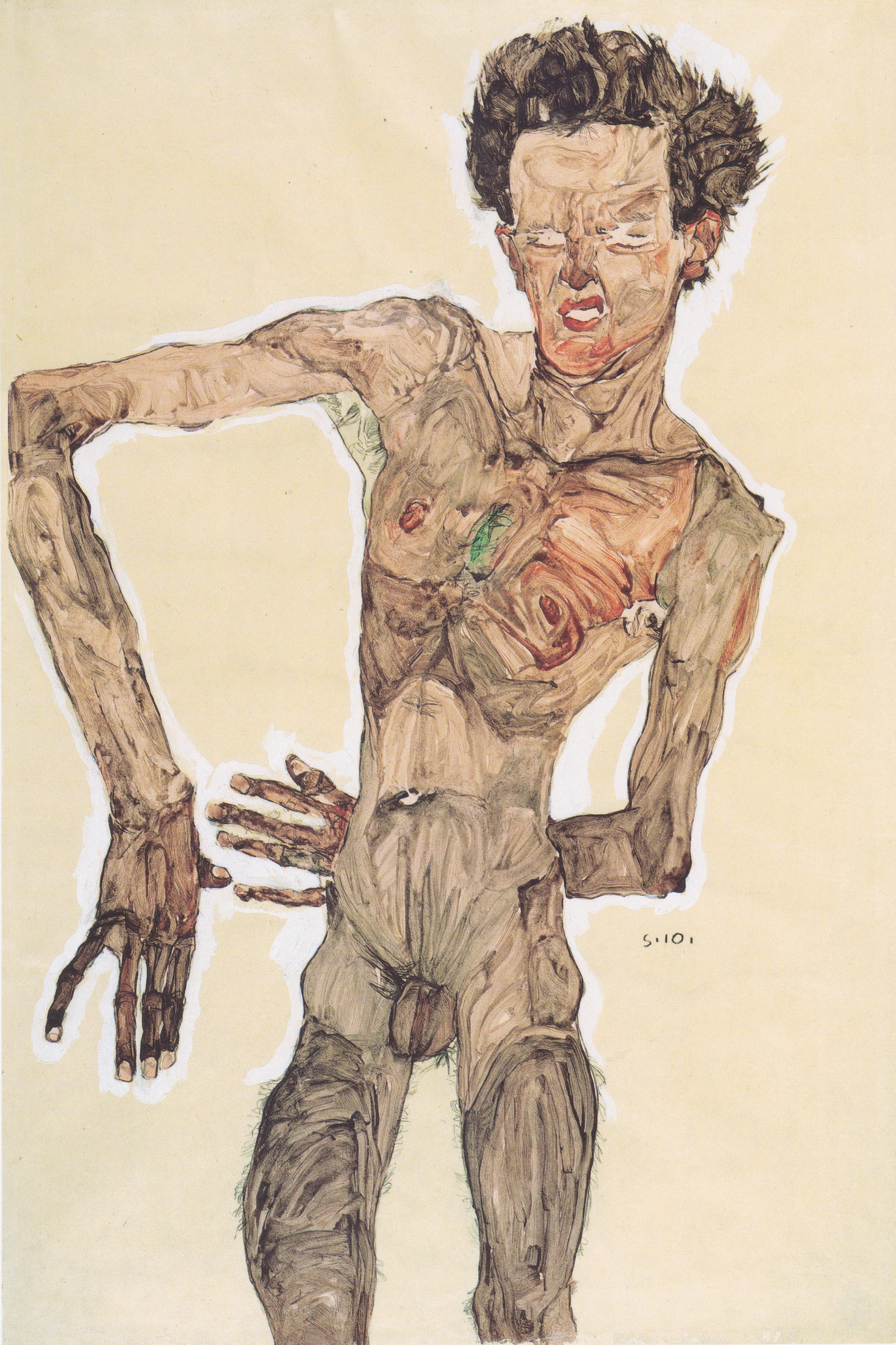
Schiele inverts this. His hands refuse absorption. They splay, point, hang dead at the wrist, press flat against the body, hold up signs. They remain individuated against any decorative field the picture might offer. In Self-Portrait with Striped Armlets (1915) the two hands are catalogued independently like anatomical specimens, one raised in a stop-sign posture, one splayed wide at the lower right. In the 1910 nude self-portrait the right hand drops like a marionette’s after the string slackens.
Across the body of work the same vocabulary recurs. Raised hands resemble benediction without blessing. Crossed hands resemble prayer or oath without devotional lift. Spread fingers resemble priestly or magical signs without liturgical office. The hands remember sacred form and cannot deliver sacred function. They carry the iconographic charge that ornamental enclosure carried in Klimt. In Schiele, the hand becomes the place where the lost ritual reappears as bodily disturbance.
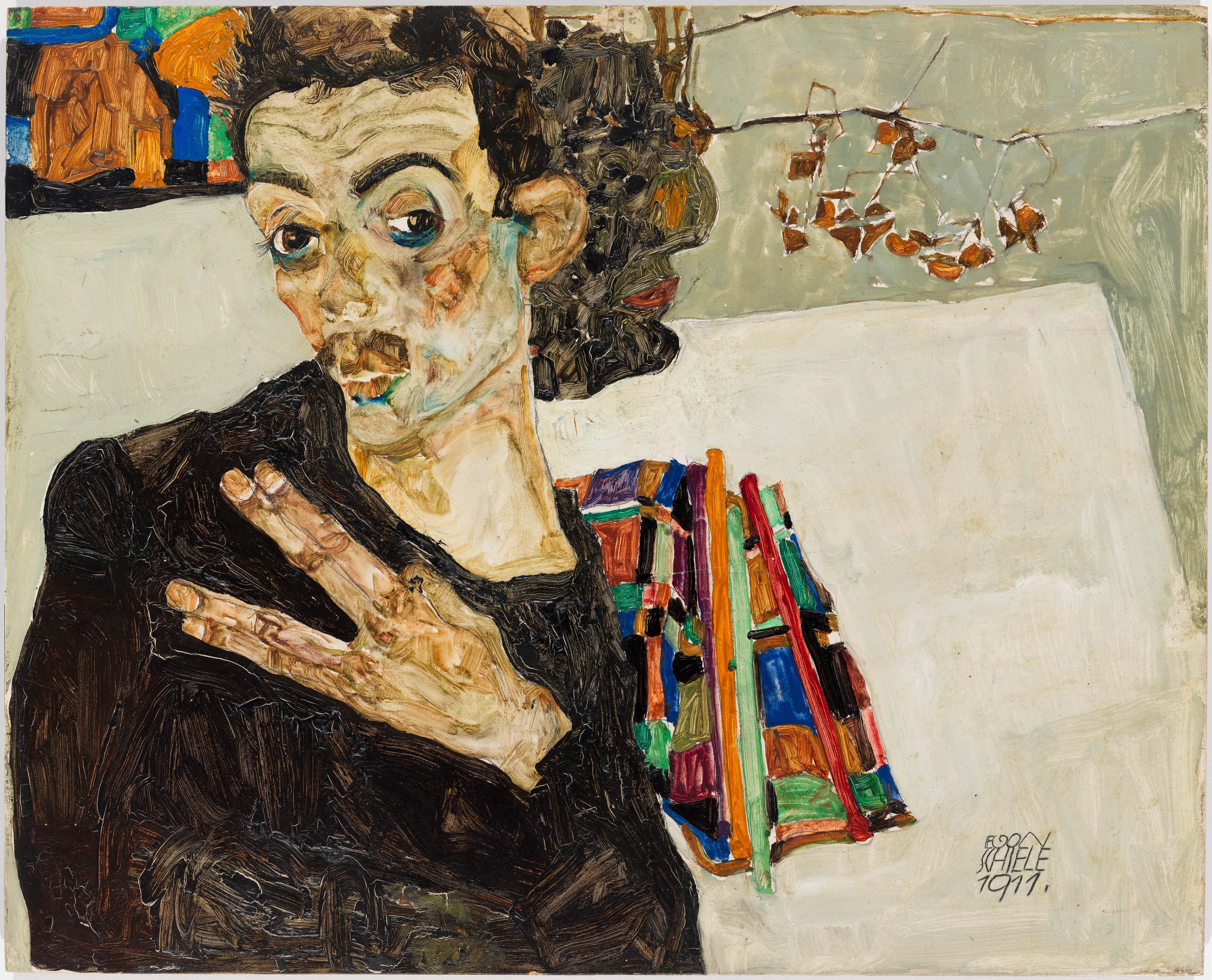
The pupil’s revision is not rejection. Schiele preserves Klimt’s premise that the body is a symbolic field. He removes the gold, the pattern, the embrace, the enclosure that lets the symbolism settle into ritual. What he leaves is the body as exposed sign without context, and the hands as the residue of the ritual that has been stripped away. The teacher’s saturation becomes the pupil’s dismemberment.
What the Pupil Saw
Schiele matters because he removes the alibi. Klimt’s alibi is beauty: the gold field, the floral surface, the titled kiss, the decorative public object. The alibi softens the throat-grip into a cradle, the cemetery grid into ornament, the Fall into a tender embrace. Schiele keeps the structure and thins the alibi. The priest is named. The nun is named. Death is named. The maiden is named. The shroud is visible. The hand is at the throat. The red is the field beneath the female. What Klimt allowed the public to mistake for beauty, Schiele forces the viewer to see as event.
This is why the cycle’s reading of Klimt is supported rather than weakened by being interpretive. The interpretation is not the imposition of a reading onto a tender embrace. The interpretation is the recovery of the event that Klimt’s alibi was designed to obscure. Schiele’s paintings are the strongest contemporaneous evidence that this event was visible within Klimt’s visual grammar.
The pupil saw what the master encoded. The eye Klimt installed on the Stoclet walls had been installed first in his own studio, in the figure of the younger painter who watched the master work. Schiele looked at Klimt with the eyes the cycle reads as the post-Fall vision of Genesis 3:7. The pupil is the eye. The eye saw. The seeing became the painting.
The fruits
Klimt’s paintings are the tree. Schiele’s paintings are the fruit. The fruit does not prove every hidden intention of the tree, but it tells us what kind of life was moving through it.
The cycle’s argument is therefore not merely the projection of a later reader onto Klimt. Schiele was close to Klimt, worked in his shadow, inherited his visual grammar, and rendered the same erotic-sacred-death structure with the gold removed and the red exposed. The Cardinal’s hand occupies the Nun’s throat inside a field of his own red. Death holds the Maiden as she collapses. The painter becomes the figure who takes what he embraces.
The gold was the surface treatment. Underneath were the cemetery, the throat, the silenced witness, the cross on the body of Death, the red beneath the female, the slashes on her clothing, and the painter holding the body he is also taking.
By their fruits ye shall know them.