
The Kiss as Embedded Protoevangelium

A reading by inversion
Turn the most reproduced painting in the world upside down.
That is the whole method of this essay. Klimt painted The Kiss between 1907 and 1908. It hangs in Vienna at the Belvedere, and in the century since it has been printed and hung and worn more than any other canvas of its era. Everyone has seen it. Everyone has seen it one way.
The orthodox reading treats The Kiss as a sacralized embrace: lovers turned into icons by gold and gesture, the centerpiece of the gold period, Klimt’s attempt to make human love holy. That reading is correct as far as it goes. It is also incomplete. The same canvas holds a second iconographic structure inside its compositional geometry, accessible only by inversion. The same figures, the same gold leaf, and the same scatter of flowers read as the Fall in the orientation we are used to, and as the Resurrection when the painting is turned on its head.
My claim is that The Kiss is a protoevangelium painting in disguise, and that Klimt built it that way on purpose. Whether he did is the question the essay arrives at, not the one it starts from. The argument starts with the canvas. The structure is in the canvas, it can be measured, and it organizes the painting’s iconography in a way the standard reading has not.
The instinct’s first application to Klimt is the entry piece of this cycle, Klimt’s First Love, which reads the 1895 Love as the system’s earliest legible form, twelve years before the canvas in front of us. This essay turns the instrument on the famous one.
So stand it on its head, and look.
The canonical view
Anyone who has seen the painting before will recognize the canonical orientation at a glance. The two figures kneel in the lower right of the canvas, at the edge of a small flower meadow. The meadow drops off into the vast gold field that fills the rest of the painting. A single gold mantle wraps both figures and rises around them. The man is taller. He leans over the woman with his face pressed to her cheek. She tilts her face up to receive the kiss. Her eyes are closed and her body is slack. His robe is patterned with black-and-white rectangles. Hers is patterned with circles and ovals that read as flowers. Their two heads sit at the top of the figure mass, ringed by gold haloes. Her bare feet are curled at the cliff edge.
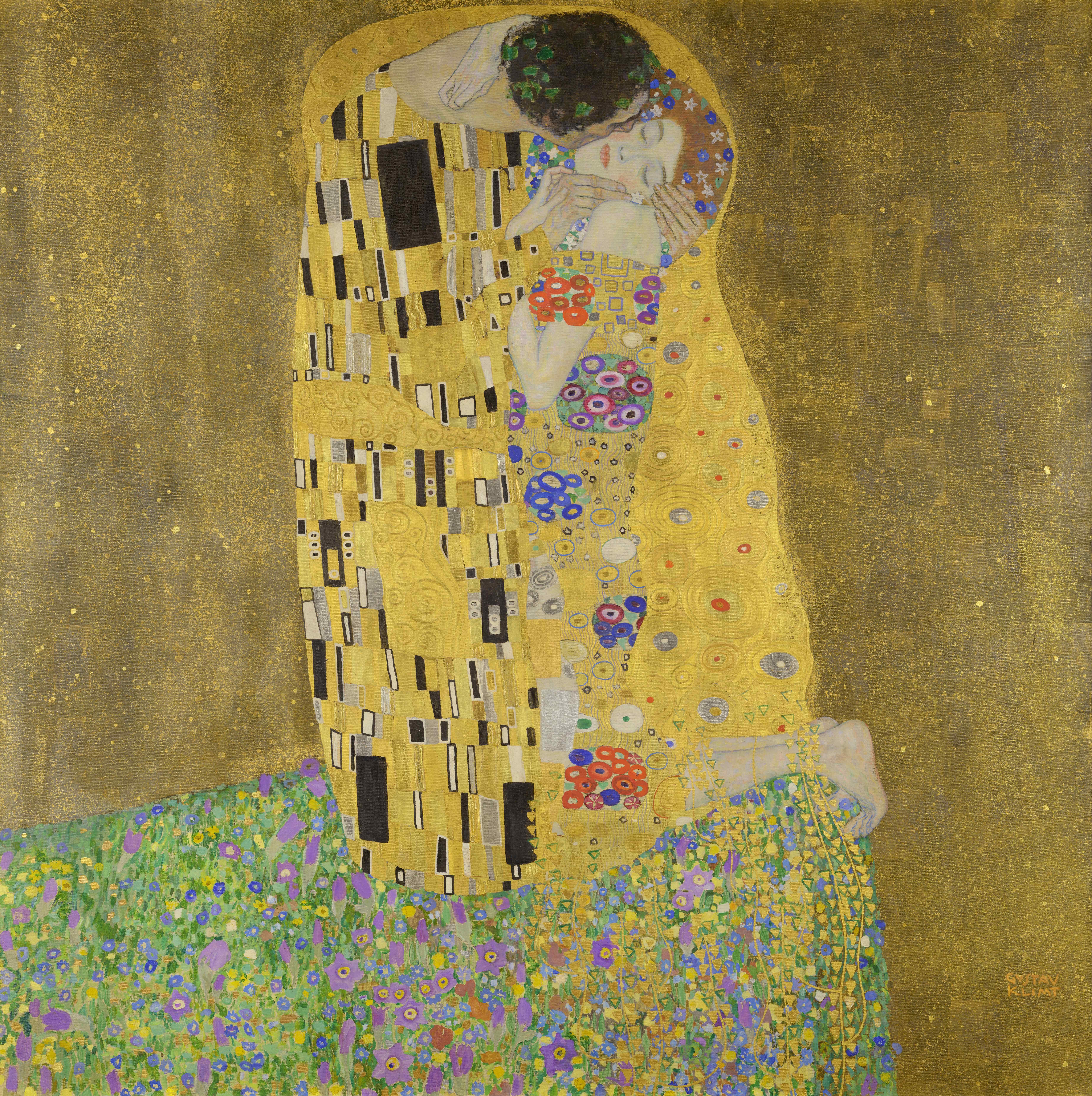
In this orientation the painting reads the way the standard interpretation says it does. The lovers are consecrated by gold. The embrace is iconic in the Byzantine sense, drawing on the mosaics Klimt studied in Ravenna in 1903. The meadow is paradise. The figures are joined.
That is the reading most viewers carry away. It is not the only reading the painting will support, and the rest of this essay is about the other one.
The Fall in plain view
Before turning the canvas, look at what is already there. Several features of the painting in its standard orientation point to a Fall reading on their own, no inversion required.
The man bends over the woman from above. That is the posture of a serpent striking down from a tree. Look at his hair. It coils, sinuously, in dark masses that read as snake before they read as hair. The Edenic serpent is in the painting if you let yourself see it.
The iconographic move is twelve years older than the canvas. In Love (1895), the male already emerges from a dark mass of roses behind the reclining female. The 1907 canvas relocates the dark serpentine field from the surround onto the male's head.
Look at his neck. It is thick and craning, disproportionate to the head. Klimt could draw normal proportions when he wanted to. The male in The Kiss does not. The neck does the same iconographic work the hair does, applied to a second feature of the same figure.
The woman’s pose is troubling. Her head has fallen back at a sharp angle. Eyes closed, mouth slack, no muscular resistance in the body anywhere. Art historians have argued for a long time over whether the pose reads as ecstasy or as unconsciousness. They have not settled it. The same pose appears in Pietà compositions, where the dead Christ’s head falls back over the supporting arm of the Virgin. Corpse, swoon, ecstasy, violence: the pose accommodates them all. Klimt offers no resolution. The viewer chooses.
The man’s hand on the woman’s face is, geometrically, a hold. The fingers sit near her throat. You can read the gesture as tender or as controlling. The painting will not decide for you. But once you have seen the throat, the painting does not let you stop seeing it.
The hand position is anatomically precise. The fingers extend along the lower jaw and the upper neck below the ear, at the carotid location. The body shows no willing tension anywhere. The head has fallen back at an angle that requires either applied pressure or an unposed slackening of the kind seen in unconscious or dying bodies. Klimt has rendered the hold with anatomical accuracy that the standard cradling reading does not accommodate. The iconographic site was already active in 1895. Love covers and stresses the same throat under a high white collar; the 1907 canvas replaces concealment with applied pressure at the carotid. The Toppled Pillar piece in this cycle develops the throat iconography across the corpus. For present purposes, the hold belongs to the Fall reading.
The feet are the detail most often noted by critics. The toes curl and grip the edge of the meadow where it drops off into the gold void. They are not relaxed. They are tense. The tension at the foot contradicts what the face is doing. She is at a cliff edge. She is about to fall.
Put these four things together: the man bending over the woman from above, the woman slack and falling backward, the hand on her throat, the feet gripping the cliff edge. Even without any inversion, the painting reads as the Fall. Eve is in the garden, embraced by the serpent who has just bent down to her. She has gone slack in his arms. She is about to fall from Eden. The flower meadow she kneels on is paradise. The gold beyond the meadow is what comes after the expulsion.
None of this displaces the orthodox reading. Both readings are available at once. In its standard orientation, The Kiss is a love painting and a Fall painting simultaneously. Klimt does not pick one.
The inversion
Now turn the canvas upside down. A third reading appears, and the iconography reorganizes in ways the standard orientation will not allow.
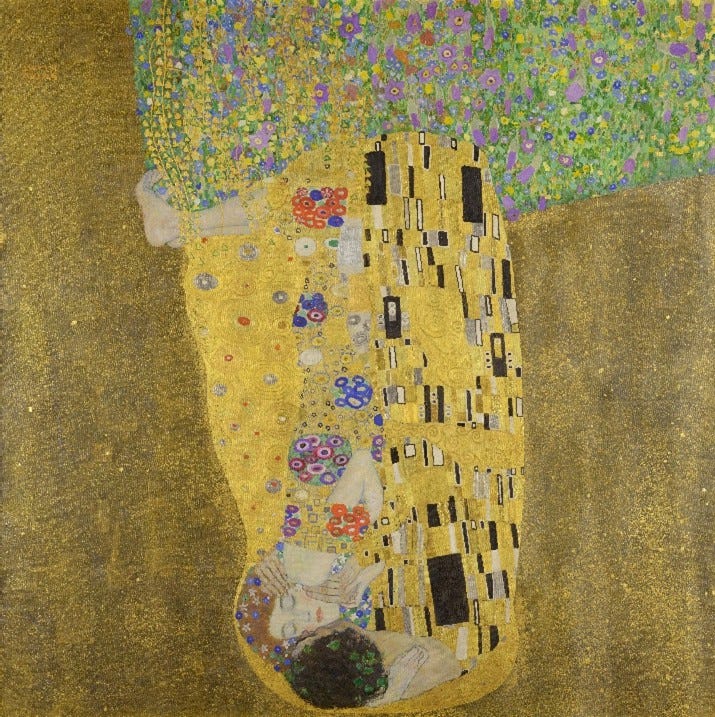
The inversion is not a gimmick. It is legitimate only if the inverted image produces new order rather than mere disorientation. It does. The same features that trouble the upright love reading reorganize into a coherent resurrection structure when the canvas is turned.
The flower meadow that sat in the lower right under the lovers’ knees now hangs in the upper left of the composition. It used to be earth. It is now sky. The vines and lilies and jewel-like blossoms read, inverted, as the regained paradise above.
The gold mantle that rose from below around the kneeling figures now drapes from above like a canopy. The silhouette has not changed. Its directional meaning has been flipped. The rising halo becomes a descending shroud. More accurately: it becomes a tomb. The rectangular grid that decorated the man’s robe is no longer fabric. It is masonry now, stone tiles, the wall of a sepulchre. The mantle inverted reads as an arched vault.
The figures, formerly upright, hang head-down. Their heads, which had been the highest point of the figure mass, are now the lowest. Their feet, which had been at the bottom, gripping the cliff edge, are now at the top, near the boundary with the garden above.
The absence or obscuring of the ascending Christ’s head is not iconographically anomalous. Medieval Ascension images often show only Christ’s feet and the hem of his garment disappearing into cloud; later artists such as Rubens and Dalí likewise emphasize the upward-passing body from below while withholding the face. The inverted Kiss therefore need not fail as an Ascension image because the head is visually unavailable. On the contrary, the covered or absent head belongs to a long pictorial grammar of ascent: Christ is shown precisely at the threshold where the visible body is being withdrawn from sight.
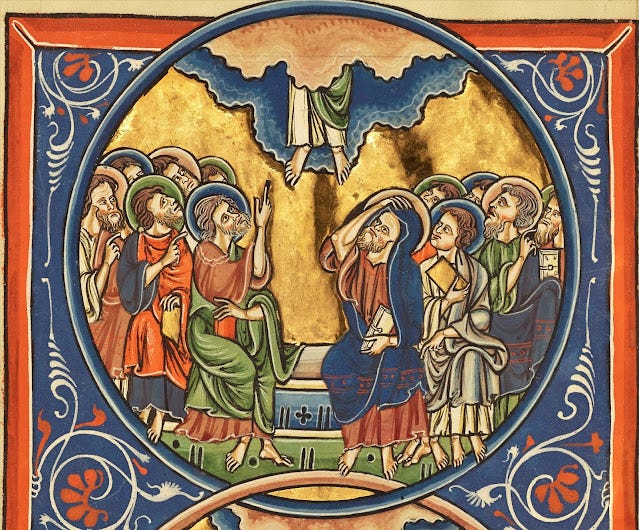
Ascension
from the Psalter of St. Louis and Blanche of Castille
French (Paris), c. 1225
Paris, Bibliotheque nationale de France
MS Arsenal 1186, fol. 27v
The mantle has fused the two figures into one silhouette. Klimt does not give the viewer two outlines. He gives one bounded mass with two heads inside it. Turned upside down, that mass rises from the lower part of the frame. The two painted heads are at the bottom. The body fills the mantle. The head of the singular new figure ascends into and penetrates the Edenic field, regaining it.
In the canonical view, the man’s dark hair only suggested a serpent. Inverted, it stops suggesting and starts declaring. A coiled, dark mass sits at the very bottom of the painting, beneath the rising body. The serpent’s head is positioned exactly where the heel of the ascending figure would come down on it. The painting renders Genesis 3:15 as geometry.
Genesis 3:15: “He shall bruise thy head, and thou shalt bruise his heel.” The inverted Kiss makes that verse visible in the painting’s geometry. The body ascends. The woman’s foot and hand reach into the garden above. The mantle runs from the garden down to the painted heads at the bottom. At that lowest point, where the rising body would plant its feet, the serpent’s coil is being crushed.
The geometric move is twelve years older than the inversion. Klimt's First Love identifies the same verse installed as spatial geometry in the 1895 Love, where the infant in the upper register sits directly above the head of the male figure who emerges from the roses below. The seed-above-serpent relationship is installed in the canvas as painted, without requiring inversion; the 1907 canvas develops it into the bivalent toggle.
Inverted, the painting is the Resurrection. The body was pressed into the tomb of the gold mantle. It was crushed in the press. It is now rising. The garden above is Eden regained. The serpent at the bottom is the adversary, his head about to be bruised by the heel of the ascending Christ.
Same painting. Same figures, same flowers, same gold. In one orientation it reads as Fall. In the other it reads as Resurrection. Only the direction has changed. The painting is bivalent at the level of its geometry, and the bivalence is exact.
The cross
There is more.
Look at the inverted view again, this time for the compositional axes. The painting is organized by two perpendicular lines: one vertical, one horizontal. The canonical view contains the same lines, but they are harder to see there.
The vertical runs through the figure mass at the seam where the man’s rectangular-pattern cloak meets the woman’s circular-pattern cloak. The seam is not decorative. It is the line where the two bodies fuse into one silhouette. The vertical axis is the spine that joins them.
The horizontal runs across the canvas at the boundary between the gold field and the flower meadow. The boundary is not decorative either. It separates the gold of Byzantine sacred light from the earthly garden of paradise. The horizontal axis is the threshold between heaven and earth.
The two lines cross. In the inverted view, the intersection occurs at the upper boundary of the mantle, where the figure breaches into the garden above.
The result is a Latin cross. The vertical’s long arm runs downward through the figure mass and terminates at the painted heads and the serpent. The short arm runs a little way upward into the meadow above, where the foot breaches the garden. The horizontal arm runs the full width of the canvas. The proportions are those of a traditional Latin cross, the lower portion roughly four to five times the length of the upper.
In the inverted orientation, this is the standard cross. Long arm down, short arm up. The same orientation found on every crucifix in every church in the Western tradition.
Rotate the painting back to the canonical orientation. The axes do not move. The seam is where it was. The meadow-gold boundary is where it was. The cross still runs along the same two lines. But now the long arm points up and the short arm points down. The cross has inverted.
The Petrine cross. The upside-down crucifix. In the older Christian tradition it carries the Petrine humility reading: Peter requested crucifixion upside down on the ground that he was unworthy to die as Christ had. In modern popular reception it has become the satanic inversion. The symbol is bi-valent. The Kiss disambiguates via context. In the canonical orientation, the painting’s governing cross-form is inverted within a composition saturated with Fall iconography: serpentine hair, hand at the throat, slack body, feet at the cliff edge. In this context the inverted form reads as the Fall configuration, not as Petrine humility. The Latin cross that appears under inversion does not carry the same ambiguity.
In its canonical orientation, The Kiss has an inverted-cross structure built from the seam where two bodies merge and the threshold between heaven and earth. Rotate the canvas and the cross becomes upright. One hundred eighty degrees of rotation takes the painting from the inverted cross to the Latin cross, and from the Fall to the Resurrection. The two toggles are the same toggle.
The geometry and the iconography are saying the same thing. The Fall reads through an inverted cross. The Resurrection reads through an upright cross. One canvas holds both. The hinge between them is a half-turn.
The horizontal as composite
The cross geometry has a feature that ties The Kiss directly to the Beethoven Frieze of 1902. The horizontal beam of every cruciform Klimt rendered is composed in part of a human limb.
The Knight on the left wall of the Beethoven Frieze stands armored and cruciform, with his sword held horizontally at the waist. The horizontal beam of his cross is composite. Half is the Father’s armored arm holding the sword. The other half is the suppliants’ bare arms reaching upward from the kneeling figures below. The cross is built from two figures meeting at the body of the Knight. The divine half and the human half together complete the crossbar. The composition borrows the logic of Chalcedonian union without stating it doctrinally.
The upright Kiss carries a different version of the same rule. Eve’s lower leg, bent and folded at the meadow’s edge, runs along the meadow-gold boundary at the right of the composition. Her leg is the human half of the horizontal. The divine half is absent. The fallen configuration carries only the human limb at the cross beam; the half that would complete the Chalcedonian composite is missing. The cross is incomplete because the union is broken.
The inverted Kiss restores the missing half. In the inverted reading the male figure is Christ, the seed of the woman crushing the serpent at the heel below and rising into the garden above. His arm, wrapped around the female body, lies along the horizontal in the rotated view. The arm is the human limb on the cross beam, but the figure is no longer human only. The same arm that was absent from the fallen configuration is now part of the single body that carries both natures unified. The Chalcedonian composite of the Beethoven Knight, with two figures forming the cross between them, has been compressed into one divine-human figure with the horizontal beam running through his own body.
The progression renders Chalcedon as structural geometry. The Beethoven Knight is the composite cross: two figures, two natures, distinct. The upright Kiss is the broken state: the human limb alone at the cross beam, the divine half absent. The inverted Kiss is the inhabited cross: one figure, two natures, inseparable. The horizontal beam of every cruciform contains a human limb in part. The variable across the corpus is which form the union takes.
The protoevangelium spatially
The full structural identity is now visible.
In the canonical view, the painting shows the Fall. Eve is in the serpent’s embrace at the edge of the Eden cliff, slack and falling. The compositional axes form an inverted cross above the threshold between worlds.
In the inverted view, the painting shows the Resurrection. The body rises from the tomb of the gold mantle. The serpent’s head is crushed beneath the heel of the rising figure. The garden of Eden has been regained as the heaven above. The axes form an upright Latin cross at the threshold the rising body breaches.
Genesis 3:15 is the spatial structure of the painting. The seed of the woman ascends and crushes the serpent’s head at the lowest point of the rising body. The serpent, dying, bruises the heel. Vertical posture, held against gravity, drives the body’s weight through the heel and into the head of the adversary. The cross is built from the spine where the two bodies merge and from the horizon between earthly garden and divine gold. The first announcement of the gospel in Genesis 3:15, the prediction that the seed of the woman would crush the serpent’s head, is rendered in the geometry of The Kiss.
The Garment as Cemetery
The male figure’s robe in The Kiss is built out of a rectilinear grid of dark compartments with smaller bright punctuations, overlaid in gold. The pattern is not generic ornament. It is the same iconographic object Klimt installed as a panel in the Stoclet Frieze, where the curvilinear field of spirals and eyes surrounds a framed rectilinear grid set at the center of the dining-room program. The Stoclet panel reads as a columbarium or burial wall: a grid of compartments arranged in the form of cells holding the dead.
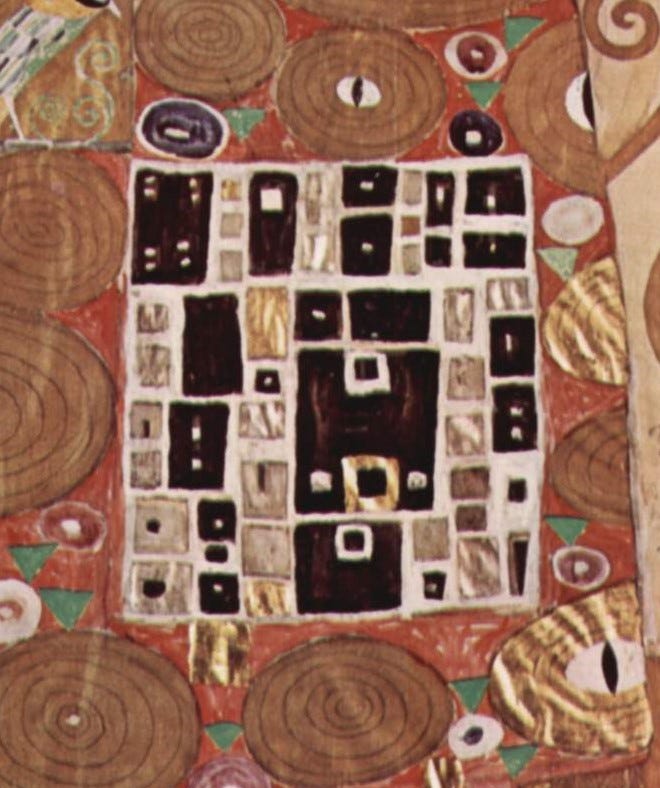
Above: the cemetery grid on the robe of the Stoclet’s Fulfillment male figure.
Klimt has clothed the lover in the cemetery. The gold is the surface treatment that allows the upright reading of The Kiss to feel like consolation. The grid is what the garment was carrying at every viewing. The bivalent reading does not oscillate between two iconographies. It oscillates between two narratives that share the same iconographic substance. The Kiss is mortality in both orientations. The cemetery grid does not change its content when the painting is rotated.
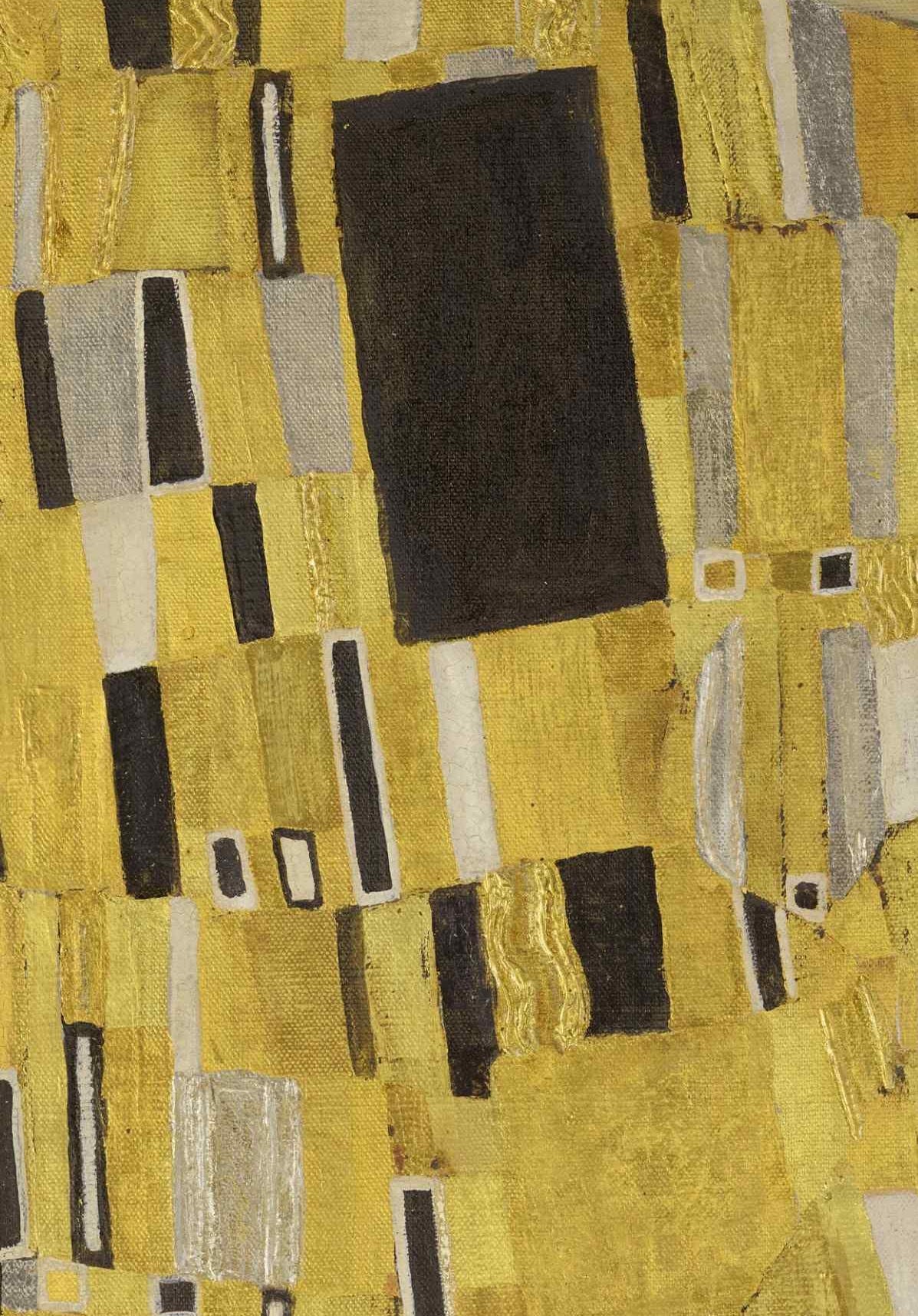
Above: the cemetery grid forms the robe of the Kiss’ male figure
This identifies the male figure with precision. He is Satan at the moment of prevailing over Eve in the garden. He is Klimt himself, in the working smock and forward head posture that recur across his self-portraits. He is the man sexually overtaking the female. He is the man attacking, choking, and wounding the female, with the hand at the carotid and the body slack at the cliff edge in the canonical reading. He is the bridegroom-Fall figure who carries mortality into the embrace because the embrace produces mortality. He is the bridegroom-Fall figure who carries mortality into the embrace because the embrace produces mortality.
The five readings are simultaneous. The figure carries all five at once. Klimt has placed himself into the iconographic role of the Fall agent and painted the role accurately. The painter who fathered fourteen children and lived inside the tangle knew that every act of sexual generation produces a body that will die. He painted that knowledge into the male figure’s garment.
The cemetery grid is the cycle’s load-bearing iconographic object. It appears on the Kiss male’s body and as a panel within the Stoclet program. The pattern carries the same content in both locations: the introduction of mortality into the human story at the Fall.
Strengthening observations
Several other features of the painting strengthen the case once the structural reading is in view.
The cliff edge does iconographic work in both orientations. In the canonical view, it is the edge of the world, the boundary of Eden, the threshold Eve is about to fall past. In the inverted view, it is the horizon of paradise above, the threshold the rising body breaches. The same painted line, doing opposite theological work.
The head positions encode Genesis 3:15 in space. In the canonical view, the man’s dark-haired head sits at the top of the figure mass and the woman’s head sits just below it. Invert the canvas. The man’s head is now at the bottom and the woman’s head is just above. That is precisely the spatial arrangement of Genesis 3:15: the serpent’s head positioned beneath the seed of the woman. The inversion does not create the arrangement. It reveals what was already in the canvas. The spatial diagnostic is consistent across the Klimt corpus. In the Beethoven mandorla of 1902, the male head ascends into the curly golden field at the apex of the composition; the serpent is not present because the configuration is redeemed. In the upright Kiss, the dark serpentine field has been substituted for the curly golden field at the apex; the configuration is fallen. In the inverted Kiss, the dark field moves to the base; the curly bushy meadow moves to the apex; the configuration restores to the Beethoven redemption. The serpent’s position is the iconographic indicator of where in the fall-redemption sequence the canvas sits.
The mantle’s inverted silhouette is Byzantine. The rounded form with the flat base, viewed upside down, echoes the apsidal niche behind altars in the churches Klimt studied at Ravenna in 1903. The shape is ecclesiastical, and Klimt knew it. The Byzantine influence on his gold period is well documented in the scholarship. The structural argument here is that the influence was not only stylistic but iconographic. Klimt did not just borrow gold leaf from Ravenna. He borrowed the architectural geometry of the icon.
The gold leaf itself carries iconographic weight in both orientations. Byzantine icons used gold to denote uncreated divine light, light that does not come from any source within the painted scene but seems to emanate from the painted surface. Klimt’s gold ground places the figures inside sacred space whether the canvas is rotated or not. Both readings, Fall and Resurrection, happen inside that space. The gold is the constant. Only the bodies’ relationship to gravity changes. The painting keeps its theological weight in both orientations because the material does not care which way is up.
The Blood
The red discs on the woman’s dress are stylized red blood cells. Recent work in the Journal of Korean Medical Science (Hong et al., 2025) identifies the donut-shaped patterns on her chest and between her knees as accurate iconographic renderings of erythrocytes under the light microscopy of the period: thick pericellular zone, thin central concavity, the biconcave form visible in Haeckel’s 1903 The Evolution of Man, in Sobotta’s 1902 Atlas and Epitome of Human Histology, and in the blood-corpuscle plates of Meyers Großes Konversations-Lexikon, which Klimt owned. The biomedical register entered Klimt’s working vocabulary by 1903 through Emil Zuckerkandl’s lecture series, which projected lantern slides of stained microscopic samples to the Secession artists at his wife Bertha Zuckerkandl’s salon.
The blood reads in both orientations because the iconographic site is the same site at two different moments in salvation history. In the canonical view, the RBCs sit at the chest and between the legs of Eve at the moment she is becoming the mother of all the living. The blood she will bleed in childbirth and menstruation is rendered as ornament before Genesis 3:16 names the pain that will accompany both. Invert the canvas. The same discs now sit on the body of the ascending Christ at the same anatomical sites. Hebrews 9:22: without the shedding of blood there is no remission. The blood that was drawn at the Fall is the blood that was given at the cross. The bridegroom redeems the bride at the cost of his own life, with his own blood, in payment for the blood spilled when she was consumed. Klimt installed the redemption exchange itself on the body of the figure, at the same iconographic sites, accessible by the same half-turn that toggles every other feature of the canvas.
Displaying the Palm to Thomas
The outstretched hand strengthens the Christological identification in the inverted reading. In the canonical orientation, the woman's arm hangs limp at her side as she is consumed by the serpent, the hand fallen open in the slack posture of a body losing consciousness. In the inverted orientation, the same arm becomes an ascending arm, the fingers pointing upward, the palm facing outward toward the viewer. The gesture matches the Johannine wound-display tradition after the Resurrection. John 20:27 renders the risen Christ extending the wounded hand to Thomas: “Reach hither thy finger, and behold my hands.” The Western iconographic tradition from Byzantine mosaic through Caravaggio's Incredulity of Saint Thomas centers on the displayed palm as the iconographic proof that the body that died is the body that rose. The canvas does not depict Thomas literally, and no distinct nail wound is visible in the palm. The exposed palm functions as the iconographic position of display, the same site where the canonical orientation renders the limp hand of the dying Eve. The bivalence at the hand is exact: dying body and risen body, at the same iconographic location, distinguished only by the orientation of the canvas. The ascending figure is identified not merely as rising, but as the same wound-bearing body that had been crucified.
The Beethoven Frieze
Klimt had already painted The Kiss once. Five years before the freestanding canvas, in the spring of 1902, he made the same composition the closing image of the Beethoven Frieze, installed for the Vienna Secession’s fourteenth exhibition. The frieze was a single integrated work, accompanied by a published program, designed to surround Max Klinger’s polychrome Beethoven sculpture. It traced humanity’s longing for happiness through its struggle with the hostile powers and arrived, in the closing panel, at redemption. The panel takes its title from the Schiller line set in the choral finale of the Ninth Symphony: Diesen Kuß der ganzen Welt. This Kiss to the Whole World.
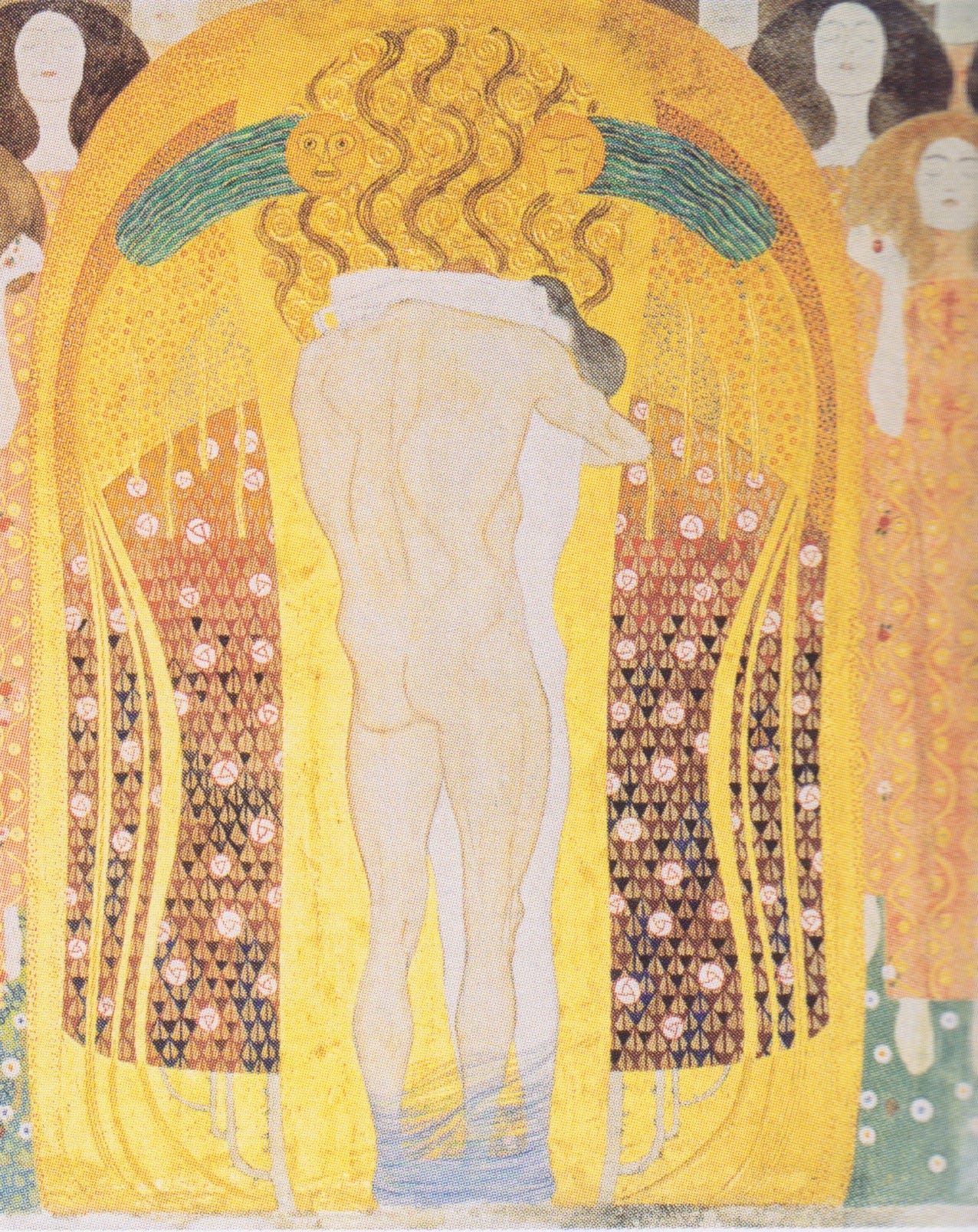
The panel shows two figures wrapped in a single gold mantle inside a gold mandorla. The woman’s head rests against the man’s shoulder. The man’s body shields hers from view. Above the embrace, at the apex of the mandorla, a curly golden field fills the upper composition with two sun-and-moon disc faces installed within it. To either side of the embrace, two vertical decorative columns flank the central pair, dark with white floret circles and downward-pointing triangle patterns. Beneath the figures, stylized blue water.
This is The Kiss five years before The Kiss. The compositional vocabulary is identical: gold mandorla, single mantle, embracing couple, ornamental flanks, gold ground. Three features deserve particular attention.
(1) The figures in the frieze stand on water. Look at the base of the mandorla. The gold dissolves into stylized blue at the figures’ feet. The couple is suspended above the water inside the mandorla, in a region the program identifies as transcended. That is Christ-walking-on-water iconography, attached by Klimt’s own text to the moment of redeemed humanity.
(2) The male figure’s hair in the frieze is rendered as tight curly gold whorls surrounding the head and expanding into the curly golden field that fills the apex of the mandorla. The same compositional feature, the male head crowned with coiled hair, appears in the 1907 canvas. The difference is the color. In 1902 the coils are gold and the curly field extends from the head outward into the cosmic field at the top of the mandorla. In 1907 the coils are dark and read in the canonical orientation as serpentine, and in inversion as the serpent’s head positioned beneath the heel of the rising figure. Same shape, opposite valence.
(3) The vertical flanking columns of the mandorla, with their downward-triangle patterns, occupy the iconographic position that the cherubim of the kapporet occupy in the throne of grace iconography of Exodus 25:18-22. Two cherubim flanking the divine presence, gold throughout. The sun-and-moon disc faces above the embrace are the standard cosmological attendants of Byzantine Crucifixion iconography. The mandorla is simultaneously throne of grace and architecture of the cross, in the patristic typological convergence the Ravenna mosaics teach.
Geometric identity of inverted Kiss and Beethoven mandorla
The deeper relationship between the two works is geometric. The inverted Kiss configuration is identical to the Beethoven mandorla configuration.
In the Beethoven mandorla, the male body rises as a vertical column from the water at the base to the curly golden field at the apex. The bushy flowered field with the sun-and-moon disc faces is sited at the top. The dark base is sited at the bottom. The cosmic-architectural ascent is upward, with the male head plunging into the field at the climactic point.
The upright Kiss reverses this configuration. The bushy flowered field (the meadow) sits at the base under the lovers’ feet. The dark serpentine field (the male’s hair) sits at the top of the composition. The cosmic-architectural orientation is inverted. The serpent has usurped the apex. The bushy flowered field has been demoted to ground.
When the Kiss is inverted, the configuration restores to the Beethoven mandorla configuration. The serpent moves to the bottom. The bushy flowered field moves to the apex. The male body now ascends from the dark base through the figure mass to the bushy flowered field at the top. Same vertical male axis. Same bushy flowered field at the apex. Same dark base.
The diagnostic is exact. The serpent’s spatial position is the iconographic indicator of the fallen versus redeemed configuration. Above the figure (upright Kiss) is the fallen configuration with the serpent usurping the apex. Below the figure (inverted Kiss, Beethoven mandorla) is the redeemed configuration with the serpent crushed.
The 1907 canvas as bivalent-toggled compression
The 1907 canvas was painted without an accompanying text, and the standard scholarship has taken that silence as license to read the freestanding Kiss independently of the frieze. It is hard to defend on the documentary record. The two works share too much. Same artist, same composition, same gold mandorla, same single mantle, same flowers, same Byzantine sacred light, same vertical male axis, same cosmic configuration.
What 1902 makes explicit, 1907 compresses to bivalent toggle. The 1902 panel paints the redeemed configuration with the curly golden field at the apex. The 1907 canvas paints both configurations in one painting, distinguishable by 180-degree rotation. The upright orientation paints the fallen configuration. The inverted orientation paints the redeemed configuration. Both readings are accessible on the same canvas because Klimt installed both spatial positions of the serpent on the same composition.
The vocabulary did not change between 1902 and 1907. The register did, and the compression is the iconographic event of the later work. What the Beethoven panel rendered as architectural single-orientation redemption, The Kiss renders as a canvas-scale toggle disclosing fall and redemption to the viewer who rotates it.
The Three Scales
The Beethoven Frieze (1902), The Kiss (1907-1908), and the Stoclet Fulfillment panel (1905-1911) are three scales of one iconographic statement.
Beethoven is the public architectural scale, Christian-framed. The composition is installed in a public exhibition under a published Christian program. The mandorla is the redeemed configuration at full architectural elaboration. The audience reads the Christian frame. The iconography paints the program under it.
The Kiss is the canvas scale, bivalent and rotation-toggled. The same composition is compressed onto a single canvas with no published program. The fall configuration and the redeemed configuration are installed in the same canvas, accessible by 180-degree rotation. The serpent’s spatial position is the diagnostic. Above is fallen, below is redeemed.
Stoclet is the domestic architectural scale, consummated. The same iconographic act is staged in a private dining room, with the Knight stripped to plumb line, the Tree of Life and the Rosebush as the iconographic elaboration, and Fulfillment as the consummated act. The full Stoclet essay develops the darker implication of that setting: the diners eat within an Edenic room where fulfillment, consumption, and the embrace have become the same act.
The Kiss is the middle scale. It sits between the public-explicit deployment at Beethoven and the domestic-consummated deployment at Stoclet. The bivalent toggle is the iconographic event specific to the canvas scale. The architectural scales render one configuration each. The canvas renders both with the rotation as hinge.
The Stoclet Frieze
The case for an Edenic reading of The Kiss does not rest on the internal iconography of the painting alone. Klimt returned to substantially the same compositional template across three contemporaneous works, and used it a fourth time, near the end of his life, for an explicitly biblical subject. The pattern is consistent enough that the standard reading of The Kiss as a non-religious love painting has to account for it.
The Stoclet Frieze, executed in cartoon form between 1905 and 1909 and installed as mosaic in the dining room of the Palais Stoclet in Brussels by 1911, was being worked at the same time as The Kiss. The three-panel mosaic shows a standing female figure (Expectation) on one wall, a Tree of Life on the long central walls, and an embracing couple (Fulfillment) on the opposite wall, with the embracing pair positioned in direct iconographic relation to the Tree. The Fulfillment couple is, on any honest reading, The Kiss couple under another title. The man’s back is to the viewer; he stands in a robe ornamented with circular black-and-white geometry; the woman is drawn forward into the embrace in a robe of floral and curvilinear ornament; the figure-cloak treatment, the gold ground, and the embrace posture are all transposed directly between the two works.
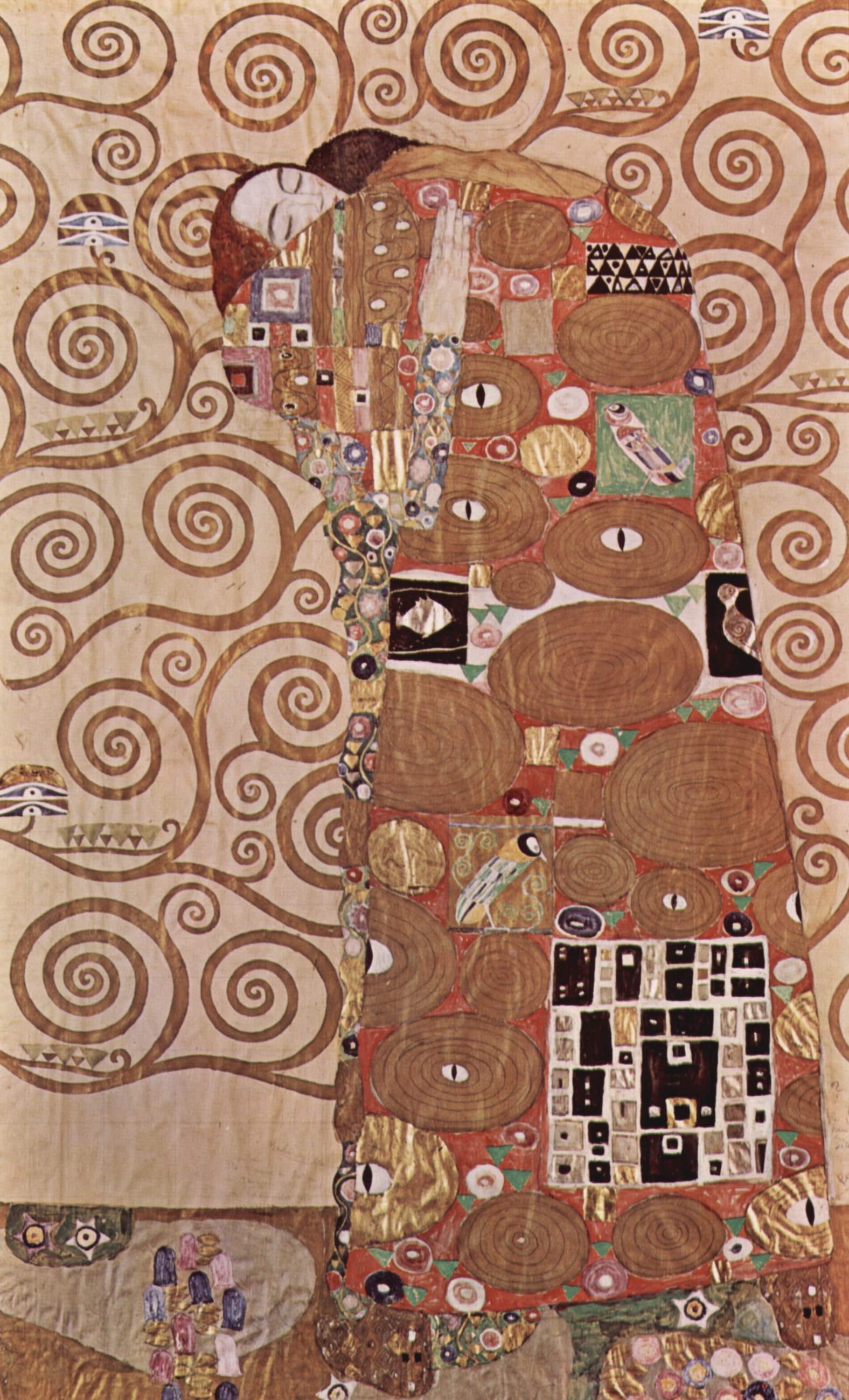
The iconographic register of the Stoclet room is already accepted in mainstream Klimt scholarship as Edenic. The Hatje Cantz catalog for the exhibition Gustav Klimt: Expectation and Fulfillment describes the dining room as an enchanted garden read as a Garden of Eden, and Tobias Natter’s catalog work supports the same reading. The Tree of Life is the central iconographic marker of Eden in Genesis 2:9 and again at Revelation 22:2. The embracing couple stands beside it. Whatever else is happening in the Stoclet Frieze, the embrace is taking place in a garden that the standard scholarship has already coded as Eden. The mainstream scholarly identification of the Stoclet couple as a portrait of Klimt and Emilie Flöge does not displace this reading; artists from Dürer through Caravaggio have inserted themselves into biblical scenes, and a self-portrait inside Eden remains a portrait inside Eden.
The late evidence does the remaining work. His last major painting, Adam and Eve (1917-18), unfinished at his death and the only explicit biblical subject in his entire oeuvre, evolved directly from the Kiss compositions; the preliminary drawings indicate the evolution. The compositional template that Klimt himself selected, at the end of his life, as the appropriate vehicle for explicitly Edenic content was the template of The Kiss.
The case for intent
Three claims are available about the iconography in the canvas. The first is that the geometry and the iconographic features are in the canvas. That is a measurable fact, defensible from the painting alone. The second is that the configuration reads as Fall above and Resurrection below within the Christian iconographic system Klimt’s training and Ravenna trips placed him inside. That is interpretively persuasive. The third is that Klimt intentionally built the canvas as a dual-orientation object knowing the second reading would remain submerged for most viewers. That is the contested claim and is the one this section defends.
The likely orthodox objection is that Klimt almost certainly did not intend the protoevangelium reading. He was a Vienna 1900 artist, raised Catholic but moving in circles saturated by Nietzsche, Schopenhauer, and the emerging psychoanalytic project. His milieu was post-Christian. He modeled the woman on Emilie Flöge. The standard reading treats the canvas as a deliberate sacralization of erotic love. To claim he consciously encoded a Fall-and-Resurrection dialectic into it would overclaim what we can prove.
That is the objection. I am going to argue against it.
The version of the claim I will defend is narrower than the one the orthodoxy attacks. The strong form does not require Klimt to have been a theologian. It does not require him to have been thinking about Genesis 3:15 by chapter and verse. It requires him to have been a conscious iconographer who knew what he was doing with Byzantine, Christian, and Edenic imagery, and who built the canvas as a dual-orientation object knowing the second reading would remain submerged for most viewers. That is a smaller claim than the version the orthodoxy attacks. It is also the one the evidence supports.
Six pieces. The six pieces vary in evidentiary force. Pieces 1, 4, and 5 are intent-establishing. Pieces 2, 3, and 6 establish opportunity, motive, and pattern. The cumulative case rests on the conjunction.
(1) Klimt was a documented programmatic iconographer. The Beethoven Frieze is the proof. He worked to a published text. He designed the iconographic sequence (longing, hostile forces, redemption) and the vocabulary that carried it (the gold mandorla, the choir, the embrace, the suspended figures, the angelic chorus, the sun-and-moon attendants of Byzantine Crucifixion convention). The objection that he could not have known what he was doing with Christian iconography in 1907 is closed by the documentary record of what he was doing with it in 1902. He had built exactly this kind of structure before, with public text confirming it.
The biomedical register is documented at the same level. Klimt attended Bertha Zuckerkandl’s salon, where her husband Emil Zuckerkandl, professor of anatomy at the University of Vienna, gave a 1903 lecture series projecting lantern slides of stained microscopic samples to the Secession artists. Klimt owned Meyers Großes Konversations-Lexikon, which contained the figure plates of blood corpuscles that the dress in The Kiss reproduces. The pattern is consistent. Klimt incorporated specific iconographic content from documented source materials, working in multiple iconographic vocabularies simultaneously.
(2) He went to Ravenna twice in 1903 to study the Byzantine mosaics. Two trips in seven months. The gold ground, the mandorla, the haloed embrace, and the standing-on-water iconography all enter his vocabulary in the years immediately after. He did not pick up Christian iconography by accident in 1907. He went to Ravenna in 1903 and deliberately absorbed the visual language from which the gold ground, mandorla, halo, and sacred architectural geometry of the later work emerge.
(3) He painted The Kiss after a professional rupture that forced him from public-programmatic register into private-condensed register. The Frieze got him attacked. The Faculty Paintings got him destroyed. By 1905 he had quit the Secession and repurchased the rejected canvases. The 1907 painting was made under conditions in which an explicit programmatic claim would have carried obvious professional risk, while a submerged one could survive as ornament, eroticism, and private iconography at once.
(4) The technique of explicit content under ornamental concealment is documented in his unfinished work. The Bride, found in his studio at his death, has the female figure’s anatomy painted in full underneath a planned dress overlay that would have concealed it in the finished canvas. The sequence is on the panel. Explicit content first. Ornamental concealment second. The technique the strong form attributes to him in The Kiss is the technique he is documented to have used. The objection that he did not work by burying content under ornament is refuted by the physical evidence of how he worked.
(5) The geometry of The Kiss is too precise to be accident. The cross axes are not casual. The seam runs through the figure mass at the exact line where the rectangular cloak meets the circular cloak. The horizontal runs at the exact threshold between gold and meadow. The proportion of the long arm to the short arm is the Latin cross proportion. The serpent’s head sits at the foot of the vertical axis where the heel would crush it. The flower meadow inverts to the garden above. The mantle inverts to the tomb arch. Every iconographic feature aligns with the structural feature it would need to align with for the bivalent reading to work. Klimt could have placed any of these elements anywhere on the canvas. He placed them where the protoevangelium geometry required them to sit.
(6) The same compositional template recurs across Klimt’s career at four points, with the iconographic register of the apex field shifting between deployments while the underlying composition holds. Read in iconographic order (the Kiss falls within the Stoclet date range), the development runs as follows. The 1902 Beethoven Frieze panel renders the embracing couple inside a gold mandorla under a published Christian redemption program, with the male head crowned in tight gold whorls that expand into the curly golden field at the apex of the mandorla, the redeemed configuration. The 1905-1911 Stoclet Frieze places substantially the same embracing couple beside the Tree of Life inside a dining room read in mainstream scholarship as Edenic, with the female head fallen into the male’s chest at the iconographic point of consummated consumption. The 1907-1908 Kiss isolates the embrace, substitutes the dark serpentine field for the curly golden field at the apex of the male head, and renders the canvas as a bivalent toggle in which the upright configuration paints the fall and the inverted configuration restores the Beethoven mandorla geometry with the serpent crushed at the base. The 1917-1918 Adam and Eve, evolved from the Kiss compositions on the evidence of the preliminary drawings, returns the same compositional template to explicit Genesis subject matter. The shift from curly golden field (1902) through Edenic embrace and consummated consumption (1905-1911) to dark serpentine field with bivalent toggle (1907-1908) to explicit Adam and Eve (1917-1918) is not stylistic evolution. It is the same iconographer working a single compositional vocabulary across four works, with the apex field as the iconographic variable that toggles between redemption and fall.
Closing
The Kiss is, on the standard reading, a sacralized embrace, lovers turned into icons by gold. That reading is correct. It is incomplete. The painting carries a second iconographic structure accessible by half a rotation, in which the same canvas reads as Fall and as Resurrection. The cross axes toggle from Petrine to Latin with the same operation. Genesis 3:15 is rendered in the spatial arrangement of the heads.
The orthodox readings of The Kiss as sacralized eros, as Schopenhauerian will-consummated, or as Vienna 1900 decadence are not displaced by the protoevangelium reading. They sit on the surface of the canvas accurately. The argument here is that a second iconographic system runs underneath them, accessible by inversion and by attention to the spatial position of the serpent, and that the canvas is structured to hold both.
The deeper structure is the geometric identity between the inverted Kiss and the Beethoven mandorla of 1902. Klimt rendered the redeemed configuration at architectural scale in his public Christian-Symbolist program for the Beethoven exhibition. Five years later he compressed both configurations onto a single canvas, installing the fall at the canvas’s apex by substituting the dark serpentine field for the curly golden field of the Beethoven mandorla, and leaving the redeemed configuration accessible by inversion. The painting is a bivalent toggle whose hinge is a 180-degree rotation. The serpent’s spatial position is the diagnostic indicator of which configuration the canvas is rendering at any given orientation.
The Kiss is therefore not the love painting it has been received as for over a century. It is the canvas-scale compression of an iconographic vocabulary Klimt deployed at architectural scale in Beethoven and Stoclet. The three scales render a single iconographic statement: Klimt’s complete cosmology of fall, redemption, and embrace, with the canvas as the middle scale at which both directions are accessible on one composition.
The structure is in the canvas. It can be measured. It carries the protoevangelium in the geometry of the gold and the meadow and the seam where two bodies fuse. Klimt placed it there on purpose. The scholarship has credited him as a sensualist in gold. He was also an iconographer, and a careful one.
Stand the painting on its head. Look at what has moved to the top, what has moved to the bottom, what now sits beneath the heel. The painting has been telling this story for over a century in plain view. We did not see it because we kept accepting the painting’s inherited orientation as the only one it was built to bear.