
The Missing Structure of Stoclet
"Whoever wants to know something about me ought to look attentively at my pictures and try and see in them what I am and what I want." - Gustav Klimt, Commentary on a Non-Existent Self-Portrait

I. The Empty Chair
The Stoclet Frieze has been documented, conserved, catalogued, and described for over a century. It has not been read as a single architectural program.
The scholarship contains every element of the iconographic program and recognizes none of the relations between them. The Rosebush is named without identity. The Knight has no described function. The Eye of Horus appears in catalogues as decoration, the vultures as memento mori. The fall narrative running across the long walls is not recognized as such, nor is the cruciform geometry of the dining room. The table is not recognized as an altar, the twenty-four seats as the doubled apostolic twelve, the artist’s confession installed throughout as a confession.
The single sustained academic study of the frieze’s iconography is M.E. Warlick’s “Mythic Rebirth in Gustav Klimt’s Stoclet Frieze: New Considerations of Its Egyptianizing Form and Content,” published in The Art Bulletin in March 1992. Warlick reads the frieze as Egyptian death-and-rebirth mythology with Fulfillment as Isis resurrecting Osiris and the Tree as Osiris-vegetation under the Nile flood cycle. She concedes that Expectation cannot be traced to a specific Egyptian source. She does not identify the Rosebush. She does not account for the Knight. She does not read the vultures as fall-consequence. Her frame is too thin to hold the parts. No subsequent study has supplied the missing structural account.
The 2012 MAK exhibition catalogue, edited by Christoph Thun-Hohenstein and Beate Murr, is the authoritative recent treatment. It documents Klimt’s handwritten material specifications panel by panel and traces the cartoon-to-mosaic transposition with conservation precision. It does not propose an iconographic reading. The Ezekiel 28:13 material correspondence is sitting in its data unread. Jenny Albani’s 2017 work on the Byzantine sources establishes Klimt’s familiarity with early Christian iconography and notes that the symbolic elements suggest competence beyond decorative pastiche. Albani does not extend the argument into a sustained narrative reading. Anette Freytag’s work on the garden context is contextual rather than iconographic. Carl Schorske’s Fin-de-Siècle Vienna reads the frieze as cultural symptom. Berta Zuckerkandl’s contemporary 1911 review praises the materials and notes that the Knight “watches over the bright glow that makes everything more beautiful and better.” None of these is wrong. All are incomplete in the same direction.
The popular accounts in the museum descriptions, the catalogue raisonné entries, and the standard surveys treat the frieze as a loose allegorical program with multicultural symbolism and decline to commit to a specific narrative structure. The Google Arts & Culture description of the Rosebush panel, which draws from MAK sources, gives the canonical popular reading: the panel “incorporates designs and symbols typical of Jugendstil and the artists of the Vienna Secession. Flowers, butterflies, and an eye of Horus, taken from ancient Egyptian art, lend the frieze an enigmatic, mysterious quality.” That is not a reading. That is a description of motifs.
The Schopenhauerian reading of Klimt’s gold-period work, which treats the embrace as the will-as-eros consummated, and the fin-de-siècle decadent reading, which attributes the room’s affect to mood and aesthetic intoxication, are not displaced by the decipherment that follows. They sit accurately on the surface of the room. A structured iconographic program runs underneath that surface, and the room is engineered to fold the diner into the program at every meal. The decadent surface is the cover. The iconographic device is what the cover conceals.
The room itself, before any iconographic reading, is a long rectangular dining hall designed by Josef Hoffmann. The short wall at the head carries the Knight. The two long walls carry the figural panels: Expectation on one, Fulfillment on the opposite, with the Tree of Life and the Rosebush running between them. A long rectangular dining table sits along the room’s long axis. Twenty-four seats surround it. The Klimt mosaics, executed in gold leaf, enamel, mother-of-pearl, coral, and semi-precious stones, surround the diners on three walls. The empty chair sits at the center of the field. Every element is in the scholarly record. The structure that the elements compose is absent.
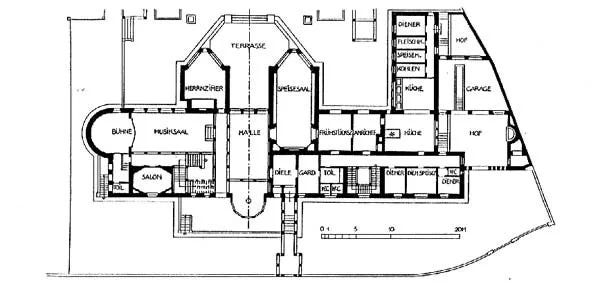
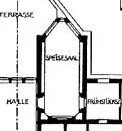
The floorplan of the dining room. A large rectangular room in the center of the palace with triangular widows on one of its short sides.
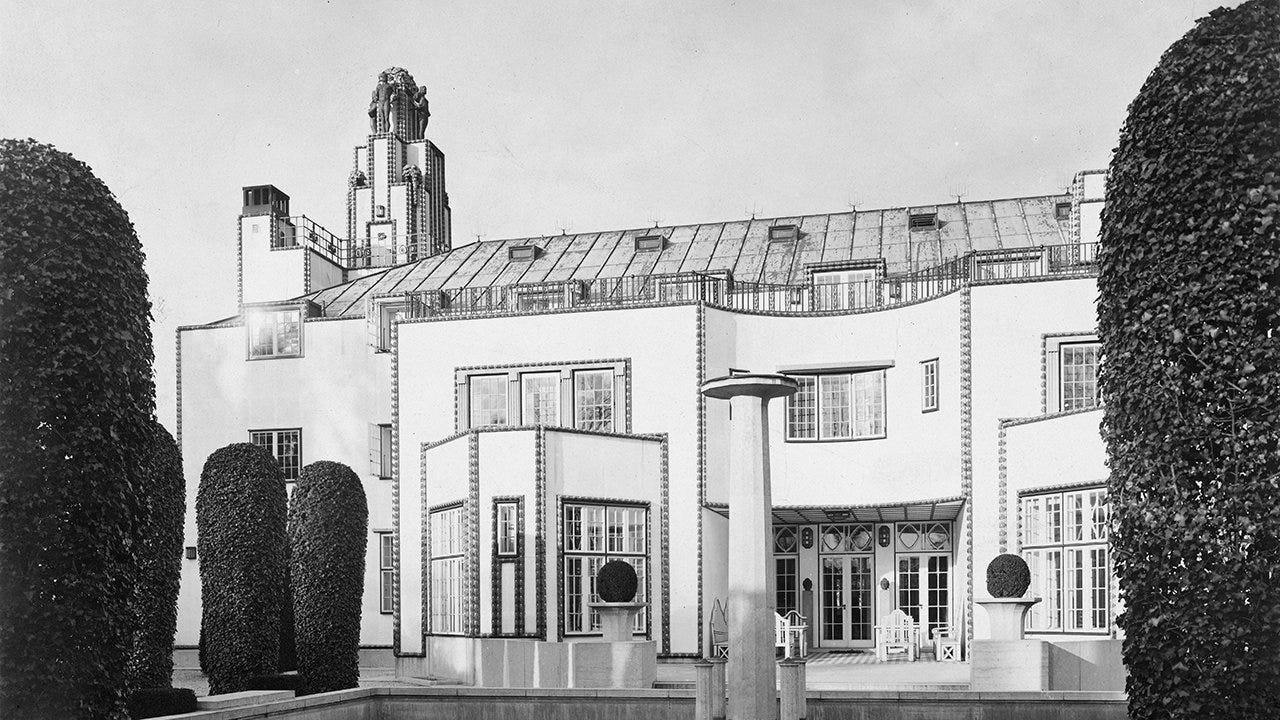
As seen from the exterior, the triangular window bay appears on the left.
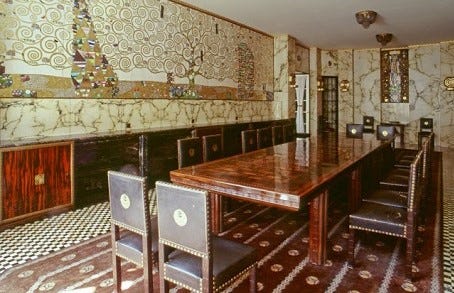
The primary figures from left to right: (a) Expectation, (b) Tree of Life, (c) Rosebush; (d) on the far wall, in line with the table, The Knight. The right long wall cannot be seen from this vantage but mirrors the left long wall. The window bay is behind the viewer.
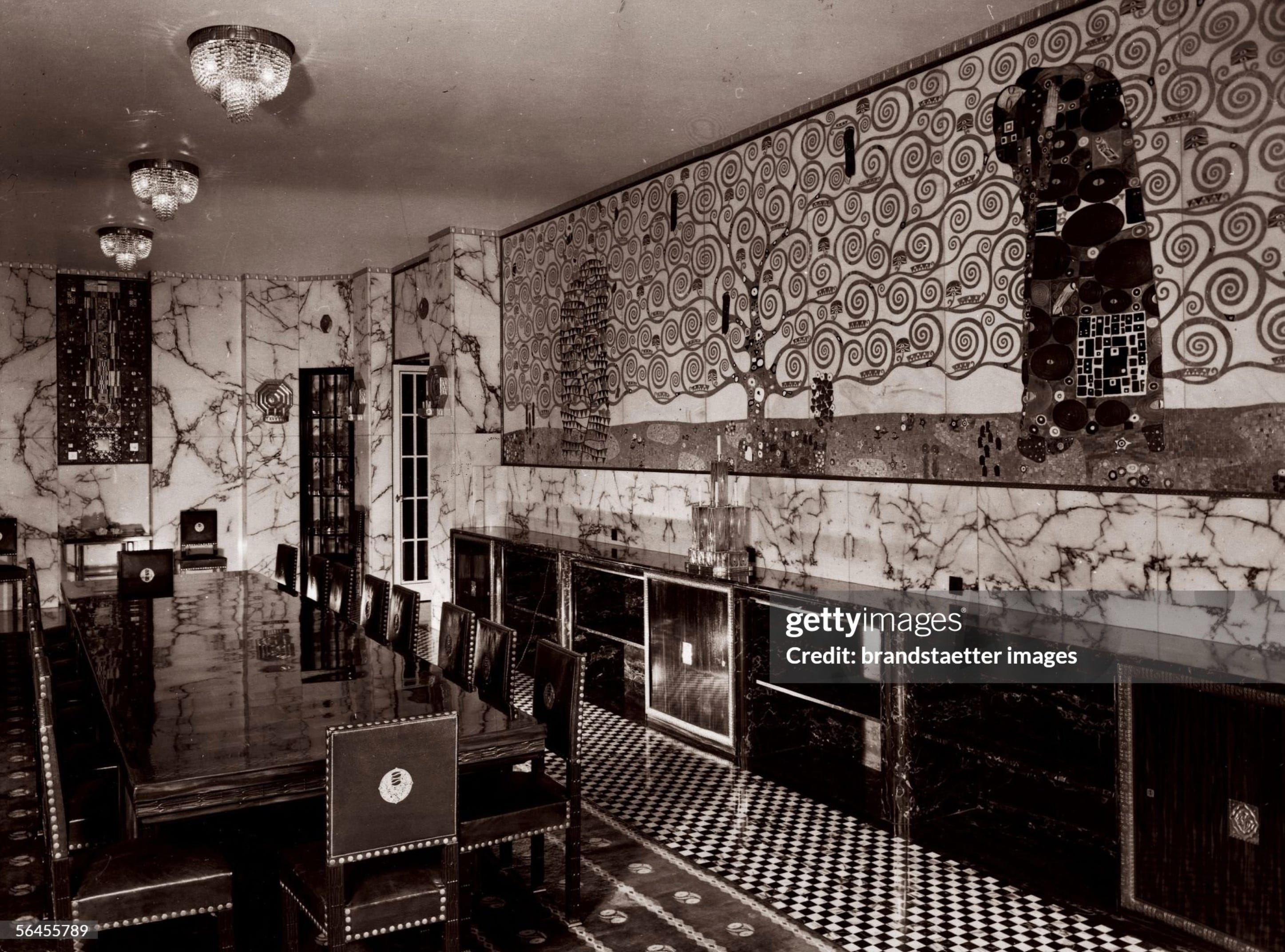
The right long wall. From right to left: (a) Fulfillment, (b) Tree of Life, (c) Rosebush; (d) on the far wall, in line with the table, The Knight. The window bay is behind the viewer.
II. Klimt’s Method
The argument requires one preliminary: Klimt’s capacity for sustained Christian iconographic work. The standard treatment of Klimt as eroticist, decorator, and symptom of fin-de-siècle Vienna has tended to rule out programmatic Christian iconography on grounds of biographical implausibility. Klimt was not confessional. He was not pious. His subject matter ran heavily toward female nudity. The presumption is that his deployment of Christian iconographic vocabulary must therefore be allusive, atmospheric, or ironic.
The presumption does not survive contact with the evidence. Klimt’s 1903 trip to Ravenna, where he spent extended hours studying the early Christian mosaics of San Vitale, Sant’Apollinare Nuovo, and the Mausoleum of Galla Placidia, is documented and consequential. The gold ground, the flat picture plane, the iconic frontal-or-profile figures, the cruciform compositional axes, the gemstone-and-enamel materials installed on sacred substrate: these are the techniques he absorbed in Ravenna and deployed thereafter in The Kiss, Adele Bloch-Bauer I, the Beethoven Frieze, and the Stoclet Frieze. The Beethoven Frieze of 1902 is already explicit in its deployment of Christian angelology, with golden-haloed redemptive figures, the floating chorus, and the embracing pair beneath the cosmic embrace. Klimt’s iconographic literacy was substantial and demonstrable.
The patristic principle that organizes the Stoclet Frieze is praeparatio evangelica, the doctrine that pagan religions contain partial, anticipatory revelations that find their completion in Christ. Eusebius named the doctrine in the early fourth century. Augustine extended it. The Renaissance hermetic tradition installed it as the dominant interpretive principle for pagan material in Christian art. By Klimt’s time the fin-de-siècle Symbolist milieu in Vienna, Munich, and Paris was saturated with this principle, mediated through the Theosophical revival, Wagner’s Parsifal, and the Egyptological Christianity of figures like Gerald Massey. The premise: Egyptian and other pagan iconographic vocabularies are doctrinally legitimate for Christian iconographic work because the pagan material is the anticipation that the Christian material fulfills.
This is the air Klimt was working in. It is also the principle that organizes Milton’s poetic method in Paradise Lost, where pagan gods become fallen angels and classical Hades types for Christian Hell. The form is pagan. The matter is Christian. The relation is typological. Klimt deploys the same method in painting. The Stoclet Frieze is a Byzantine Christian compositional structure carrying Egyptian iconographic content carrying Christian typological argument. Three layers, with the deepest and shallowest both Christian and the middle layer Egyptian. Warlick’s reading captures the middle layer and stops. She is not wrong. She is incomplete. The Egyptian register is doing typological work for the Christian register. Osiris is the prefiguration. Christ is the fulfillment. Isis is the prefiguration. Mary is the fulfillment. The Tree of Life with Osiris embedded is the prefiguration. The Cross as lignum vitae is the fulfillment. The frieze operates in both registers at once because in patristic typology they are one register at different stages of revelation.
Klimt veils the Christian argument in Egyptian dress for the same reasons every Symbolist of his moment veiled Christian argument in pagan dress. Patron taste favored the Egyptian. Confessional Christian iconography in 1907 Vienna read as reactionary. The Egyptian veneer made the work intelligible within the Symbolist movement. The veil supplied deniability. A confessional rendering of Eden, fall, protoevangelium, and Cross would have been impossible in his idiom and his market. The Egyptian iconography lets him make the maximalist Christian argument without nominal Christian content. The reader who decodes the Egyptian gets the Christian. The reader who does not gets a sumptuous Symbolist mystery. Klimt protects the argument by veiling it.
The two-level method established in the entry piece of this cycle, Klimt’s First Love, operates here at architectural scale. First Love reads the 1895 canvas as the system’s earliest legible form: male emerging from rose-darkness, female thrown back with throat compromised, Genesis 3 consequences arranged in the upper register, the seed positioned spatially above the serpent’s head. Stoclet is the same system rendered as a room.
III. The Iconographic Program
The frieze depicts the fall, with every element doing identifiable work.
The Rosebush as pre-fall Lucifer.
First Love reads the rose as Klimt’s most useful trap, the beautiful symbol that lets the adversary hide in plain sight. In Love (1895) the rose remains partially plausible as romantic atmosphere; the male emerges from rose-darkness above the reclining female. At Stoclet the rose has become a freestanding architectural panel, no longer atmospheric, no longer concealable as romance. The Rosebush is the rose installed at full iconographic scale and positioned where its function is structural.
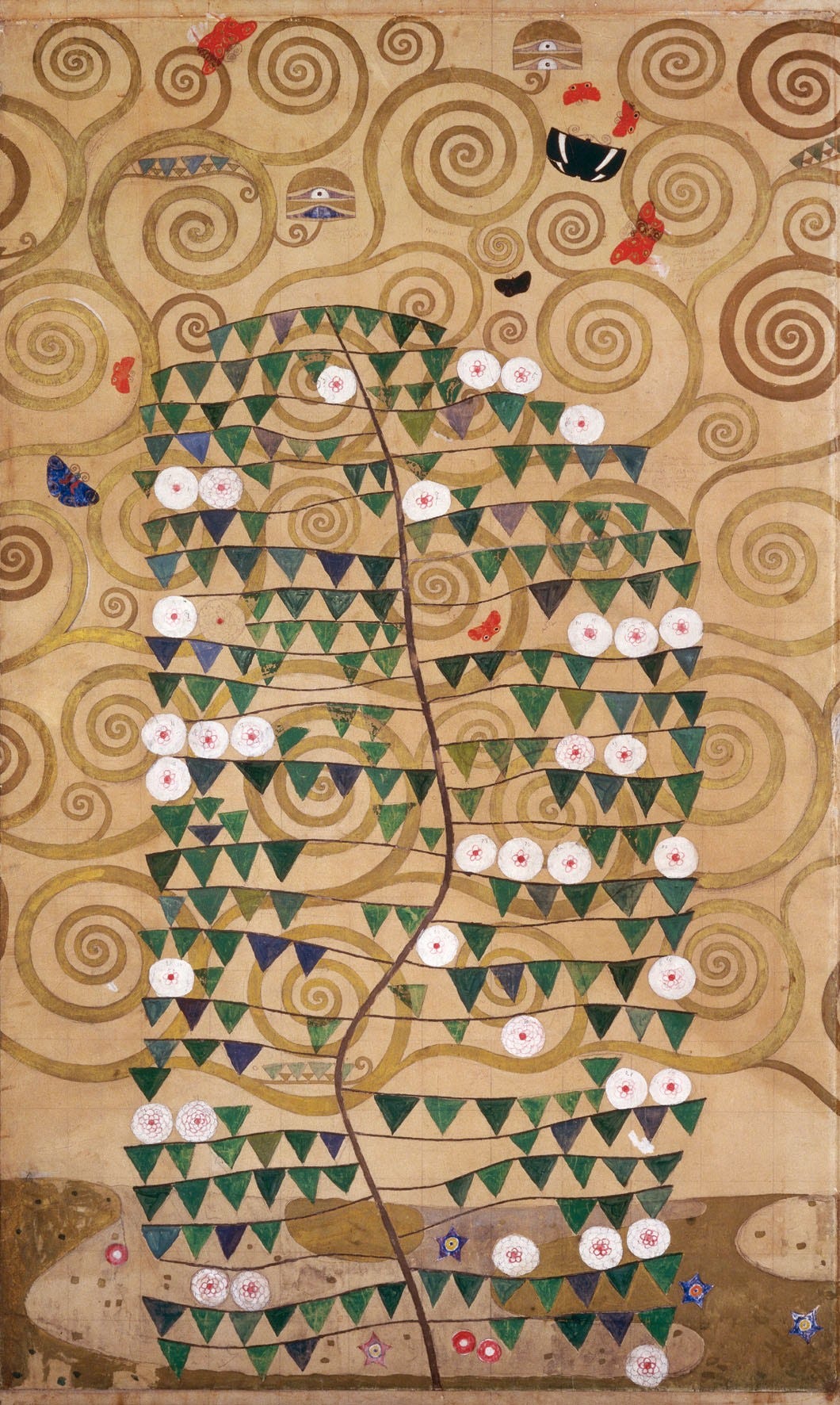
The Rosebush appears in mirror on both long walls of the dining room, the only figural element of the Tree program to repeat in this way. It occupies the structural position the tempter occupies in Genesis 3, standing between Expectation, the unfallen Eve longing toward consummation, and Fulfillment, the embrace that should have been the union of Eve with her created complement. The Rosebush intercedes at the inflection point of the fall.
The iconographic identification rests on Ezekiel 28:11-19, the prophetic indictment of the king of Tyre as the type of Lucifer in Eden before the fall. Verse 13 catalogues Lucifer’s covering: “Thou hast been in Eden the garden of God; every precious stone was thy covering, the sardius, topaz, and the diamond, the beryl, the onyx, and the jasper, the sapphire, the emerald, and the carbuncle, and gold: the workmanship of thy tabrets and of thy pipes was prepared in thee in the day that thou wast created.” Klimt’s documented material specifications for the frieze, written in his own hand on the cartoons and preserved in the MAK collection, call for enamel, mother-of-pearl, coral, semi-precious stones, and gold leaf, with the Rosebush panel concentrated at the densest deployment of these materials in the frieze. The medium is the iconography. No other biblical passage inventories these materials in this Edenic setting. The Rosebush is constructed from the material list of Ezekiel 28:13.
Verse 14 names Lucifer the anointed cherub that covereth, the angel stationed over the throne of Eden. The Rosebush silhouette is a covering geometry, conical and enclosing, with triangulated bands functioning as overlapping scales or wing-feathers. The form is angelic flame ascending, the iconographic signature of the covering cherub.
A single sinuous black axis bisects the form vertically. This is the serpentine line that pre-fall Lucifer carries in latent form, the seam along which the fall will occur. Pre-fall Lucifer is not yet identified with the Genesis 3 serpent, but the serpentine line is already inscribed within the unfallen form. Klimt has rendered the moment before the inversion.
The triangles of the Rosebush are small and downward-pointing. The triangles of Eve’s garment in Expectation are large and upward-pointing, pyramidal, aspiring. Western symbolic tradition assigns upward triangles to fire ascending toward the divine and downward triangles to fire inverted, the descent of the higher principle into matter, the visual signature of the angelic fall. Above the Starry Canopy reads the same downward-triangle iconography at its first deployment on the Beethoven middle wall, where the patterning surrounds the gluttonous body and the inverted Trinity composite, and again on the labial flanking columns of the Beethoven mandorla. The Stoclet Rosebush is the downward triangle installed at architectural scale and at the structural position of the tempter. The two figures face each other across the Tree. Her triangles point up. His point down. They meet in the middle. The temptation is encoded geometrically before any narrative reading is applied. Klimt has rendered the moment of seduction as the collision of inverted vectors.
The choice of rose rather than any other vegetal motif activates additional iconographic registers. Patristic and medieval tradition holds that the rose in paradise had no thorns until the curse of Genesis 3:18. Klimt’s Rosebush is rendered without thorns. The form is the pre-fall rose, the unfallen splendor of the covering cherub. The Marian inversion is also present: the rosa mystica tradition makes Mary the thornless rose of restored Eden, the second Eve. The same iconographic site names the figure who falls and prefigures the figure through whom the fall is reversed. Klimt has compressed the protoevangelium into the choice of plant.
The Eye where the head would be.
The Rosebush has no head. Above the figure, in the position the head would occupy, Klimt places an Eye of Horus. The Eye recurs throughout the frieze, distributed across the golden volutes of the Tree of Life. The MAK catalogue notes the motif. The scholarship treats it as decorative Egyptiana. The placement above the headless Rosebush demands a different reading.
The Eye of Horus, the wedjat or udjat, is the eye torn out by Set and restored. In Egyptian iconography it carries protection, royal vision, and divine surveillance. In Christian iconographic transmission it becomes the Eye of Providence, often deployed within a triangle in post-Renaissance art. In the esoteric and Hermetic register that saturated Klimt’s Vienna, the Eye carries an additional meaning: the offer of forbidden vision, the eye that promises divine knowledge to the initiate.
Genesis 3:5 supplies the textual anchor: “For God doth know that in the day ye eat thereof, then your eyes shall be opened, and ye shall be as gods, knowing good and evil.” The fall is not about eating. The fall is about eye-opening. The serpent’s promise is visual. The transgression is the acceptance of the offer of unauthorized sight. The Eye is what the serpent offers. The Eye is what Eve accepts. The Eye is the substance of the temptation.
The Rosebush has no head because Lucifer in this iconographic register has no identity apart from the offer. The figure is the offer rendered in form, with the Eye as the literal head of the operation. Klimt has compressed the temptation: tempter is offer is Eye is head. The figure does not need a face because the figure has no personal identity. The Rosebush is what Lucifer extends to Eve, and what he extends is the Eye.
The dispersion of Eyes across the Tree of Life follows from this. If the Rosebush is the source, the Tree carries the consequence. The fall does not stay in the Rosebush. The offer propagates. Once Eve accepts, the Eye is everywhere. The Tree of Life becomes the Tree of the Knowledge of Good and Evil because the Eye that promised “ye shall be as gods” has been distributed across the entire vegetal program. The vultures are the consequence at higher resolution. The Eyes are the cause distributed.
Expectation as Eve unfallen.
Expectation stands on the wall opposite Fulfillment, facing toward the Tree, the Rosebush, and the embrace beyond. Her body is in motion. Warlick describes her as a dancer and concedes that she cannot be traced to a specific dance. Within the Eden reading the dance has a precise object.
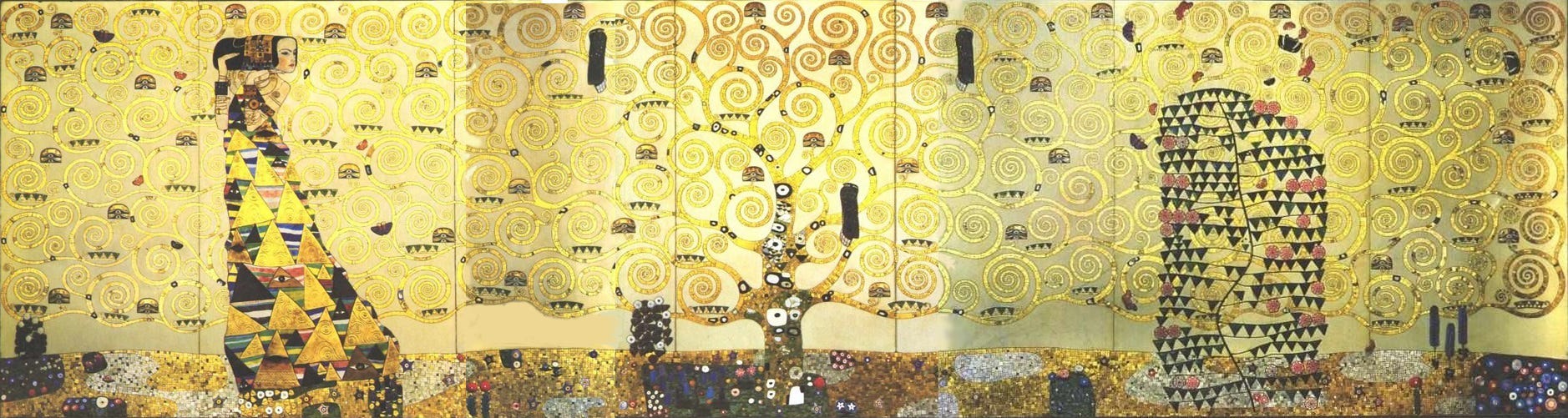
She is approaching consummation. The Rosebush stands between her and that union, presenting itself as the path. Pre-fall Lucifer in the patristic tradition is the creature who positions himself as the indispensable intermediary between humanity and divine union. Eve’s eagerness is the unfallen creature’s response to created beauty, including the beauty of the covering cherub. The fall occurs when that eagerness accepts a false mediation.
Genesis 3:6 specifies that the fruit was “pleasant to the eyes.” The fall is aesthetic before it is moral. Lucifer in Ezekiel 28:17 is “perfect in beauty.” Klimt is depicting the moment when beauty becomes the vector of the fall. Eve dances toward what she sees, and what she sees is glorious. The triangles of her garment point upward in unfallen aspiration. The triangles of the Rosebush opposite her point downward in the descent of the higher principle into the act of seduction. The two vectors collide at the middle of the long wall.
Her face is flushed with color. Her eyes are open and forward. Her posture is alert and leaning. Her body is upright and self-supporting. She is living. This matters because the figure of Eve on the opposite wall is none of these.
The Tree of Life and the vultures.
The Tree spreads across the long wall between Expectation and Fulfillment. It is the central iconographic element of the frieze and the structural anchor of Warlick’s Osirian reading. The Osirian register is present. The Tree carries the Osiris-vegetation under the Nile flood cycle. The Egyptian myth specifically places Osiris’s coffin embedded in a tamarisk tree at Byblos, from which Isis recovers the body. The Tree as locus of death and resurrection in Osirian myth is the direct iconographic source for the Christian typology of the Cross as Tree of Life, the lignum vitae of Revelation 22 on which the dying Christ becomes the source of resurrection.
The vultures on the Tree are the iconographic mark you would expect if Klimt is depicting the fallen Tree of Life. Genesis 3 ends with the Tree guarded against fallen humanity. Death has entered creation. Vultures attend death. Klimt perches them on the Tree itself. The gold ground remains intact, but black birds puncture it. The Genesis 15:11 echo is also active: Abraham’s covenant sacrifice attracts birds of prey he must drive away. Patristic tradition reads these as the demonic forces that contest every covenant. Vultures on the Tree of Life are the rival claim asserted on creation after the fall.
The Egyptian register doubles. The vulture is also Nekhbet, the protective goddess of Upper Egypt whose wings shelter pharaoh. Christian iconography inherits both readings. The wings hovering over the Tree recall the Spirit hovering over the waters in Genesis 1:2. The scavenger registers fall-consequence. Klimt’s birds carry the protective hovering and the mortality simultaneously, which is consistent with the typological method governing the rest of the frieze.
Fulfillment as the fall consummated.
The mosaic title is Erfüllung, Fulfillment. First Love reads this as the fourth of Klimt’s protectively innocuous titles for the recurring scene, sitting alongside Love, the closing line of the Beethoven Frieze’s published Schiller program, and Liebespaar (Lovers), the title under which The Kiss first exhibited in 1908. The four titles do protective work in sequence. The Stoclet panel is the most architecturally permanent of the four and carries the most domestic-sounding title. The closer the iconography moves toward consummation, the more reassuring the title becomes.
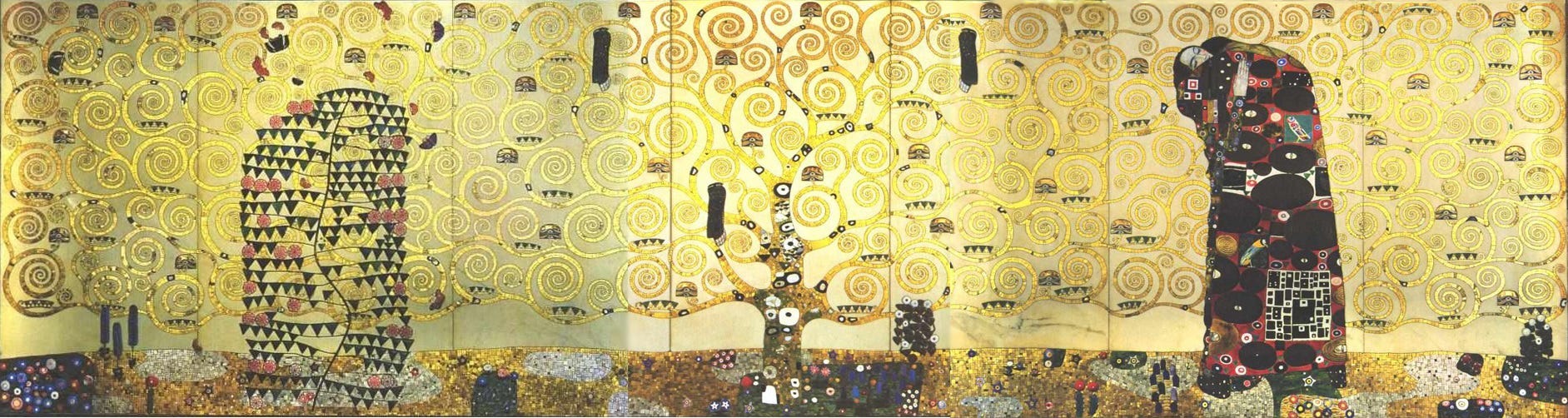
The standard reading of Fulfillment is romantic union. The iconographic evidence does not support it.
The male figure is faceless, hooded, dominant in mass, and structurally consuming the female. His garment patterns subsume hers within the single shared form. The triangles in his robe are downward-pointing, matching the triangles of the Rosebush. The female figure’s eyes are closed. Her head is fallen back or tilted into the male. Her body is limp. Her face is pale to the point of white. She is indistinguishable from Klimt’s death-figures in Hope I, Hope II, and Death and Life. The same visual signature he uses for women in the death-state.
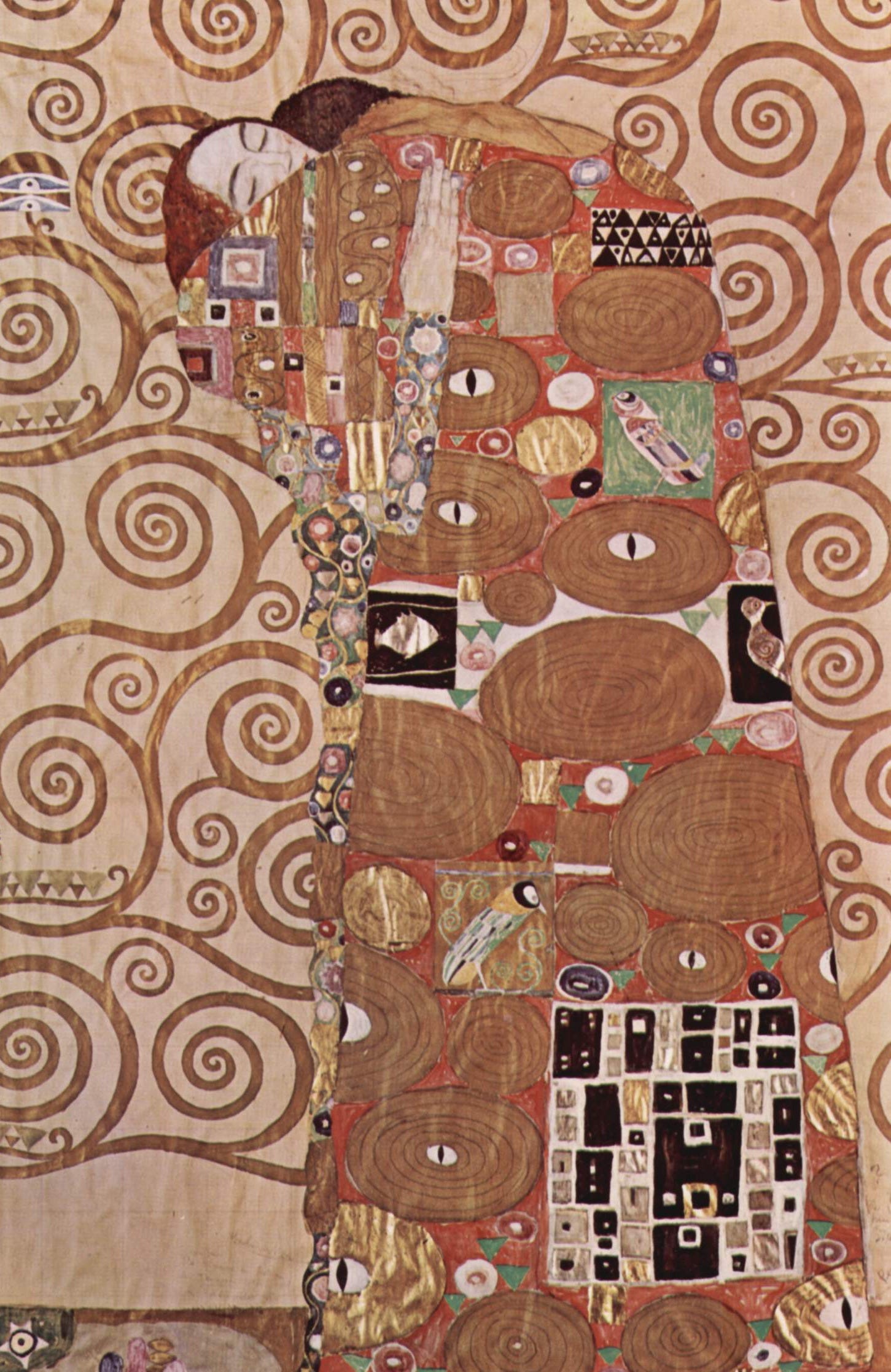
The male figure is Lucifer fallen into the act, the covering cherub having descended from offer into consumer of the beloved. Eve has not been united with Adam. Eve has been consumed by the tempter. The merger is not marriage. The merger is absorption. The male hand at her face and throat is doing what the choker does in Klimt’s Judith and Adele Bloch-Bauer portraits, applied directly rather than through jewelry. The full diagnostic of the throat iconography across Klimt’s corpus belongs to The Toppled Pillar. For Stoclet, the central observation is sufficient: the female head is broken, her eyes closed, her color drained, her body limp, her form absorbed into the male’s downward-pointing triangles.
Above the Starry Canopy reads the same embrace at its 1902 cosmic-Christian deployment. The Beethoven mandorla stands the male body as vertical axis rising from blue stylized water at the base into the curly golden field at the apex, with the female head fallen into his chest and the two flanking rosebush columns carrying the same downward-triangle patterning as the Stoclet Rosebush. The Kiss as Embedded Protoevangelium reads the same scene compressed onto a single 1907-1908 canvas, with the upright orientation rendering the fall and the inverted orientation restoring the Beethoven mandorla geometry under the redeemed configuration. The Stoclet Fulfillment is the same scene rendered in mosaic without a toggle. There is no inversion available. The figures are fixed in the wall. The act is consummated.
The journey across the long wall is the journey from Expectation to Fulfillment, which is the journey from life to death, from upward aspiration to downward absorption, from flushed face to pale face, from open eyes to closed eyes. The Rosebush stands at the inflection point. The Tree marks the path with vultures. The Eyes distributed across the volutes mark the propagation of the offer Eve accepted at the Rosebush. The fall is rendered as a horizontal traverse along the long wall, with cause, consequence, and consummation in sequence.
The Robe of Opened Eyes
The male figure’s robe in Fulfillment is densely populated with eye-forms: almond eyes, ovoid eyes, ring-and-pupil eyes, and eyes-within-circles. The robe is not generic ornament. It is an eye-bearing surface. The male presence approaching the female from behind is clothed in eyes.
The eyes are the eyes of Genesis 3:7: “And the eyes of them both were opened, and they knew that they were naked.” The Fall’s first consequence is ocular. The opened eyes produce shame, knowledge, and the need for covering. Klimt has clothed the male figure in the consequence the Fall introduces. The Fulfillment male wears the post-Fall vision.
The female turns her face away from him and toward the viewer. Her eyes are closed or downcast. She is the recipient of post-Fall sight rather than its bearer. The male carries the eyes. She carries the body. The embrace is the moment at which the eye-clothed presence meets the body-presence, and the body-presence is the one whose face is turned away.
This is the Kiss figure at the next moment in the Genesis sequence. The Kiss is the act of the Fall (Genesis 3:6, the eating). Fulfillment is its immediate aftermath (Genesis 3:7, the opening of the eyes). The same male figure who carried the cemetery grid into the Kiss embrace now carries the opened eyes into the Fulfillment embrace. The cemetery has been augmented by the new vision. The figure has acquired the iconographic marker of the new condition. He sees what he is doing. The female still has her face turned away.
The eye-vocabulary on the Fulfillment robe is the same eye-vocabulary that lines the walls at Stoclet. Klimt has installed the post-Fall vision as the iconographic environment of the Stoclet dining room. The Fulfillment male’s robe and the Stoclet walls are made of the same eyes. The two works are iconographically continuous. The robe carries the vision; the room is built out of it.
The figure-type biography runs across the cycle’s central paintings: The Kiss (Fall agent, cemetery grid), Fulfillment (post-Fall recognition, eyes), Stoclet (architectural installation of the post-Fall condition), Death and Life (eschatological terminus, crosses). The same robed vertical male appears at all four moments. His garment changes with the theological moment. Klimt has painted the Genesis 3 sequence as the iconographic biography of one figure, with himself in the role.
The Knight as plumb line.
The Knight occupies the short wall at the head of the room, perpendicular to the long-wall fall narrative. The figure is rigidly vertical, abstract, stripped of features, and inert.
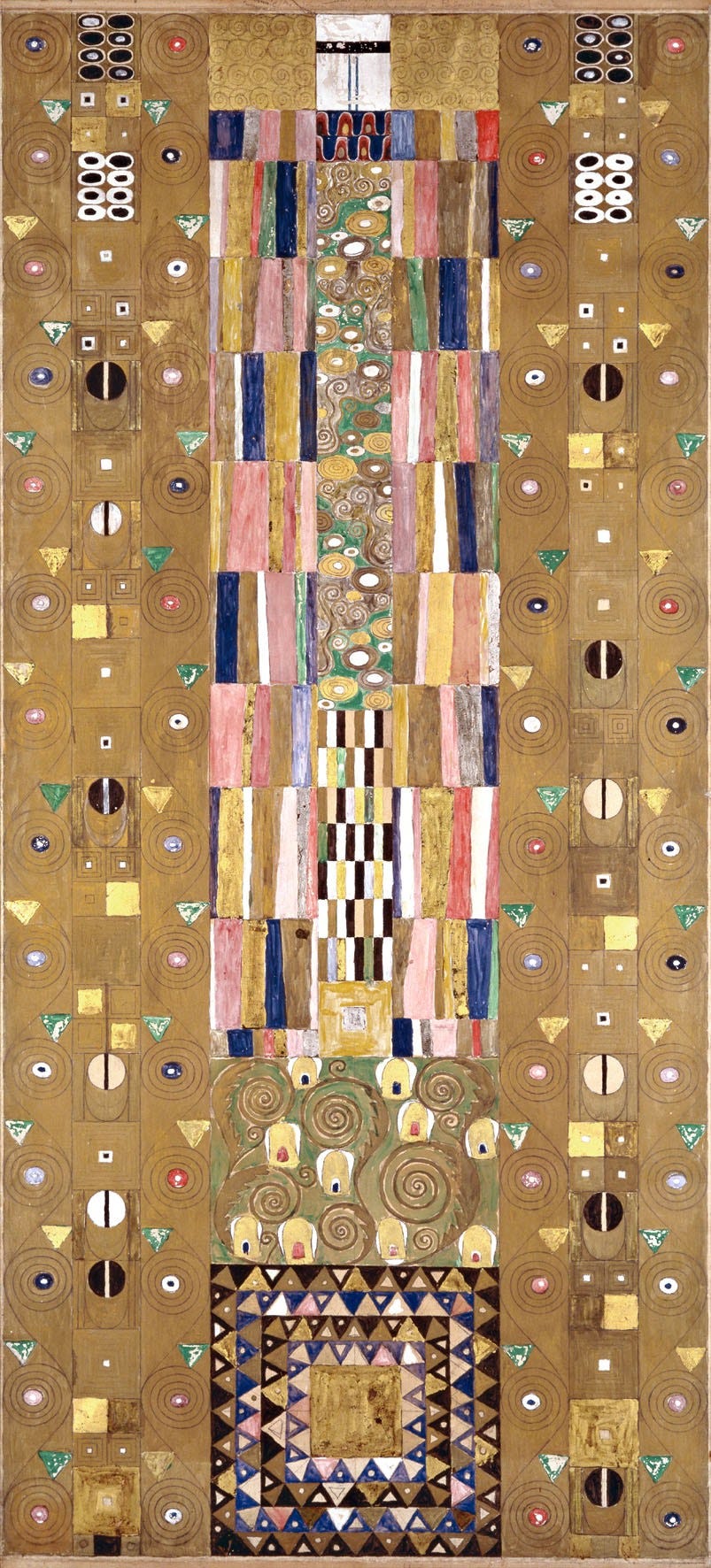
Above the Starry Canopy reads the Beethoven Knight of 1902 as the Father in cruciform Christian-pictorial vocabulary: armored, faced, sword held horizontally at the waist, attended by Compassion and Ambition, with three triangles arranged triadically inside a circle on the shields as the Trinity geometry installed at the armor. Klimt’s Stoclet Knight has none of that. He removed the armor, the sword, the face, the attendants, the shields, and the figural narrative. What remains is the vertical axis. The removal is the iconography.
The audience determined the vocabulary. The Beethoven Knight stood in the Secession exhibition under a published Christian redemption program, surrounded by a Vienna audience trained to read iconography in Christian-pictorial vocabulary. The Stoclet Knight stands in the dining room of Adolphe Stoclet, a Brussels banking heir with no religious commitment in the documentary record, whose palace was the visible form of a soul oriented to mathematics, money, and ornamental display. The Father is translated into the iconographic idiom the patron’s room could carry. The plumb line stands either way. The standard is preserved across both renderings. Two Knights, one office, two vocabularies.
A plumb line is purely vertical, dropped by gravity. It has no character because it is not personal. It is a measure. It does not act. Things either align with it or they do not. It does not intervene in events. It registers them. Each property the Knight exhibits is a property of a plumb line. The match is exact.
The textual anchor is Amos 7:7-9: “Thus he shewed me: and, behold, the Lord stood upon a wall made by a plumbline, with a plumbline in his hand. And the Lord said unto me, Amos, what seest thou? And I said, A plumbline. Then said the Lord, Behold, I will set a plumbline in the midst of my people Israel: I will not again pass by them any more.” The plumb line is set, not wielded. Its presence is the judgment. The crookedness of the wall is revealed by the line hanging beside it.
Klimt sets the plumb line on the short wall at the head of the dining room. The fall narrative runs along the long walls. The standard hangs at the head. The Knight does not intervene because the plumb line does not intervene. Eve falls or does not fall. The Tree bears vultures or it does not. The plumb line measures none of this by acting. The line is invariant. The world is what is held against it. Zuckerkandl’s 1911 description of the Knight as the figure who “watches over the bright glow that makes everything more beautiful and better” is precise. The standard does not improve things by acting. Things are made beautiful by their conformity to it. The glow is the gold ground of the entire frieze. The Knight watches over the standard that makes the gold gold.
The Cemetery Panel and the Eyes
The Stoclet program includes a rectilinear cemetery-grid panel set at the center of the curvilinear field. The panel is framed in white. Its interior is a tiled arrangement of dark compartments with smaller bright punctuations, arranged in the form of a columbarium or burial wall. Around the panel: spirals, ovals, almond-eyes, and the eye-vocabulary that runs through the entire dining-room program.
This grid is the same iconographic object Klimt placed on the Kiss male’s body. The Kiss male’s robe is the cemetery grid overlaid in gold. The Stoclet panel is the cemetery grid presented without the gold, framed, and surrounded by eyes. The dining-room program contains the iconographic object that the Kiss garment carries as ornament. The room is built around the announcement of mortality the Kiss figure brings into the embrace.
The eye-vocabulary that surrounds the cemetery panel is itself iconographically loaded. The eyes are the eyes of Genesis 3:7: “And the eyes of them both were opened, and they knew that they were naked.” The Fall opens vision. The new sight produces shame, knowledge, and the need for covering. Klimt has built the dining room out of this vision. The walls are eyes. The eyes are the diffused condition of post-Fall sight installed as the architectural environment of the family meal.
The family who dines in this room dines above the cemetery and under the eyes. The meal at Stoclet is taken in the room that has the Fall as its iconographic substance. The Knight, the Tree of Life, the Rosebush, and the Eye are not separate decorative elements. They are the iconographic furniture of the post-Fall condition installed as the environment of eating.
The Last Supper reference and the Genesis 3 reference are layered. Klimt has built a room in which the eucharistic table is surrounded by post-Fall vision and stationed above the cemetery grid that announces mortality. The eucharist conventionally promises eternal life through the body and blood of Christ. The room Klimt built around it withholds the promise. The body and blood are taken under the eyes that opened at the Fall, above the grid of the dead. The consolation is not in the architectural program.
IV. The Cruciform Room
The iconographic program installs the cross in the room’s geometry.
The fall narrative occupies the horizontal axis, running along the two long walls. Expectation on one wall, the Tree and Rosebush in the center, Fulfillment on the opposite wall. The viewer entering the room and traversing its long axis follows the fall in sequence.
The plumb line occupies the vertical axis, standing on the short wall at the head of the room. The Knight rises perpendicular to the fall narrative.
They intersect at the viewer’s position in the room.
Klimt and Hoffmann have constructed the cross spatially. The horizontal beam is the fall: longing, temptation, mortality, consummation. The vertical beam is the standard against which all of it is measured. The dining room is built around the intersection. The diners eat at the crossing point.
The cross is built by mirroring. The room is symmetric along its long axis. The Rosebush mirrors across the two long walls. The Tree of Life spans both walls in mirrored composition. The table runs centrally beneath the program. The seating doubles the apostolic twelve into twenty-four around a symmetric arrangement. The only break in the symmetry is the figural pairing at the ends of the long walls: Expectation on one side, Fulfillment on the other. The mirror is ruptured precisely where the narrative requires the rupture. The unbroken mirror would have shown two Expectations, the unfallen Eve repeated. The broken mirror shows the same female figure rendered twice: alive on one wall, consumed on the opposite wall. The asymmetry between the two long walls is the Fall.
The same cruciform device organizes the Beethoven Frieze at proto-cycle scale, where the Knight stands as composite cross on the left wall, the suppliants below him with hands pressed in the geometry of feudal homage and bound captivity, the hostile forces wall opposite, and the mandorla embrace at the right-wall climax. Above the Starry Canopy reads that program in full. Stoclet renders the same cross at full architectural scale, with the diners installed inside the geometry rather than outside it. The Beethoven viewer stood in a room next to the cross. The Stoclet diner sits at the crossing.
This is the cruciform tension this blog has named in other registers. Gravity drawing the vertical. Entropy pulling along the horizontal. The cross as the structural pattern of reality under force. The Trinity as the house standing. At Stoclet the pattern is rendered architecturally. The room is the cross, full size, in marble and gold and electric light, with diners installed inside it.
V. The Table
The room is not yet the device. The device is the table.
The Stoclet dining table is long, rectangular, low, austere, dark wood, slab-form, centered on the long axis of the room. Period descriptions specify twenty-four seats around it, with the unusual feature that the conventional one chair at each head has been replaced by two chairs at each head. The Klimt friezes surround the table on three walls. The table sits beneath the iconographic program and at the focal point of the architectural cross.
The configuration is structurally identical to a Christian sanctuary.
In a Christian sanctuary, the crucifix rises vertically on the wall behind or above the altar. At Stoclet, the Knight rises on the short wall at the head. The altar sits horizontal in front of the cross; at Stoclet the table sits horizontal in front of the Knight, extending along the long axis. The iconographic program of the passion runs along the side walls of the nave; at Stoclet the fall narrative runs along the long walls, with the Stations of the Cross translated into Stations of the Fall. The congregation gathers around the altar to participate in the sacrifice. The twenty-four diners gather around the table to participate in the consumption.
This is not metaphor. This is the architectural plan of a chapel translated into the architectural plan of a dining room. Hoffmann and Klimt have built a Eucharistic space.
The altar in Christian tradition is structurally the tomb of Christ. The early Christian practice of celebrating Mass on the tombs of the martyrs developed into the medieval rule that every consecrated altar must contain a relic, that the altar stone is the sepulchre, that the Eucharistic sacrifice is performed at the tomb-as-altar. The altar-tomb identification is doctrinally settled and architecturally explicit. The sarcophagus becomes the table of the sacrifice. The two surfaces are one surface in two registers.
The Stoclet table operates on this same identification. The long rectangular slab is iconographically a sarcophagus. The same slab is liturgically an altar. The diners eat at the tomb of Eve, who has been consumed in the fall narrative on the surrounding walls. The eating is the participation in the consumption.
The Catholic Mass commemorates the death of Christ as the redemptive sacrifice that reverses the fall. The participants consume the body of the one who died to undo Eve’s consumption. The structure of the Mass is the structure of the cross: vertical crucifix, horizontal altar, congregation gathered, sacrifice consumed, fall reversed.
Stoclet inverts this. The iconographic program on the walls depicts the fall consummated, not the fall reversed. The figure consumed in the surrounding narrative is Eve, not Christ. The body laid out on the altar-as-tomb is the female who has been absorbed by the male figure on the long wall. The diners participate in the consumption of Eve every time they eat at the table. The room is a Eucharist of the fall, performed at every meal, with Klimt as the iconographic priest who designed the program and the Stoclets as the celebrants.
The Knight is now positioned with terrible precision. The plumb line stands behind the altar where the cross stands in a Christian sanctuary. The standard set in the midst of the people measures the act being performed at the altar. The diners eat at an altar over which the plumb line judges. They consume Eve while the standard measures.
VI. The Twelve Mirrored
The shape of the table is the shape of the Last Supper table: long, rectangular, low, with participants seated along the long sides. The Stoclet table is built on the geometry. The seat count specifies the figures who occupy it.
Twenty-four seats around the table. Two at each head instead of the conventional one. The Gospels record thirteen at the Last Supper: Christ and the twelve apostles. Subtract Christ and twelve remain. Mirror the twelve as their inverted counterparts and twelve plus twelve is twenty-four. The Stoclet dining room seats twenty-four. The Last Supper is doubled into its inverted form.
The two-chairs-at-each-head feature, noted by period commentators as unusual and described as egalitarian, performs the iconographic move. Christ at the head of the original Last Supper table is the singular figure who breaks the symmetry. He occupies the head alone because the redemptive sacrifice is performed by one. The doubled head at Stoclet removes the singular head and replaces it with two seats. No one occupies the position Christ would have occupied. The center of authority has been emptied and replaced by a paired arrangement that produces twenty-four equal positions.
Twenty-four disciples without a head. Twelve and their inverted counterparts. No Christ. The fall Eucharist is presided over by absence at the center where Christ would have stood. The Knight on the short wall is the only vertical figure in the room, and the Knight is faceless. The plumb line stands where Christ would have stood, except the plumb line does not preside. The plumb line measures.
The Revelation 4:4 echo is also present. The twenty-four elders around the heavenly throne are themselves a doubled twelve: the twelve tribes of Israel plus the twelve apostles, the Old Covenant and the New Covenant doubled around the divine throne. Twenty-four is the canonical number of the witnesses gathered around the seat of authority. At Stoclet, the twenty-four sit around the altar-tomb. The throne is absent. The witnesses are present. The witnesses watch the consumption.
Every numerical and architectural element keys to the Eucharistic-Last Supper register and every element is inverted. The table is shaped as the Last Supper table; its seat count is the doubled apostolic twelve. The head position is emptied of the singular figure, the cross above the altar replaced by the plumb line. The body consumed is the female figure rather than the male Christ. The iconographic program is the fall narrative rather than the passion narrative, the Eye that watches the offer of forbidden vision rather than the Eye of Providence. The participants gather to consume what the iconography depicts. The Christian liturgical form is preserved in every structural element and inverted in every semantic element. The diners cannot escape the reference. The room enforces it on them.
VII. The Non-Existent Self-Portrait
Klimt wrote an essay called Commentary on a Non-Existent Self-Portrait. The title is a paradox. There is no self-portrait, and yet here is a written meditation on one. The non-existence is the form. The denial is the disclosure. The essay states that there is nothing special to see when looking at the man, that he is a painter who paints day after day, and that whoever wants to know what he is and what he wants ought to look attentively at his pictures.
The verb choice is decisive. Not “what I painted.” Not “what I tried to depict.” What I want.
The pictures are records of desire. The self-portrait is everywhere in the pictures and nowhere on the surface. The artist is hidden in plain sight in the iconographic program. Look at the pictures, and you will see what he wants.
First Love identifies the two halves of Klimt’s non-existent self-portrait. The first half is the Eye distributed across the Stoclet program. The second half is the hand at the throat across the corpus, developed in full at The Toppled Pillar. The two iconographic positions name the artist as watcher and as agent of the act. Klimt is in the room as the gaze and in the embrace as the hand.
The Eye has a precursor at the 1902 proto-cycle. Above the Starry Canopy reads Typhon’s enlarged face on the Beethoven middle wall as the artist’s first deployment of the watcher position, installed as a literal face on a serpent next to the offered bodies of Wollust, Unkeuschheit, and Unmäßigkeit. The Stoclet Eye is the abstraction of the same self-position. The face on the serpent has been distributed into ambient ornament across an entire room. The 1902 watcher has a head. The 1911 watcher is everywhere and nowhere.
At Stoclet, the self-portrait is locatable with precision. The Eye distributed across the frieze is the artist’s gaze. The Eye is everywhere watching, nowhere as a face. The artist’s signature on the work is the Eye that watches the diners eat at the altar where Eve has been consumed. The non-existent self-portrait is the all-seeing eye that has no face because the artist refused the face. He is everywhere the Eye is, and the Eye is the offer of vision that Eve was asked to accept.
This positions the diner within the iconography. The viewer who enters the dining room is invited to look at the frieze. Looking at the frieze is accepting the offer of opened vision that the Eye extends. The aesthetic experience of the painting is structurally identical to the temptation it depicts. The diner who looks accepts the offer. The diner who eats consumes Eve. The diner who attends to the iconography enters the consumption ritually. The room folds the viewer into the depicted act.
Klimt installed his confession in architectural form. He depicted himself in his work as the male figure consuming the female. He told the viewer in writing that the pictures are where to find what he is and what he wants. He installed the device at Stoclet that draws the viewer into the act he was performing. The confession sits at architectural scale, with twenty-four witnesses seated at every meal, under the plumb line, around the altar-tomb, beneath the Eye.
VIII. The Sealed Room
The Palais Stoclet has been closed to the public since its construction. The family has guarded access for over a century. Period descriptions praise the materials and rarely engage the iconography. Zuckerkandl in 1911 noted the Knight’s function and stopped. Warlick in 1992 identified the Egyptian register and stopped. The MAK in 2012 documented the materials and stopped. The scholarship has not entered the room because the scholarship has been studying photographs and cartoons. The structure of the architectural device requires standing in the room and turning around.
The question whether the Stoclets knew what they had commissioned is open. They collected widely, paid lavishly, and lived with the dining room for decades. Either they understood the program or Klimt installed it beyond their reading. The two outcomes converge: the dining room is the iconographic method at its architectural climax, performed on the diners at every meal whether they read it or not.
The room has been sealed for over a century. The Eye has continued to watch. The plumb line has continued to measure. The altar-tomb has continued to wait. The structure is still there.
It is no longer missing.