
The Occultation
What Artemis II Brought Down


A prophet is judged by what he brings down from the mountain.
As I post this, the federal government is hosting a cage fight. Tonight, on the South Lawn of the White House, inside a temporary arena the promoters named The Claw, the Ultimate Fighting Championship stages a card billed as Freedom 250, timed to the President’s eightieth birthday and sold as a tribute to the nation in its two hundred and fiftieth year. The President announced the date himself, at a speech marking the Navy’s anniversary, and he will attend. The weigh-ins were staged at the Lincoln Memorial. It took a federal judge to let the event proceed over a lawsuit that called it an unlawful commercial seizure of public land, a hijacking of the capital’s most sacred civic ground. Fighters will be paid to concuss one another on the lawn of the people’s house, with the blessing of an administration that calls itself Christian. [1]
Ask the plain question the evening invites. What does a self-described Christian government promote when it turns the executive mansion into an arena, fuses a blood sport with the flag and a birthday, and calls the result a celebration of the country? In a cage match the answer is not hard to read: spectacle as worship, domination as virtue, the state as the show. I could prosecute the whole case from the lawn, and most readers would nod along before I finished. That is exactly why I will not start there. The obvious instance implicates no one. I want the quieter one, the same theology wearing a costume that people applauded as holy, the version they cheered without noticing what they were cheering. So before the fight, the flyby.
I read the article on a Friday evening and was angry before I could have said why. It was a careful, generous profile: the pilot of Artemis II taking Communion at his last meal before launch, quoting the Greatest Commandment from behind the Moon, coming home and describing how he had grown comfortable not putting words to what he had seen. Nothing in it was dishonest. Nothing in it was even unkind. It left me agitated in a way I could not immediately take apart, which is its own kind of warning, because diffuse anger is usually either unjust or imperfectly understood. [2]
So I did what I do with a document that bothers me without telling me why. I went looking. I read what the mission actually was and what it cost, the science it returned and the science it did not, the congressional record that funded it, the launch-day rhetoric, the coverage that canonized it, and the older protest poem the astronaut himself still keeps in his ear. The anger did not dissipate under examination. It resolved. What had felt like a single objection separated into seven or eight distinct ones, each able to stand on its own, each aimed at the same defect from a different direction.
This essay is the autopsy, written after the anger rather than during it, because anger makes a poor advocate and I wanted to see whether the case survived cross-examination. It did. What follows is the part that held. I have tried to grant every concession the other side is owed before pressing the charge, because an audit that refuses to concede anything is not an audit. It is a verdict looking for facts.
Begin with the thing itself. Glover went higher than any living man. He rounded the Moon, watched the Earth withdraw into black, saw a solar eclipse from a vantage almost no one has occupied, and came home to account for it. He had prepared the ground for a religious reading. Before launch, Communion. In flight, the commandment to love God and neighbor. Afterward, talk of God, creation, and the beauty of the cosmos. The press supplied the rest, and the mission became a story about faith in space, science and religion reconciled, a Christian astronaut carrying the old words into the new dark.
The question is not whether Glover felt something. I assume he did. The question is what he brought down.
Let me be clear before going further, because everything after it depends on the distinction. This is not a charge of bad faith against Glover. He appears sincere, careful, and in some ways admirable, and nothing here is meant to punish a man for being moved by what he saw. The question is not whether his experience was real. It is whether a real and private experience was converted, by him a little and by others a great deal, into public meaning it could not carry.
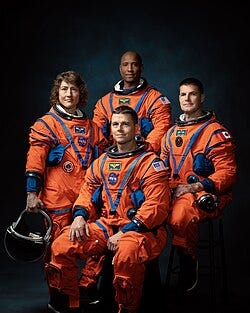
A man does not become a prophet by ascending. He becomes one by returning with a word. Moses brings down law. Elijah hears the still small voice and goes back to act. Christ comes down the mountain toward Jerusalem. Even a false prophet is judged by the content of what he carries, not the altitude at which he received it. The ascent is never the point. The return is.
Glover came back without doctrine, without command, without revelation, without repentance, without even an interpretation he was willing to stake anything on. He came back with a softened precis: love something bigger than yourself, love your neighbor, and understand that this is true for people of any faith or none. By his own account he also came back more comfortable than before with declining to answer. [3]
There is a defensible version of that. Silence can be holy. Not everything seen at altitude needs to be converted into content, and the vertical resists the horizontal machinery of explanation. Declining to label an experience too quickly can be genuine humility. But the silence was not left alone. The coverage and the political reaction packaged it, circulated it, and converted it into meaning on his behalf. A private spiritual event was made into a public instrument. The holy was not merely carried aboard a state mission. It was harvested from one.
What follows is not an attack on faith or on science. It is an audit conducted from inside both, on their own terms. I take the hardest ground first, the dollars and the data, because that is where the case has to be earned before the theology can be trusted. Then the question of what was made of all this, by the press, the politicians, and the people who collected the man for their own use. And last, the question the mission itself raised and never answered: whom did it love.
Part One: The Thing Itself
I. What the Mission Was
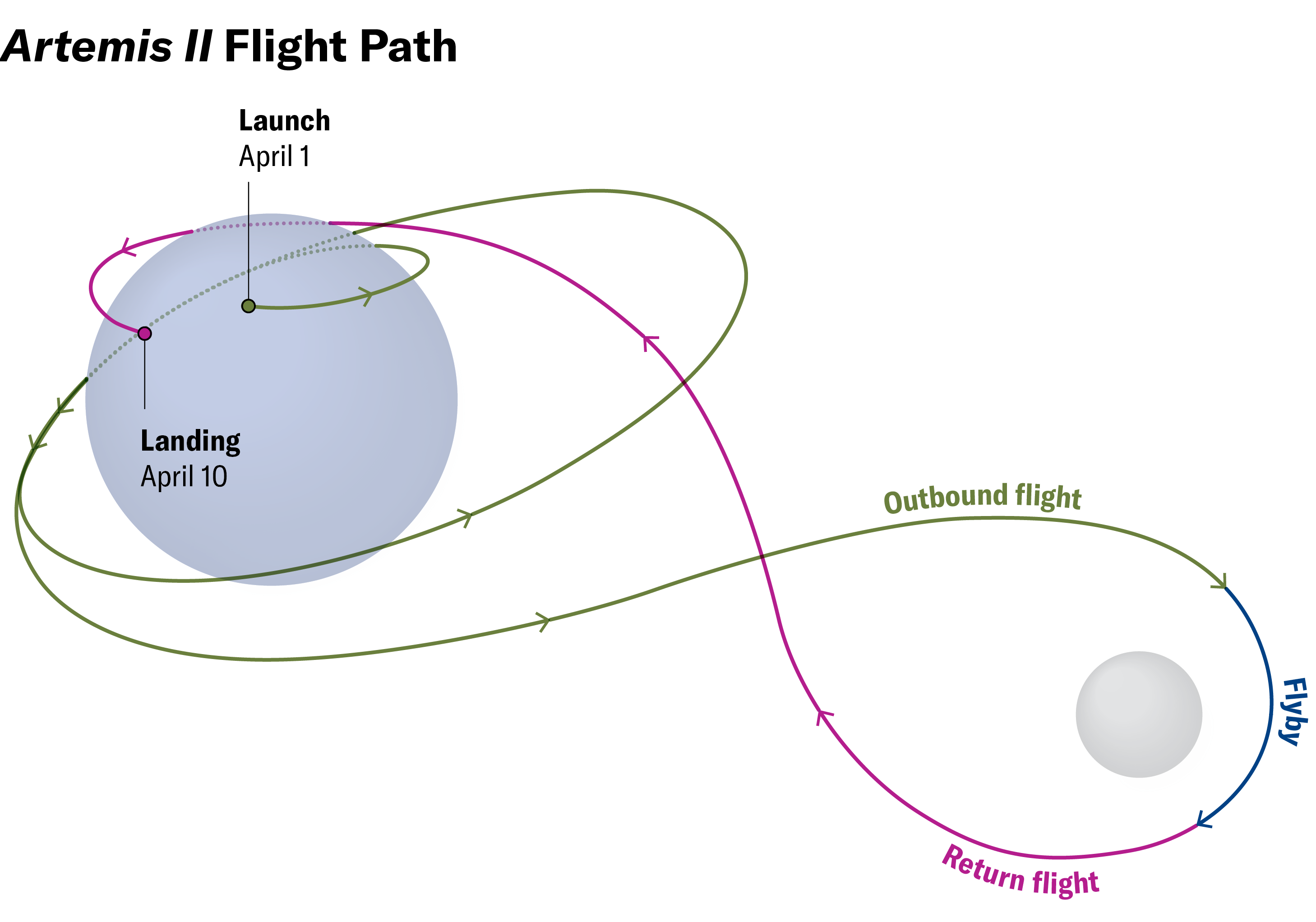
Artemis II was not a Moon landing. It put no one on the surface, achieved no lunar orbit, returned no samples, and conducted no surface science. It was a crewed test flight of the Orion spacecraft and the Space Launch System, a flight of roughly ten days on a free-return loop around the Moon and back, the first crewed flight beyond low Earth orbit since Apollo 17 in 1972, meant to validate Orion’s systems, life support, crew operations, and return capability before the missions that follow. NASA described it accurately as a test flight. [4]
That is not a small thing. Four people rode a new rocket and a new spacecraft farther from Earth than any crew before them and came home alive. Engineering is real work. So is risk, and so is validation.
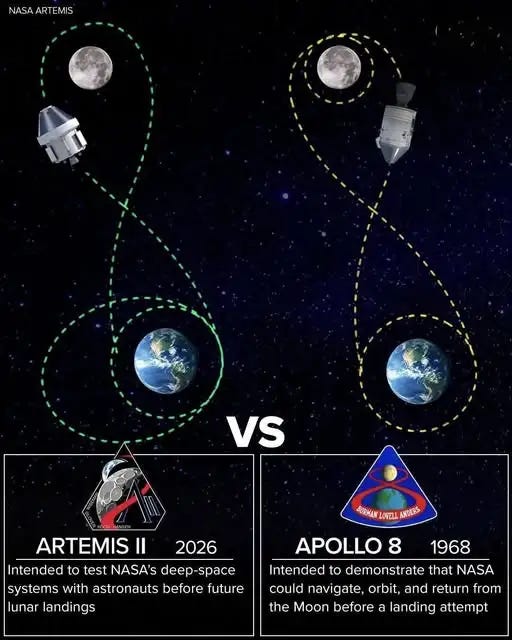
The trouble is the gap between what was done and what was said about it. Artemis II was received as discovery. It was described as a reopening of the heavens, in language thick with history, awe, destiny, and return. Its actual accomplishment was narrower: it proved that a very expensive government launch architecture could carry four human beings around the Moon, without landing, and bring them back. In substance it reenacted Apollo 8, the 1968 flyby, at many times the inflation-adjusted cost and with none of the novelty.
That has to be said plainly, because the whole argument is an argument about proportion. A systems test earns systems-test language. It does not earn prophetic language without producing prophecy, or scientific triumph without producing comparable science, or Christian triumph without producing anything distinctly Christian.
The record distance was real, about 252,756 miles from Earth, surpassing Apollo 13 by roughly 4,100 miles, the farthest any human beings have traveled. It is also about 1.36 light-seconds. The nearest star system lies about 4.25 light-years off, on the order of one hundred million times farther than Artemis II went. [5]
I am not sneering at the courage. I am stating the scale. The crew did not reach the edge of the cosmos, or the first outer rung of it. They stepped a little farther off the porch than Apollo 13, looked back, and were undone by the sight of home. The awe was real and the distance was trivial. What moved them was not the magnitude of the journey but the poverty of the human frame: move the eye one step off the porch and the world cracks open. That does not establish the cosmic significance of the mission. It establishes the confinement of the observer. They were moonstruck at the end of the driveway.
II. The Science It Did Not Bring Back
The scientific comparison is where the rhetoric starts to give way, and the contrast is not flattering.
China has been running an uncrewed lunar program that banks a specific, falsifiable result on each flight and builds a capability the next flight uses. Chang’e 4 made the first soft landing on the lunar far side in 2019. Chang’e 5 returned near-side samples in 2020 and found volcanic activity roughly two billion years ago, extending the known lunar volcanic timeline by about a billion years. Chang’e 7, in 2026, is tasked to scout south-pole water ice, and Chang’e 8, in 2028, is to test using lunar material in place and lay groundwork for a base. The far side is reached through a relay satellite, Queqiao-2, that makes the communication possible. [6]
The centerpiece is Chang’e 6. In June 2024 it returned the first samples ever taken from the far side of the Moon, out of the South Pole-Aitken basin, and the analysis produced four cover papers in Nature: evidence of far-side volcanism around 4.2 and 2.8 billion years ago, an ancient magnetic field that appears to have rebounded around 2.8 billion years ago and filled a billion-year gap in the lunar paleomagnetic record, and a far-side mantle measurably drier than the near side. That is original knowledge about the body itself, the kind that revises textbooks. [7]
Artemis II returned no lunar material. It ran human-health and technology experiments useful to future crews, including biological and performance studies, but nothing that approaches the yield of far-side samples. [8] Set the two side by side and the asymmetry is stark. One program is accruing knowledge. The other reenacted a lap. The country spending roughly a third of the United States space budget brought home the first far-side rock in history; the bigger spender brought home footage.
Now the concession the comparison requires, because without it the contrast is unfair. The two missions were built for different purposes, Chang’e 6 as a sample-return science mission and Artemis II as a crewed systems test, so the gap in scientific output reflects design and is not by itself a measure of either program’s total capability. It is also true, and I will not pretend otherwise, that the broad claim that human crews add nothing to science is wrong as a general law. Field studies bear this out: at a Mars-analog crater a highly automated rover was only about five to ten percent as productive per unit time as a geologist in a spacesuit, who was in turn a fraction as productive as a geologist working in shirtsleeves; Apollo 17’s crew drove some thirty-five kilometers in three days and selected samples by trained judgment no contemporary robot could match. The honest case for humans is not pure science but space development, since present robots cannot build or repair other robots. [9]
Concede all of that, and the indictment narrows to something unanswerable. Whatever a human crew might add in principle, none of it was in play here, because Artemis II landed nowhere and collected nothing. It did no field geology, deployed no instruments, returned no samples, and built no infrastructure. On this flight the crew did no lunar science a machine could not have done, because the crew did no lunar science at all. They were not instruments. They were the cargo, and their symbolic value was the entire point. Scientific American has made the structural version of this critique for years: NASA sells its programs with entertaining visuals and, in its words, “compelling human characters.” The astronaut is the compelling human character. That is a casting decision, not an experimental design. [10]
If the mission is defended as engineering, the defense holds. If it is defended as geopolitical theater, it is at least honest about itself, because the people who funded it said so on the record. At a 2025 Senate Commerce hearing organized around thwarting China in the space race, a witness argued that whoever reaches the Moon first will “write the rules of the road,” and that controlling the Moon means controlling the Earth; the economic witness tied support for Artemis directly to beating China and building a stronger industrial base. [11] A representative called space the “ultimate military high ground.” The acting administrator cast the moment as a second space race the Chinese would not be allowed to win. The confirmed administrator told the Senate that America would return to the Moon before its great rival, and ranked the value as scientific, economic, and national security, in that order. Science was the third item on a list headed by rivalry. [12]
And here is the contradiction the rhetoric cannot survive. The same administration that sold Artemis as the instrument for beating China proposed, in its own budget requests, to cut NASA’s science by roughly forty-seven percent, from about $7.3 billion to $3.9 billion, while seeking close to a billion dollars more for the Moon program. Of all the agency’s directorates, only human exploration was slated to grow. The Planetary Society called the science cut an extinction-level event, and a Republican Congress refused to enact it. [13] A government that believed its own language about discovery would not try to halve discovery to pay for the parade. It cut the science and funded the flag. Defended as science, then, the mission does not merely come up short. It was advanced by people who were busy defunding the science.
III. What It Cost, and What It Burned
The NASA Office of Inspector General put the production and operations cost of a single SLS and Orion launch at about $4.1 billion across Artemis I through IV, before earlier development costs, and projected roughly $93 billion in Artemis spending through fiscal year 2025, with a warning that the program faced serious sustainability problems if costs were not brought down. With the exception of the Orion capsule, its subsystems, and the supporting launch facilities, the hardware is expendable and single-use. [14]
This is the point that must not dissolve into the truism that space is expensive. Of course it is. The question is never whether exploration costs money. The question is what the money bought, what it threw away, what went undone in its place, and what moral vocabulary was draped over the purchase.
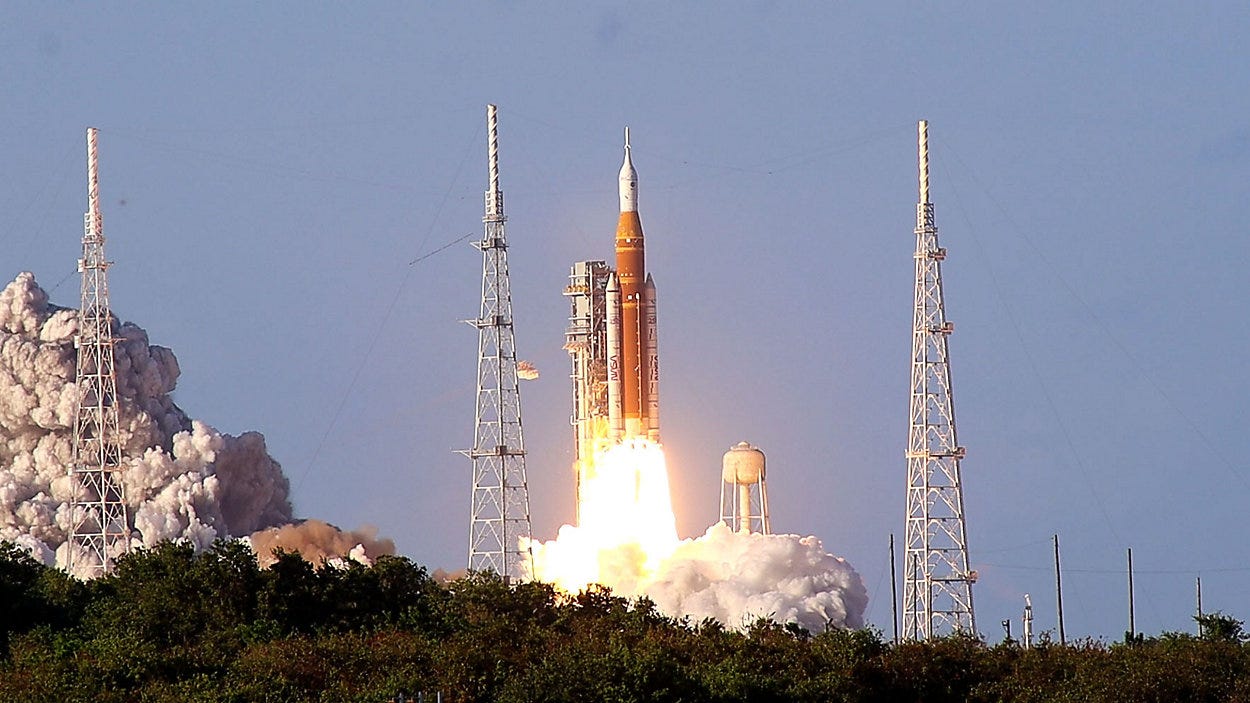
Begin with what it threw away, because the waste is not incidental, it is designed in. The four RS-25 engines that fly on each launch are not new. They are flight-proven Space Shuttle engines, priced between roughly $100 million and $145 million apiece under NASA’s production contracts, so each launch consumes something on the order of half a billion dollars in engines that NASA spent three decades learning to reuse. The agency paid its contractor to modify engines built to fly again into engines built to be thrown away. The booster casings include segments flown on as many as forty shuttle missions, the oldest dating to 1982. The Orion service module’s main engine had earlier flown as a shuttle orbital maneuvering engine. The agency took hardware specifically engineered to be recovered and flown again, flew it once more, and let it burn or sink. [15] The vehicle that did this holds about 733,000 gallons of supercooled hydrogen and oxygen in the core stage, and its two solid boosters consume something like five and a half tons of propellant a second to produce the spectacle. [16] The spectacle is astonishing because the consumption is astonishing, and then most of the hardware is simply gone.
This is not a fringe complaint. A former NASA administrator has called the architecture excessively complex and unrealistically priced, and said it compromises crew safety. That is not a critic from outside the agency. That is a man who ran it. [17]
Now place the price beside the unmet need, carefully, because the opportunity-cost argument is easy to abuse. I found no peer-reviewed study isolating Artemis II and pricing it against hunger or clean water; what exists are program-level juxtapositions, not controlled analyses. The comparison is blunt but not frivolous: the World Food Programme has estimated that roughly $40 billion a year would move the world toward ending hunger, and that about $7 billion would provide one daily life-saving meal for a year to the fifty million people nearest famine, less than ten percent of the projected cost of the Artemis program. Feeding America says a single donated dollar can help provide at least ten meals. [18] [19]

And the honest counterweight, which I include because leaving it out would be advocacy rather than audit. NASA is a small share of federal spending, on the order of three to five tenths of one percent, so the literal trade between a Moon rocket and a soup line is not how a budget works. Defenders cite a spinoff multiplier, a claim that lunar programs return around three dollars to the economy for every one spent, though that figure is contested and at least one recent analysis argues modern space activity shows far weaker spillover than the Apollo era. A NASA-affiliated researcher has said plainly that she sees no evidence human settlement of space will benefit humanity, and economists have struggled to find a financial justification for crewed space activity at all. [20]
Granting all of that, the verdict on the mission’s own terms is intact. A nation may decide that geopolitical competition, national prestige, industrial policy, and future exploration justify billions for a single-use lunar flyby. The strongest case for Artemis is not love. It is power, capability, rivalry, and the long wager that expansion beyond Earth repays its cost. Make that argument. What you may not do is call the decision neighbor-love and expect the commandment to stay quiet. Do not baptize it as mercy. Whether it had any claim to mercy at all is a question I will hold until the end, where it belongs.
IV. The Atmosphere It Spent
The environmental point has to be made carefully, because the lazy version collapses on contact.
One launch did not change the climate. The core stage burns hydrogen and oxygen, whose main combustion product is water vapor, and the emissions literature does not support treating this single flight as a climate catastrophe in miniature. Pretending otherwise would only discredit the real objection. [21]
The real objection is narrower and harder to dismiss. Solid rocket motors release chlorine compounds and alumina particles into layers of the atmosphere that surface emissions do not reach in the same way, and rockets deposit soot where it lingers. A 2022 study in Earth’s Future found that rocket black carbon produces radiative forcing per unit mass on the order of five hundred times that of surface and aviation sources. A 2025 study modeled how near-future launch rates could slow the recovery of the ozone layer, identifying chlorine from solid motors and black carbon as the principal agents. [22]
So the charge is not that Artemis II wounded the climate by itself. The charge is the contradiction. The state used science as spectacle while discounting science as warning. It invoked the cosmos while venting exhaust through the only atmosphere we have. It treated a dead world as worth the sacrifice and the living world beneath it as an acceptable place to put the externality. This is not an argument against science. It is atmospheric chemistry set against the theater of exploration, the living Earth set against the cinematic Moon. The mission photographed a sterile world by spending part of the only habitable one. That closes the audit. The facts are not in serious dispute. What remains is what was made of them.
Part Two: The Harvest
V. The Faith Was in the Man, Not the Mission
Structurally, nothing about Artemis II was Christian.
It was a federal mission, funded by public money, run by a secular civil agency, and justified by engineering, exploration, national leadership, international partnership, and strategic competition. The agency even hired spiritual and cultural advisers before the flight to brief the crew on how the Moon is seen around the world, which is the behavior of an institution managing meaning, not receiving revelation. [23] Remove Victor Glover and the mission is unchanged. The Christianity was in the man, and the reaction kept collapsing that distinction.
Glover did supply the material. Asked about Easter in flight, he spoke of reading the Bible and called Earth a created place, a spaceship made to give us somewhere to live, while adding that the thought held true whatever one’s faith or lack of it. At a homecoming event he said he wanted to thank God in public. He worships with the Churches of Christ, took Communion at the crew’s last meal before launch, and had carried Communion to the space station on an earlier flight. [24] None of that makes the mission Christian. It places a Christian inside a secular mission. The collapse was completed by others: a widely shared post declared that “space travel is distinctly Christian,” stringing together Apollo 8’s Genesis reading and Buzz Aldrin’s lunar Communion as if a pattern of Christians in spacecraft made spacecraft Christian. [25]
Nor did the flight produce anything distinctly Christian. The crew saw Earth, darkness, the Moon, an eclipse, distance, fragility, scale. These are real, and none is sectarian. A Muslim, a Hindu, an atheist, a Stoic, a Buddhist, or a frightened child could have seen the same things and trembled. The eclipse was geometry. The Earthset was optics. The void was space. The interpretation belonged to the observer. A man who carries Christianity to the Moon and returns saying the Moon confirmed Christianity has not necessarily found Christianity there. He may have found what he brought.
The record makes the point better than I can. The two crew members who have not publicly discussed any faith, Christina Koch and Jeremy Hansen, reported the same awe. The commander, Reid Wiseman, calls himself not really a religious person, and yet among his first acts after splashdown was to ask for a chaplain, a Navy lieutenant named Eliseo Morales, and to break down in tears because the crew felt they had no other way to explain what they had seen. He later said he had told Glover they had slipped through the hands of God on that mission, and that Glover agreed. That may be the most persuasive religious datum in the entire record, precisely because no one packaged it. The believer gave a broadcast. The man who professes no faith, and was selling nothing, gave the unguarded thing. [26] It does not make the mission Christian. It makes the experience human.
Glover’s own framing is gentle by design, and the coverage seized on exactly the quality that made it safe. Commentators praised what one called his “gentle faith.” [27] He cast his message as true for people of any faith or none, which is why it traveled so easily. It did not press the scandal of the first commandment. It did not insist on the God of Israel, the crucified Christ, resurrection, sin, repentance, judgment, grace, or the Church. It rendered the Greatest Commandment as civil religion: love something bigger than yourself, and love your neighbor. That may be humane and pastorally generous. It is not a Christian particular. It is Christianity made safe for a federal broadcast. The first commandment names God; on the broadcast it became something bigger. The result is a message nearly everyone can applaud because nearly no one is accused. No idol is named, no empire judged, no sinner called to repent. Christ is invoked and immediately translated into something the state can carry without embarrassment. That is not prophecy. It is devotional vapor. And vapor is portable, which is the whole problem, because it can be carried wherever its handlers want it to go.
VI. What the Press Made of It
The first thing they did with the vapor was bottle it as uplift.
Glover guessed that the warm reception to his remarks might mean that “people’s hearts needed something,” at a time when, as he put it, there was a lot of negativity in the air. [28] Needed what? He does not say. He names no wound and offers no mechanism by which a lunar flyby healed it. He gestures at a general negativity, as if the country were under a low-pressure system of the spirit and Artemis II had moved through with clearing skies.
The press did not interrogate the sentence. It amplified it. The coverage described a mission steeped in spiritual significance from blastoff to splashdown, ran the breathtaking photographs, canonized the gentle faith, and profiled a commander still, in one magazine’s word, moonstruck. This is the machinery the Scientific American critique predicts: hand the public a compelling human character and it will supply the meaning the mission did not. The reporting did not lie. It simply took the casting bait, mistook the awe of four tired people for a national sign, and printed the feeling as news.
And the feeling was the product. What the coverage delivered was absolution by spectacle: a national event large enough to feel cleansing, religious enough to feel holy, modern enough to feel like progress, vague enough to include everyone, and expensive enough to seem important. Awe without command. Transcendence without repentance. Christianity without the cross, science without the data, patriotism without humility, love without the neighbor. The press got a heroic frame, the public got the sense of having risen above the world while the world stayed exactly where it was, and almost no one asked what the mission had actually obeyed, discovered, or loved.
VII. The Allah Test
State the constitutional point precisely. Glover did not surrender his First Amendment rights by becoming an astronaut. A public employee remains a person. He may pray, speak personally, and carry his faith into his work, so long as the state is not coercing others, establishing a religion, or converting his private expression into official doctrine. Current Supreme Court doctrine protects private religious expression by public employees, and the First Amendment protects both free exercise and free speech. [29] So the argument is not that NASA had a duty to silence him. It did not.
The argument is that the public reaction exposed the asymmetry establishment always tries to hide. The majority’s faith is heard as gentle, universal, and familiar. An identical act by a minority is heard as sectarian, foreign, and political. Call it the Allah test. Imagine the same capsule, the same federal mission, the same silence behind the Moon, the same broadcast, and an astronaut who returns saying that what he saw revealed the greatness of Allah, who praises Allah on splashdown, whose clip is circulated as proof that spaceflight is distinctly Islamic, and a president who closes the moment by asking Allah to bless NASA and the greatest nation in history. No serious person believes the reception would be the same.

We do not even have to imagine the mechanism, because the history records it running in both directions. When the Apollo 8 crew read from Genesis while circling the Moon in 1968, the reading drew a lawsuit and left NASA wary of religious rhetoric for decades. The constraint was real when the words were merely unfamiliar to some. It eased the moment the words were the majority’s own. The anxiety appears when the invocation feels foreign and recedes when it belongs to the tribe, which is the tell. A free-exercise principle that hears the majority’s God as gentle on a federal channel while it would erupt at a minority’s is not freedom of religion. It is establishment in freedom’s coat.
The Constitution carries both religion clauses in one breath, no establishment and no prohibition of free exercise, and the difficulty lives exactly here. The government should not suppress Glover’s faith because it is religious. The public should not pretend that a Christian invocation on a federal platform becomes neutral merely because the majority recognizes the words. The United States was not founded as a Christian church. The Treaty of Tripoli, ratified in the founding generation, stated that the government of the United States is not founded on the Christian religion and bears no hostility toward Muslims. The point is not that America is anti-Christian. It is that the federal government is not the Church. Caesar may protect worship. Caesar may not become worship. [30] The majority forgets this because it experiences its own symbols as air. The stranger’s God is heard as religion. The tribe’s God is heard as weather.
VIII. Domination Theology
The President made the hidden part explicit, in writing, on the day of the launch.
In a Truth Social post he called the Space Launch System among the most powerful rockets ever built, said it was sending astronauts farther into deep space than any human had gone, declared that the country was winning in space, on Earth, and everywhere in between, insisted that America does not merely compete but dominates, and closed by asking God to bless the astronauts, NASA, and “the Greatest Nation ever to exist.” [31]
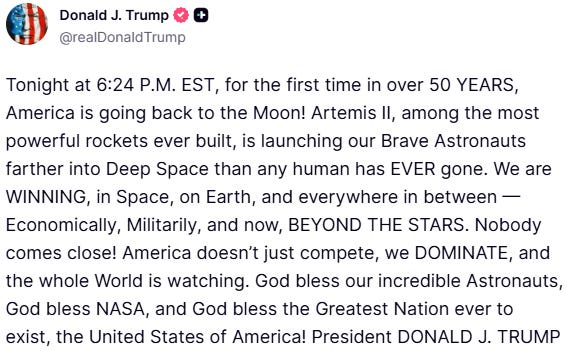
This is where civil religion stops pretending to be gentle. Set the statement beside the Gospels, and no invented quotation is required; the documented words and the text of Matthew do the work. Christ says the greatest among you must be servant; the statement says America dominates. Christ blesses the meek, who will inherit the earth; the statement blesses the greatest nation ever to exist. Christ warns against piety performed to be seen by men, and tells his followers to pray in secret; the statement fuses God, NASA, the astronauts, and national supremacy into one public benediction. Christ says render unto Caesar what is Caesar’s and unto God what is God’s; the statement renders God to Caesar as a closing line. The juxtaposition is the argument.
The theology of that statement is not Christianity. It is national self-exaltation with a Christian garnish, a rival gospel in which the nation is the god and dominance is the sacrament. It does not proclaim a crucified God. It conscripts God as the final adjective of American power and the closing applause line of a victory post, which is the use a man makes of a deity he treats as a mascot rather than a judge. And this is where the culpability sorts itself out. Glover supplied a sincere and gentle faith, and his soft universalism made the religious moment portable enough to carry anywhere. The press made it uplift. The President made it dominion. Love went up in the capsule. Domination came down in the press release. The accessory was sincere. The offense belongs to the people who took what he handed them and turned it into a weapon.
IX. The Trophy
There is one more use the man was put to, and it deserves a single pass rather than a sustained one.
Conservative commentators embraced Glover as an anti-woke trophy, praising him for describing his seat as human history rather than Black history, a useful Black astronaut for a movement that had spent the prior years warning about so-called DEI pilots. The trouble is the man they adopted. Glover has said he listens to Gil Scott-Heron’s “Whitey on the Moon,” the 1970 poem that set the spectacle of lunar spending beside the Black Americans who went sick, poor, and unheard, on a regular rotation, reportedly about twice a week. He has tied that history to his own family and to a country that sent him to space after once denying men like his grandfather the chance to fly. [32]

That makes him more interesting than the people who annexed him. The same man they held up as proof against racial grievance carried the oldest racial grievance about the space program in his ear, on purpose, as a discipline. He knew the poem. He knew the protest. He knew that the rocket always rises over someone’s unpaid bill. That does not make him a hypocrite. It makes the public use of him dishonest. The question is enough on its own, and I will ask it once and leave it open: what does it say that the movement most afraid of the unqualified diversity hire adopted a Black astronaut as its mascot and never noticed he had been driving to the launchpad listening to a poem that calls the whole enterprise whitey’s vanity?
Part Three: The Reckoning
X. Whom Did It Love
I said the case for the mission is power, not love, and I promised to test the other claim at the end. Here it is. Glover did not defend Artemis II as power. He quoted the Greatest Commandment. So take him at his word and let the commandment ask its own question.
In Matthew, Christ gives two commandments: love God with everything you are, and love your neighbor as yourself. We have prosecuted the second and skipped the first, which is backwards, because Christ put the first first. So begin where He began, with the Father, and ask the harder question. Take the whole Bible as the Father’s word, and point to the place where the Father, and the things the Father is shown to care about, were advanced one inch by this flyby.
There is no such place, and the reason is structural. The mission’s animating premise is that significance is found by ascending. Higher than any living man. Farther than any human has gone. The Father’s word was written to refuse that premise. God is not overhead, to be reached by altitude and brought down by engineering. In Scripture the movement that matters runs the other way. He comes down.
Begin at Babel. In Genesis 11 a people gather on a plain and resolve to build a tower with its top in the heavens, and to make themselves a name. Ascent and a name, in a single passage. The Lord comes down, confounds their speech, and scatters them, and the episode stands ever after as the archetype of collective self-exaltation. Artemis II is Babel with telemetry, and the President supplied the line Genesis leaves implicit: a name made great, nobody close, the greatest nation ever to exist.
The engine of that name is rivalry, which is where the law reaches past the act to the want behind it. The tenth commandment forbids coveting what belongs to your neighbor, and I will be precise, because the literal fit is imperfect: the Moon is no one’s, so the United States is not coveting a neighbor’s field. But coveting is the single commandment aimed not at a deed but at a disposition, and the disposition is unmistakable. We dominate. Nobody comes close. A second space race the Chinese will not be allowed to win. The good being sought is not the Moon, not knowledge, not the neighbor; it is the bare condition of not being passed, a desire defined entirely by reference to a rival. James names the mechanism: you covet and cannot obtain, so you fight and wage war, and the wars come from the desires at war within you. Set that beside the ultimate military high ground and controlling the Moon means controlling the Earth, and the race stops being a figure of speech. It is covetous desire with a defense budget, and a nation whose stated end is supremacy over a rival has already chosen its god.
Scripture even forecloses the literal error. Moses tells Israel the commandment is not in heaven, that you should say, who will go up to heaven and bring it down for us, because the word is very near you, in your mouth and in your heart. Paul repeats the warning: do not say, who will ascend into heaven. The Psalmist marks the boundary the mission crossed: the heavens are the Lord’s, but the earth He has given to the children of men. The flyby is that false question made flesh, a quarter-million-mile errand to go up and retrieve what was never up there and was never lost.
Then the passage that should settle it for anyone reading the mission as devotion. In the wilderness the tempter sets the Son on the pinnacle of the temple and dares the spectacular sign, then carries Him to a high mountain, shows Him all the kingdoms of the world and their glory, and offers the lot. Height, spectacle, dominion: the three things the mission delivered are precisely the three the Son refused. Milton built the whole of Paradise Regained to that climax, the brief epic turning on the pinnacle and the refusal of the glittering offer, the kingdom won by standing rather than rising. Artemis II accepted the bargain Christ declined. It went up. It performed the sign for a watching world. And the President closed on the kingdoms and the glory. What the Son rejected as the devil’s own terms, the state staged as a triumph and called holy.
Nor is the Father shown to want the offering. A pillar of fire burning through hundreds of millions of dollars, its smoke ascending, is a burnt sacrifice in every line of its form, and the prophets are merciless about that sacrifice when it stands in for justice. Micah: He has shown you what is good, to do justice and love mercy and walk humbly, not to send up smoke. Amos: spare me the noise of your songs, and let justice roll down like waters. Isaiah: I am full of your burnt offerings, your incense is an abomination, your hands are full of blood. Hosea, whom Christ quotes twice over: I desired mercy, and not sacrifice. The mission is the very offering the prophets say the Father despises when it is sent up in the place of justice done on the ground.
And beneath all of it lies the shape the gospel actually takes, which is descent. Paul: though He was in the form of God, He emptied Himself, took the form of a servant, and humbled Himself to death. The Father’s signature act is not elevation but condescension, the high made low to serve. A mission whose entire meaning is height has not merely failed to honor that God by a degree. It has run the film backward. They went up to be seen. He came down to wash feet.
Which carries us back to the neighbor by the shortest road, because the two tables are not two separate audits. John closes the gap between them: he who does not love his brother, whom he has seen, cannot love God, whom he has not seen. That is not a sentiment. It is a rule of evidence. The neighbor is the only admissible proof of the first commandment, and a love for the Father that leaves the neighbor in the road is, on John’s plain terms, no love for the Father at all. The first-table failure and the second-table failure are one failure seen from two sides. Having found nothing in the Father’s word that the ascent advanced, we can turn to the only test the word will accept. [33]
In Luke, asked who the neighbor is, Christ answers with the Samaritan. The neighbor is not humanity admired from altitude. The neighbor is the man left half-dead in the road, and the faithful response is not contemplation but proximity: interruption, expense, bandages, transport, lodging, and a promise to cover whatever more is needed. The Samaritan does not love mankind from the sky. He crosses the road.
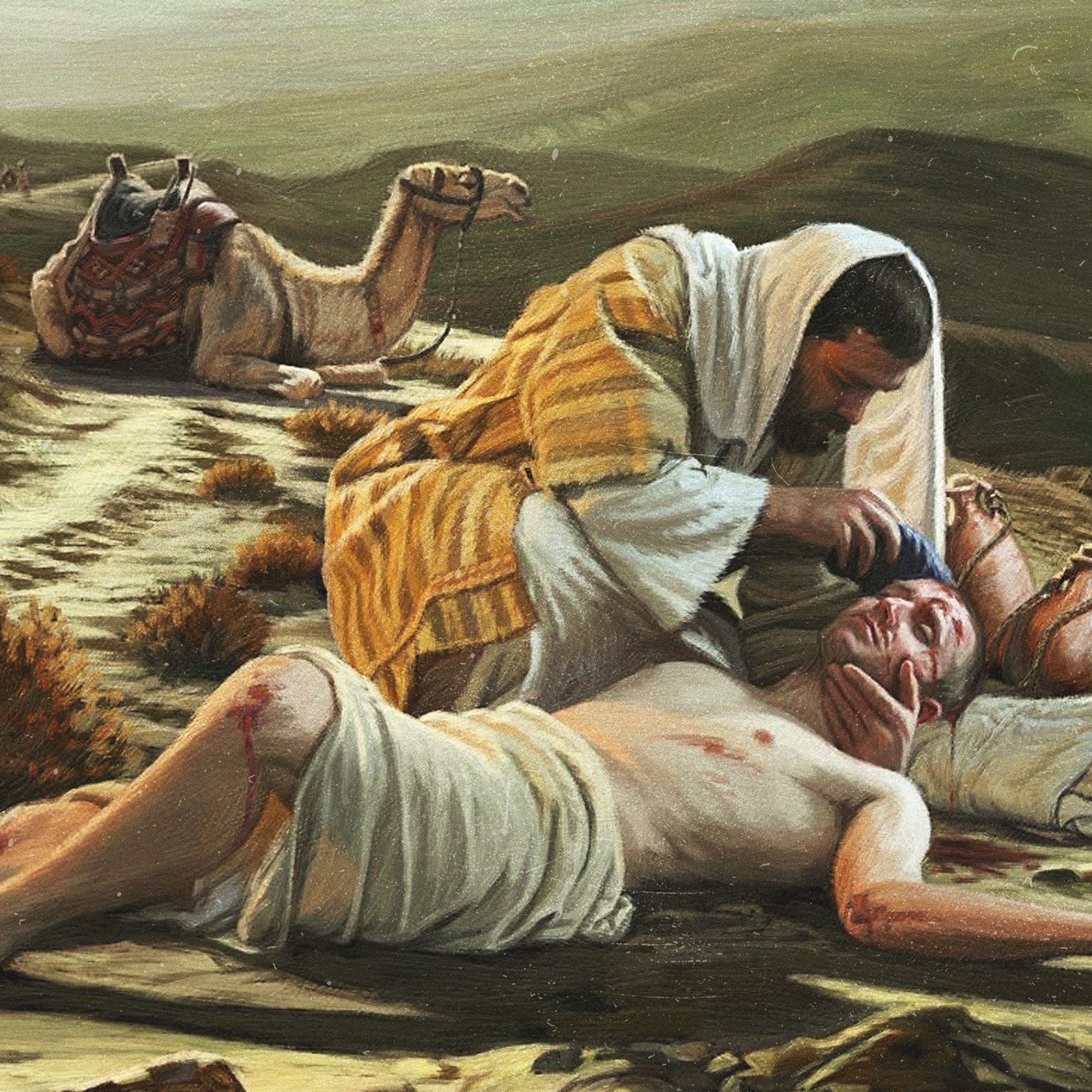
So ask it. Whom did Artemis II love? No one was fed, housed, or healed. No wound was bound, no prisoner visited, no stranger taken in, no widow defended. No child drank cleaner water because four astronauts looped the Moon. To the person without dinner, the $4.1 billion this flight consumed is not a symbol. It is dinner, and many dinners, and medicine, shelter, water, transport, clinics, and food banks, the work done on Earth among the people Christ actually named as neighbors. A nation may spend on telescopes and ships without bandaging a man in a ditch. What it may not do is lift the command to love the neighbor off the road, send it into a capsule, and bring it back as content, and then act surprised when the hungry ask what was on the table.
A senior NASA official reportedly asked, in substance, what we are doing if we cannot take love to the stars. It is a beautiful sentence, and it condemns the enterprise. [34] What love did we take? Did the stars receive it? Did the Moon need it? Was the vacuum improved, the eclipse comforted, the dead regolith any less dead for four people passing overhead? The commandment does not tell us to love the stars. It tells us to love God and neighbor, and the neighbor is on the road. The hungry are on Earth. The atmosphere is on Earth. The treasury is on Earth. The sick, the stranger, the prisoner, the widow, the orphan, the debtor, and the child are all stubbornly on Earth. To love them from the Moon is not nothing as sentiment. As obedience it is almost nothing.
Here the defenders will say that inspiration matters, and they are right. People need beauty, awe, shared events, and reminders that the world is larger than the workday and the feed; a civilization without wonder becomes a machine for appetite and fear. But wonder is not automatically a virtue. Awe can be escape. Inspiration can be anesthetic. Spectacle can substitute for mercy. When a people says its heart needs something, the first question is whether it needs comfort or correction. Artemis II gave comfort. It did not correct. It never asked whether the borrowed words had been obeyed, whether one neighbor had been loved at anything near the cost of the launch, whether science should turn us first toward the world we are burning rather than the dead one we photograph, or whether the majority’s God sounds neutral only because the majority owns the loudspeaker. It rose above the questions. That was the problem.
XI. The Empty Return
The mission did accomplish something, and that has to be granted. Orion flew with a crew. SLS launched. The capsule came home. Systems were tested. Four people survived a deep-space flight farther out than any crew before them, and future missions may depend on the data. A nation can rationally value that.
But none of that was what the event was sold as. It was sold as meaning, so judge the meaning. The audit found thin science championed by an administration cutting the science, reusable hardware incinerated to repeat a 1968 result, and exhaust vented through the atmosphere the same science begged us to protect. The harvest found a gentle, sincere, private faith converted by the press into uplift, by the Constitution’s would-be guardians into establishment in freedom’s coat, and by the President into dominion. The reckoning found no neighbor loved at anything near the cost of the launch. Three movements, one defect: at every level the mission took something real and small and dressed it as something holy and large.
What did people’s hearts need? Apparently to feel that the country could still rise, that God still approved, that science still enchanted, that America still dominated, and that love had somehow gone with us into the dark. But love did not go to the stars. Love is not an atmosphere around whatever expensive object we launch. Love is the act that turns toward the neighbor when the neighbor interrupts the mission. It did nothing for my heart but sharpen it, which is the only honest thing an autopsy can do.
Artemis II went to the Moon and came back. The neighbor stayed in the road.
A prophet is judged by what he brings down from the mountain, and this one brought back content.

Tonight the theology only changes costume. The same administration that blessed a Moon flyby as proof of national supremacy will preside over a cage fight on the lawn of the people’s house, on the President’s eightieth birthday, and call it a tribute to the country. Milton saw this scene at the end of Samson Agonistes: the blinded champion dragged out to make sport for the Philistine lords at the feast of their god. The lords are gathered on the South Lawn tonight, and they have named the temple Freedom. From the Moon to the lawn, from fire to blood. The costume changes. The theology does not.
Notes
[1] UFC Freedom 250 (UFC White House), June 14, 2026, South Lawn of the White House, in a temporary arena dubbed The Claw; weigh-ins held at the Lincoln Memorial; promoted as part of the America 250 semiquincentennial and timed to President Trump’s 80th birthday, the date he announced at an October 2025 Navy anniversary speech; Trump confirmed he would attend; a government filing cited more than $60 million expended on the event; a lawsuit challenged it as an unlawful commercial use of public land, and a federal judge (Mehta) declined to block it. Sources: Reuters; NPR; Associated Press; ESPN; U.S. News; Fox News.
[2] Jack Jenkins, “Astronaut Victor Glover is still trying to find the spiritual words to describe his Moon mission,” Religion News Service, June 12, 2026. The profile is the occasion for this essay and the source for the Communion before launch, the Greatest Commandment broadcast, and the surrounding spiritual framing.
[3] Religion News Service (Jenkins), reporting Glover’s stated comfort with declining to put words on the experience.
[4] NASA, Artemis II mission materials describing the flight as a crewed test of Orion and the Space Launch System on a free-return lunar trajectory, the first crewed flight beyond low Earth orbit since Apollo 17 in 1972.
[5] Distance figure of about 252,756 miles, surpassing Apollo 13 by roughly 4,100 miles, per NASA and Religion News Service. The light-second and light-year comparisons are arithmetic from that figure.
[6] Chang’e program timeline: Chang’e 4 far-side landing (2019); Chang’e 5 near-side return and young volcanism extending the lunar timeline (2020); Queqiao-2 relay; Chang’e 7 south-pole water-ice scouting (2026) and Chang’e 8 in-situ resource testing (2028), per the China National Space Administration and Planetary Society summaries.
[7] Chang’e 6 results reported in Nature (June 2024 sample return from the South Pole-Aitken basin; far-side volcanism near 4.2 and 2.8 billion years ago; an ancient magnetic field rebound near 2.8 billion years ago; a drier far-side mantle).
[8] NASA description of Artemis II onboard human-health and technology investigations; no peer-reviewed scientific results comparable to Chang’e 6 have been published from the flight.
[9] Human-versus-robot field productivity: Haughton Crater analog studies and Apollo 17 surface operations, as summarized in the planetary-science literature; the genuine comparative advantage of crews is identified as construction and maintenance, not sample science.
[10] Scientific American’s standing critique that NASA markets its programs with entertaining visuals and compelling human characters.
[11] U.S. Senate Commerce, Science, and Transportation Committee hearing, September 3, 2025 (“There’s a Bad Moon on the Rise: Why Congress and NASA Must Thwart China in the Space Race”); witness testimony that the first to the Moon will write the rules of the road, that controlling the Moon means controlling the Earth, and that supporting Artemis to beat China strengthens the industrial base. Sources: Senate Commerce Committee hearing record; Space.com; Space Foundation summary.
[12] Representative Bill Posey describing space as the ultimate military high ground; Acting Administrator Sean Duffy framing a second space race; Administrator Jared Isaacman ranking the value as scientific, economic, and national security, in that order, in Senate testimony.
[13] The administration’s NASA budget requests proposed cutting the Science Mission Directorate by roughly 47 percent (from about $7.3 billion to $3.9 billion) while increasing the Moon/Exploration program by close to a billion dollars; Exploration was the only directorate slated to grow. The Planetary Society called it an extinction-level event; Congress rejected the cuts and restored science funding to roughly $7.25 to 7.3 billion. Sources: NASA FY2026 budget request and technical supplement; American Astronomical Society budget analysis; The Planetary Society; SpacePolicyOnline; CNN; Space.com.
[14] NASA Office of Inspector General, report on Artemis/SLS costs: about $4.1 billion per SLS and Orion launch (Artemis I through IV), roughly $93 billion projected through fiscal year 2025, and a sustainability warning; hardware largely expendable apart from the Orion capsule and ground facilities.
[15] RS-25 engine unit cost between roughly $100 million and $145 million (NASA’s $1.79 billion contract for 18 engines implies nearly $100 million each; with the 2015 restart, about $3.5 billion for 24 engines, near $145 million each), so on the order of half a billion dollars in engines per flight; NASA’s contractor was directed to modify the reusable shuttle engine to be expendable; the first four SLS flights use 16 upgraded leftover shuttle engines; booster casing segments flew on as many as forty shuttle missions (oldest from 1982); the Orion service module main engine formerly flew as a shuttle orbital maneuvering engine. Sources: SpaceNews; Ars Technica; NASA (RS-25 and SLS releases); Space.com.
[16] SLS propellant and performance figures (core stage near 733,000 gallons of liquid hydrogen and oxygen; two solid boosters consuming roughly five and a half tons of propellant per second; vehicle near 5.75 million pounds at liftoff and about 8.8 million pounds of thrust), per NASA, Boeing, and CBS News.
[17] Former NASA Administrator Mike Griffin describing the program as excessively complex and unrealistically priced and as compromising crew safety.
[18] World Food Programme estimates that roughly $40 billion a year would move toward ending world hunger, and that about $7 billion would fund one daily life-saving meal for a year for the roughly fifty million people nearest famine; the latter is under ten percent of the projected Artemis program cost. The juxtaposition with Artemis spending is the author’s, not a controlled opportunity-cost study. Sources: World Food Programme; NASA Office of Inspector General (Artemis cost).
[19] Feeding America’s stated figure that one donated dollar can help provide at least ten meals; consistent with World Food Programme hunger-funding estimates.
[20] Counter-arguments: NASA at roughly 0.3 to 0.5 percent of the federal budget (The Planetary Society); the contested claim of a roughly threefold economic return on space spending (Space Foundation hearing testimony); skepticism that human settlement of space will benefit humanity (Linda Billings) and the methodological critique that cost-benefit analysis alone is inadequate for space programs (Financial Accountability and Management, 2026).
[21] Combustion chemistry of the hydrogen-oxygen core stage (water vapor as principal product); the emissions literature does not treat a single launch as a material climate event.
[22] Ryan, Marais, and colleagues, Earth’s Future (2022), on rocket black carbon radiative forcing roughly five hundred times surface and aviation sources per unit mass; npj Climate and Atmospheric Science (2025) on near-future launch rates slowing ozone recovery, with chlorine from solid motors and black carbon as principal agents.
[23] NASA’s pre-flight engagement of spiritual and cultural advisers to brief the crew on the Moon’s significance worldwide, as described by the commander in The New Yorker.
[24] Glover’s in-flight CBS interview (Earth as a created place, framed as true for any faith or none), his stated wish to thank God in public at a homecoming event, his Churches of Christ membership, and his Communion practice in flight and on the International Space Station. Sources: CBS News interview; Religion News Service; the Christian Chronicle.
[25] The widely shared claim that space travel is distinctly Christian, citing the Apollo 8 Genesis reading and Aldrin’s lunar Communion.
[26] Religion News Service: Koch and Hansen not publicly discussing faith; Wiseman describing himself as not religious, requesting a chaplain (Lt. Eliseo Morales, PC(USA)) after splashdown, and the slipped-through-the-hands-of-God exchange with Glover reported via The New Yorker.
[27] The “gentle faith” characterization circulated by commentators (Defector).
[28] Glover’s surmise that people’s hearts needed something amid widespread negativity (Religion News Service); the spiritual framing of the coverage from launch to splashdown; The New Yorker describing the commander as still moonstruck.
[29] Apollo 8 Genesis reading (1968) and the lawsuit it prompted, which left NASA cautious about religious rhetoric for years; modern First Amendment doctrine protecting private religious expression by public employees.
[30] Treaty of Tripoli (ratified 1797), Article 11, stating that the United States government is not founded on the Christian religion and holds no enmity toward Muslims.
[31] President Trump’s Truth Social post on the Artemis II launch day, April 1, 2026 (the most powerful rockets, astronauts sent farther into deep space than any human, winning in space, on Earth, and everywhere in between, America does not just compete but dominates, and a closing blessing on the astronauts, NASA, and the greatest nation ever to exist). Verbatim text confirmed by Fox News and Newsweek; the post is the primary source. Gospel references: Mark 10:18; Matthew 5:5; Matthew 6:5 and 6:6; Matthew 22:21.
[32] Glover’s regular listening to Gil Scott-Heron’s “Whitey on the Moon,” his references to a grandfather barred from flying, and the conservative praise for his human-history framing against the backdrop of DEI-pilot rhetoric (Axios; Fox/AOL).
[33] Scriptural references for the first-table audit (Authorized/King James Version): Genesis 11:1-9 (Babel); Exodus 20:17 and Deuteronomy 5:21 (coveting); James 4:1-2; Deuteronomy 30:11-14 and Romans 10:6 (the word is not in heaven); Psalm 115:16; Matthew 4:1-11 and Luke 4:1-13 (the wilderness temptations); Micah 6:8; Amos 5:23-24; Isaiah 1:11-15; Hosea 6:6 (quoted by Christ at Matthew 9:13 and 12:7); Philippians 2:6-8; 1 John 4:20. Literary references: John Milton, Paradise Regained (the temptation at the pinnacle) and Samson Agonistes (the blinded champion made sport at the temple of Dagon).
[34] The reported remark by a senior NASA official about taking love to the stars, presented here as reported and in substance rather than as a verified verbatim quotation.