
The Toppled Pillar
"Thy neck is like the tower of David builded for an armoury, whereon there hang a thousand bucklers, all shields of mighty men." - Song of Solomon 4:4

I. The Pattern
Klimt painted the female neck in two incompatible ways, and the split runs along the line between his commissioned portraits and his Symbolist and allegorical work.
In the portraits the neck holds. The sitter’s head stays level, the throat stays upright, and the woman remains in command of her own vertical even when Klimt bands the throat with jewelry. Adele Bloch-Bauer I (1907), Fritza Riedler (1906), Sonja Knips (1898), and Adele Bloch-Bauer II (1912) all wear a choker or a neckband at the throat, and in every case the neck under the band stays plumb. The ornament marks the site. It does not topple it.
In the Symbolist and allegorical work the neck fails. It bends, breaks, folds into the chest, disappears under hair, or is absorbed into the male body until the place where it should be is gone. The same painter who held the line in the portrait drops it the moment the subject turns allegorical.
This piece is the anatomical key to the cycle, and it is bounded. The earlier pieces read Klimt at the level of composition and architecture. This one narrows to the body, and specifically to the neck, the point at which the body’s verticality is held or lost. The claim is not that Klimt was incapable of rendering an intact upright neck. The portraits prove he could, and did, on demand. The claim is that in the symbolic work he chose not to, with a consistency that rules out accident.
That choice is the argument. Klimt could paint the standing pillar. When the subject was a Viennese woman sitting for her likeness, he painted it. When the subject was Eve, the bride, the suppliant, or the consumed, he toppled it. The contrast is too regular and too aligned with subject matter to be a matter of style. It is iconographic content, selected.
II. The Misreading
The field has noticed the throat and has named it wrongly twice over.
The standard reading categorizes the throat iconography as symbolic decapitation, with Judith and the choker as the interpretive lens. The published record offers two representative statements. The gustav-klimt.com analysis of Judith I describes the choker as a band that “rather brutally separates her own head from her body.” The Jewish Women’s Archive on Adele Bloch-Bauer I and Judith I declares that “Both Judith and Bloch-Bauer are ‘beheaded’ by the neckband. In this manner Klimt draws attention to the mythological and real woman’s expression filled with expectation.”
The first error is tense. Decapitation is sudden and complete. Klimt’s chokers depict sustained constriction, and the faces above them are not dead after a cut but present during pressure. Judith’s parted lips and half-closed eyes are the face of the act in progress, not the face of a corpse. The signature is restriction in process, not severance as event. That correction holds for Judith and for the Symbolist figures, where the neck is bent, folded, or absorbed while the woman is still in the painting and still its subject.
The second error is scope, and it is the one that kept the pattern hidden. The decapitation reading takes a single throat motif and runs it across the portraits and the symbolic work as if they were one gesture. They are not. In Adele Bloch-Bauer I the neckband sits at the throat and the neck under it holds. The head is level, the bearing upright, the sitter in command of herself. In Hope II the neck does not hold. It is bowed forward and folded into the chest. To call both of these a beheading is to miss that one woman is standing and the other has been toppled. The band and the toppling are not the same act, and treating them as one is what let the field see a recurring throat device without seeing that the device does opposite things in the two modes.
Adele is not Judith, and Adele is not Hope II. The portrait records an upright neck adorned. The symbolic work records a vertical that fails. The decapitation frame collapses the distinction the whole pattern depends on. Once the two are separated, the program comes into view: not a throat motif distributed across the corpus, but a pillar that Klimt keeps standing in one mode and topples in the other.
III. The Hand
The Kiss displays the iconography at its most condensed. The male figure’s right hand is placed at the female’s jaw and the edge of her throat. The standard reading describes the gesture as tender cradling, but the hand position does not support this reading. The fingers are spread wide across the lower face and upper neck, with the thumb pressing near the temple and the fingers extending toward the throat below the ear. The pressure pattern is the iconography of restraint. The hand performs what the choker performs in Judith, applied directly rather than through jewelry.
The placement of the fingers along the lower jaw and upper neck corresponds to the location of the carotid arteries. Sustained pressure at this location restricts blood flow to the brain, producing rapid loss of consciousness, slumped posture, parted lips, closed eyes, and pale skin. The point is not that the painting documents a medical event. Klimt repeatedly renders eroticized female collapse at the precise anatomical threshold where breath, blood, and vertical bearing are interrupted.
The female head in The Kiss is tilted back at an angle that, in any unposed body, would require either willing tension or applied pressure. The body shows no willing tension anywhere. The body is limp, the eyes closed, the lips parted, the face pale. The composite is the iconography of constriction at the moment of effect. The Kiss is the moment when the hidden collar becomes a visible hand.
IV. The Two Failure Registers
The failure appears in two forms, both confined to the symbolic work.
The first is the bent or broken neck. The Kiss (1907-1908) tilts the female head at an unnatural angle into the male’s hand. Stoclet Fulfillment (1905-1911) lets the head fall into the male’s chest at the point where her neck should be visible, and the neck is not there. Hope II (1907-1908) bows the head deeply forward and folds the neck into the chest. Death and Life (1910-1915) collects several female figures with bowed necks, heads dropped forward into the shared mass. The Three Ages of Woman (1905) bows the heads of all three figures and folds their necks into shoulders and hair. In each, the vertical that the portraits keep upright has gone out of plumb.
The second is the covered or absorbed neck. Hope I (1903) buries the neck under hair. Hope II flows the hair down to obscure where the neck meets the body. Danaë (1907-1908) masks the throat with hair while the head tilts back. Pallas Athene (1898) installs armor at the neck. Stoclet Fulfillment removes the neck from view entirely into the male’s body mass. Where the first register bends the pillar, the second hides the fact that the pillar is no longer there.
The program reaches past the neck along the same body. In Hope I (1903) the talons of the black figure point not to the throat but to the womb. Throat and womb are the two sites of Eve’s production, her vertical life and her generative life, and the one Genesis program runs along both. Hope I is allegorical rather than a portrait, and the womb is a second site rather than the load-bearing one. The reading does not stand on this case. The case stands with it.
Judith I (1901) and Judith II / Salome (1909) sit inside the symbolic work rather than the portraits, and the choker there does iconographic work the portrait chokers do not. Judith holds a severed head. The band at her own throat reads against the head in her hands, the cut she has performed set against the constriction she wears. The femme-fatale subject pulls the choker into the program. The society portrait does not.
The throat program does not begin with Judith or The Kiss. It is already present in Love (1895), the earliest work this cycle treats and an allegorical commission rather than a portrait. The woman is bent backward, the throat covered, the male emerging from rose-darkness, the Genesis 3 consequences arranged above. Love gives the first toppled pillar twelve years before The Kiss installs the visible hand.
V. The Pillar
Klimt’s late erotic paintings are not images of embrace. They are images of vertical failure at the female neck, where the body’s upper plumb line is constricted, bent, hidden, or erased.
The neck is the structural column of the head. It is the vertical that holds the face above the body, transmitting load from the head into the spine and from the spine into the legs and the ground. The neck is the body’s plumb line at its highest point. When the neck holds, the head stands erect, the eyes meet the world at the level of the standing person, and the body remains in alignment. When the neck fails, the head falls, the eyes close, the body collapses out of plumb.
Klimt’s iconographic program is a sustained assault on the vertical of the female body at its load-bearing point. The Judith choker constricts the pillar. The hand applies lateral pressure to the column. The bent neck depicts the column failed. The covered neck obscures the failure point. The Gorgon claw and the sword name the instrument of attack. Across the corpus, the female body’s plumb line is brought out of plumb in iteration after iteration.
The same structural law operates elsewhere in this cycle: sufficient lateral force applied to a vertical member produces collapse. Here, the neck is the vertical member, the hand is the lateral force, and the slumped body is the collapse.
Song of Solomon 4:4 supplies the iconographic counter-text. The bride’s neck is “like the tower of David builded for an armoury, whereon there hang a thousand bucklers, all shields of mighty men.” The canonical Christian iconography renders the female neck as architectural fortification, the tower that defends, the column hung with shields. The neck is a pillar in the structural sense and a tower in the architectural sense, and the canonical text figures it as protected and protecting.
Klimt inverts this. His female neck is the tower attacked, the pillar constricted, the column collapsed. The thousand bucklers of Solomon’s image become the heavy jewels of Judith’s choker, which protect nothing and constrict everything. The shields of mighty men become the hands of the consuming masculine. The tower of David becomes the slumped Eve dead in the embrace. The iconographic move inverts the canonical praise of the bride into the iconographic record of her destruction at the structural site that held her upright.
The Beethoven Knight at the left wall of the 1902 frieze and the Stoclet Knight at the head of the dining room are the cycle’s named verticals at architectural scale. The female neck in Klimt’s iconography is the body’s plumb line brought out of plumb by male application of force. The two figures sit at opposite ends of the same iconographic axis. The Knight is the standard preserved. The neck is the standard destroyed. Stoclet contains both ends of the axis: the Knight as the vertical preserved, Fulfillment as the vertical destroyed, the diners eating at the altar between them.
The Samson act applied to the female body. The toppling of the pillar. The destruction of the vertical by sufficient horizontal pressure. Klimt performs the act across his Golden Period and after, with the same anatomical signature and the same iconographic vocabulary, returning to it in canvas after canvas.
VI. The Limit of the Reading
Lady with a Fan (1917-1918), unfinished on the easel at Klimt’s death, is sometimes pressed into the program on the strength of its background. The dominant motif is a fenghuang phoenix in flight, and the bird’s extended leg and talon can be read as pointed toward the throat. An earlier version of this argument read the talon as the threat migrated from foreground jewelry to background bird, the choker’s work done by a claw. The narrowed thesis does not need that reading, and the reading is weaker than the rest of the case, so it is set aside here.
Lady with a Fan is a portrait. The neck is upright, uncovered, and unconstricted. The head is level. The woman is in command of her own vertical. On the line this piece draws, the painting belongs with Adele Bloch-Bauer I and Fritza Riedler in the control group, not with Hope II and Fulfillment in the program. It shows the late Klimt still able to paint the standing pillar when the subject was a woman sitting for her likeness, which is the contrast the argument rests on, not a hidden instance of the attack.
Reading the phoenix as a migrated talon requires the program to reach past the foreground, past the posture, and into a decorative bird to find the threat the thesis predicts. That is the move that turns a bounded argument into an unfalsifiable one. The neck in this painting is intact because Klimt painted it intact. The honest reading credits the portrait as a portrait and lets it stand as evidence of what Klimt did when he was not toppling the pillar.
VII. The Vienna Context
The iconographic reading does not rest on anachronistic vocabulary. The clinical references that follow establish that the category was available in Klimt’s Vienna. They do not prove conduct.
Erotic asphyxiation as a documented paraphilia entered European medical literature in Richard von Krafft-Ebing’s Psychopathia Sexualis, first published in 1886, with eleven subsequent editions through Klimt’s lifetime. Krafft-Ebing was Professor of Psychiatry at the University of Vienna from 1889 to 1902. The University of Vienna is also the institution that commissioned and then rejected Klimt’s Faculty Paintings between 1900 and 1907. The clinical vocabulary of the sexual aberrations, including asphyxiophilia and the broader category of Wollust und Grausamkeit, was developed at the same institution that became, briefly, Klimt’s most consequential professional rupture.
Sigmund Freud’s Three Essays on the Theory of Sexuality appeared in 1905, two years before Klimt began The Kiss. Freud’s framework for the sexual aberrations, the role of unconscious fixations, and the relationship between desire and destruction was a topic of conversation in the Vienna intellectual circles in which Klimt moved. Berta Zuckerkandl, the critic who reviewed the Stoclet Frieze in 1911, hosted the salon at which Klimt, members of Freud’s circle, and the Secession artists overlapped socially.
Klimt was an iconographer with access to the clinical vocabulary his city produced. The sexological literature was not a hidden discourse in Vienna 1900. It was the most discussed intellectual phenomenon of the moment.
The Christian iconographic register was equally available. Medieval and early modern Christian art deploys strangulation as the mark of the demonic in repeated forms: the strangling devils in Last Judgments, the throttled victims of Hell in fresco programs, the binding and gagging of saints by their persecutors. The throat as the locus of struggle between life and erotic destruction has a long iconographic history in the tradition Klimt knew intimately. His 1903 Ravenna trips exposed him directly to early Christian iconography of the persecution of saints, and the Beethoven Frieze of 1902 deployed the hostile forces in iconographic vocabulary drawn from this tradition.
The two vocabularies converge at the throat as the location of the struggle between order and consumption. Klimt is working in both at once. The choker in Judith is iconographically the choker of the seductress and clinically the pressure pattern of erotic asphyxiation. The hand in The Kiss is iconographically the hand of the tempter and clinically the partner hand at the carotid. The bent neck in Hope II is iconographically the bowed neck of the supplicant and clinically the collapsed posture of asphyxiation. Both readings remain present and both remain correct, because Klimt has compressed them into a single iconographic vocabulary in which the two readings name the same act.
VIII. The Self-Portrait Recovered
Klimt's essay on the non-existent self-portrait instructed the viewer who wants to know what he is and what he wants to look at his pictures. The Stoclet piece established that the first iconographic self-position is the Eye distributed across the frieze, the gaze that watches the diners eat at the altar where Eve has been consumed. This piece locates the second iconographic self-position as the hand at the throat.
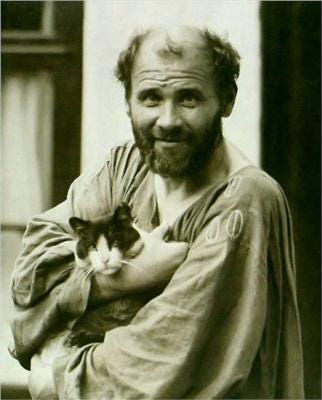
One surviving studio photograph shows Klimt in the smock that functioned as his working costume. The image does not prove conduct. It makes visible the same bodily grammar the paintings repeatedly encode: artist, smock, arm, neck, Muschi.
The corpus records a sustained iconographic structure. The artist’s recurring iconographic position pairs the Eye that extends the offer of forbidden vision with the hand that performs the consumption. Together the Eye and the hand compose Klimt’s distributed self-portrait. His own instruction was to look at the pictures to see what he is and what he wants. Across the corpus, the pictures show the pre-fall tempter. The form is beautiful because Ezekiel 28:17 describes Lucifer as perfect in beauty. The vocabulary shifts across cultures because the figure precedes any single culture’s iconographic naming of it. The Stoclet Rosebush, the dark serpentine hair in The Kiss, the masculine figure consuming Eve in Stoclet Fulfillment, and the black figure with talons at the seed-site in Hope I: each operates within Klimt’s system as a rendering of the same iconographic figure across cultural vocabularies.
The diagnostic stands at distinct levels and should not be collapsed across them.
At the iconographic level, the throat is the obsessive site of Klimt’s program. The pattern is sustained, the anatomical signature is precise, and the iconographic vocabulary is repeated across two decades.
At the interpretive level, the iconography organizes eroticized female collapse around the visual grammar of throat restriction. The cultural vocabulary for the category was available in Klimt’s Vienna. The Christian iconographic register for the throat as the locus of demonic struggle was available in his training.
At the biographical level, the corpus does not establish conduct. The historical record does not document Klimt as a practitioner of literal partner asphyxiation. The historical record documents him as a man of sustained sexual involvement with his models, fluent iconographic literacy, full access to the contemporary sexological vocabulary, and an obsessive iconographic fixation on the female neck in restriction. The fantasy structure is unmistakable in the corpus. Whether it crossed into conduct is not established by the evidence and is not required by the argument.
IX. What Holds
The man who wrote that the pictures show what he is and what he wants has been believed by no one. The reception of Klimt as eroticist and decorator has worked as a refusal of what the pictures disclose on his own instruction to look at them. The gold has done its protective work. The viewer has seen the beauty and missed the iconography under it.
The pattern is bounded, and the boundary is the proof. In the symbolic work the pillar of Eve is toppled, again and again, across two decades. In the portrait the same painter keeps it upright. He was not unable to render an intact neck. He rendered it whenever a Viennese woman sat for her likeness, and then he set it aside the moment the subject became Eve, the bride, the suppliant, or the consumed. A painter who can hold the line and chooses not to is not following a stylistic habit. He is making a selection, and the selection is the iconographic content.
The pillar of Eve is what is at stake, and what holds against its toppling is what the rest of the cycle names. The Beethoven Knight on the left wall, armored and cruciform. The Stoclet Knight at the head of the dining room, faceless and vertical, presiding over the absent center where Christ would have stood. The cross encoded in The Kiss, visible when the painting is inverted. The plumb line at Stoclet that measures where the iconography no longer measures itself. The Father who stands and waits, who is standard rather than sentiment.
These are not added decoration. They are the structural counterpart to what Klimt’s iconography destroys. The neck is the body’s upper plumb line. The Knight is the room’s. The cross is the painting’s. The Father is the cycle’s. The vertical that does not collapse is the answer to the vertical that does, and the portraits are the proof that Klimt knew the difference and painted accordingly.
The pillar that holds is what the cycle has been building toward.