
The Unwatched Hour
Why a code binds, and what fills the gap when no one is watching

Shape and Function
A prior essay sorted religions by the death they answer, the annihilation, the broken chain, the endless wheel. That is a religion’s shape, the terminal problem its deepest symbols gather around. Shape is not function. Knowing what a religion is built against says nothing about what it does in a society, and the thing it does, the hard thing, is make a code bind.
A code binds when a person obeys it at a cost to himself, in private, with no one to applaud the obedience and no one to punish its absence. That is the whole difficulty, and it is worth being precise about why it is difficult, because the difficulty is not a moral weakness to be scolded away. It is a structural feature of cooperation itself, and it is the gap every legal and religious system on earth was built to close.
This is not everything religion does. It is one function, but it may be the one without which the others cannot scale: the conversion of a public rule into a private governor.
The Memorialized Line
Start where the earlier essays left the chain. Life is a pattern that holds itself together and wants to continue. It continues better in cooperation than alone, because the arithmetic of repeated dealing rewards the partner who does not betray. Cooperation among more than a handful of people scales into something that needs rules, and the rules, to govern anyone beyond the people who happened to agree to them, have to be set down and made objective. The cave drawing, the stone tablet, the plumb line, the constitution, the statute. A standard outside any one person, that does not bend, that anyone can be measured against.
But the written line on the wall is only half of it. The code has to be set down in stone and also carried inside the person, acknowledged and obeyed when the stone is out of sight. The plumb line on the temple wall does nothing for the man in an empty field, holding a stone, staring jealously at his brother. What governs him there is whether he has taken the line into himself, and whether anything makes him keep to it when keeping to it costs him and no one is looking.
Where Law Holds
It is tempting to say a code can only bind if it comes from beyond the human, that men will not obey a rule they know other men wrote and can rewrite. That is false, and the proof is the entire apparatus of secular law. Contracts bind. Statutes bind. Constitutions bind, and everyone knows they were drafted by committees, argued over, amended, and that no voice from a mountain dictated a clause of them. People obey human law every day. So binding does not require the transcendent. The claim that it does is too strong, and a moment’s look at a courthouse refutes it.
Notice the condition under which secular law binds. It binds when there is an enforcer with eyes and a monopoly on force, and when the person deciding whether to obey expects to be seen and expects to face a tomorrow in which being caught will cost him. Law holds in the daylight, under the watch, with the future in view. Strip those conditions and the hold weakens fast, and exactly where it weakens is the whole subject of this essay.
The Unwatched Hour
Return to the arithmetic. Cooperation is the winning strategy only when the same parties expect to deal again and again, because betrayal then sours every round that follows it and the cost of a defection outruns its gain. Lengthen the shadow of the future and cooperation pays. Remove it and the math turns.
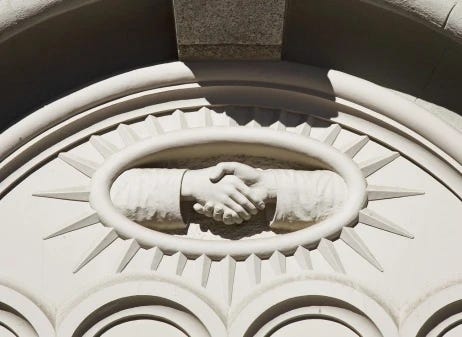
Handclasp, Salt Lake Temple
The one-shot encounter is where it turns. A stranger you will never see again, a transaction no one will witness, a moment in the dark with no enforcer in reach and no record kept. There, betrayal pays and cooperation is a mug’s game, and this is not a cynical opinion about people. It is the same survival logic that built morality in the first place, running in a setting that strips its conditions away. The logic that says cooperate when the game repeats says defect when it does not.
Every code has its weakest seam in the same place, and the place has no witness and no tomorrow. Call it the unwatched hour. It is the unobserved moment in which the gain from defection is large, the chance of being caught is small, and the partner will never be met again. The daylight is easy. Morality under observation is cheap, because observation supplies the enforcement that makes the upright move also the self-interested one. The hard problem, the only problem really, is the unwatched hour, and no code written on a wall can reach into it on its own.
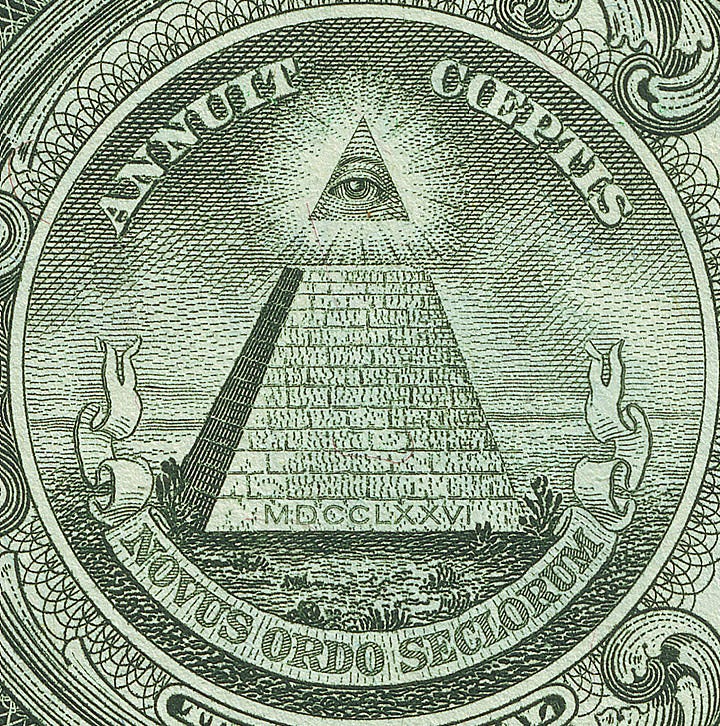
The Eye of Providence, as shown on the US $1 bill
The Thinning of the Eyes
A small band has no unwatched hour, which is how it survives without one. Everyone sees everyone. Reputation is total and instant. There are no strangers, and there is no encounter that will not be repeated, because the group is small and fixed and you will face every one of these people again tomorrow and for the rest of your life. Direct reciprocity, the watch of the whole group on each member, polices the band completely. The eyes are everywhere, so the dark never falls.
Then the band becomes a village, the village a city, the city an empire, and the eyes thin out. Strangers appear, people you will deal with once and never again. Most encounters become the one-shot kind. The reputation network that wrapped the band cannot stretch across a hundred thousand people, let alone a million. The surveillance that made cooperation rational was a function of smallness, and scale destroys it.
So as cooperation scales up into civilization, the very conditions that made cooperation rational fall away beneath it, and the society should slide back toward the one-shot equilibrium, mutual wariness, defection in every dark corner, trust no wider than the people you can personally watch. Large-scale cooperation among strangers should be impossible. It is the thing civilization most depends on and the thing the arithmetic says it cannot have. And yet the great societies cooperate anyway. Something put the eyes back.
The Watcher Who Does Not Sleep
What put the eyes back was a god who sees in the dark.
A watcher who misses nothing closes the surveillance gap that scale opened. The eye that never sleeps is present in the empty room and at the one-shot encounter, exactly where no human eye reaches. And a judgment that comes after death extends the shadow of the future past the grave, which means no dealing is ever truly the last round, because the account does not close when the witnesses go home or when the life ends. The one-shot game with a stranger becomes a repeated game played in front of a third party who never dies, never forgets, and settles up at the end. Defection in the unwatched hour stops being free, because the hour is no longer unwatched.
This is the core of what the research on large-scale religion calls the big gods, the moralizing, monitoring, punishing gods who, across unrelated cultures, are found alongside precisely the large cooperating societies of strangers that direct reciprocity cannot explain. Watched people behave, and a god of this kind is the watcher who is never absent. The intuition is old and ordinary: people are better when they feel seen, and the god is the felt seeing that no wall and no darkness can block.
The honest limit, since the survey method demands one. The causal direction is genuinely disputed. One account holds that the big gods came first and made the scaling possible. A prominent study of the historical record argued the reverse, that social complexity tended to come first and the moralizing gods followed it, though that paper was later retracted after its methods were challenged, and the question remains open and actively fought over. For the present argument the dispute does not have to be settled. Whether the watcher drove the scaling or grew up alongside it, its function is the same: it is the technology that puts an eye in the unwatched hour. The recurring association is strong enough for the argument even if the order and the coding stay disputed. Monitoring gods become especially important wherever cooperation has to reach past the range of face-to-face reputation.
The Tithes That Bind
A religion does not succeed by preaching cooperation. Every religion preaches it, and they do not grow at the same rate, so preaching cannot be the engine. The ones that succeed engineer the specific conditions under which cooperation is the winning strategy, and engineer them more completely than their rivals. The clearest modern case is Mormonism, which builds the conditions so thoroughly that the growth can be read off the census.

Eye of God, Salt Lake Temple
It does both jobs at once. It rebuilds the small band’s total surveillance inside the congregation, and it backs that with the eye that never sleeps. The sealing doctrine makes a member’s closest relationships eternal, played forever with the same fixed partners, which is the longest shadow of the future a person can be given; betraying someone you are bound to for eternity is never rational in any round. The ward assigns a member to a congregation he does not choose and cannot shop, with regular assigned visits, which converts the anonymous one-shot encounter back into a named repeated game. The dietary code, the garment, the abstentions are costly, hard-to-fake signals of commitment, the plumb line worn on the body, that make a member legible at a glance and let trust extend faster. And the discipline is the rest of the winning strategy exactly: excommunication answers defection, and the path back through repentance stays open, so the rule punishes once and forgives on return, which is the rod of iron and the crook in a single system.
The growth and retention are part of the institutional score, though not the whole of it. The high-demand, high-cohesion religions tend to grow and hold their members; the lax ones bleed away. Through much of the twentieth century Mormonism was often described as one of the faster-growing American religious movements, with real welfare structures and in-group mutual aid that pay out in measurable goods. This is where the claim that religion links to something mathematical and primal stops being a figure of speech. The cooperation pays, and the tithe is both the cost of belonging and the receipt for it.
The Price of the Wall
The same machine that produces the growth produces the shadow, and it is the same equation seen from the other side. Cooperation that strong requires a sharp in-group boundary, because the strategy works by playing the repeated, watched game with members and treating the outside as the one-shot world. High in-group trust and out-group wariness are not two traits. They are one mechanism viewed from inside and from outside. The costly signals that build trust among members are the same marks that wall off everyone who has not paid them. The eternal bond that makes betrayal irrational also makes leaving catastrophic, because a member who exits is not quitting a club, he is defecting from an infinite game with everyone he loves.
So the watcher who binds the member in the dark also draws a hard line around the stranger, and the social pressure and the steep cost of exit are not accidental side effects of the cooperative engine. They are part of the engine, running as designed. Strong cooperation is always bought with strong boundaries. There is no version of the machine that delivers the warmth and skips the wall.
The Fiction That Should Collapse
Laid out this way, the whole thing reads like a debunking. A scaling society needs its strangers to trust one another, cannot supply the surveillance that would make trust rational, and so invents a watcher who supplies it for free, an eye in the sky that frightens people into keeping the code in the dark. On that reading the god is a useful fiction, the society’s own rules dressed up as a voice from outside so they will bind where mere human rules cannot reach.
If that is the whole story, the fiction should collapse the moment it is seen through. Stop believing in the watcher and the eye goes empty, the dark falls again, and defection in the unwatched hour pays exactly as it always did. The binding should fail the instant the bluff is called.
It does not fail cleanly, and that is the strange part. People who have stopped believing in any watcher still keep the code in the empty room. The binding outlives the belief that was supposed to be holding it up. Why a structure built on a watcher survives the discovery that the watcher may not be there is a different question from the one this essay answered. It is the next one.
For now the point holds. A code is only worth what it is worth in the dark, and for most of human history the dark was given an eye.