
Where the Serpent Stood
Klimt's unfinished Eden, and the single half-verse it pins down.

Klimt died with this canvas on the easel, and the dying is the first thing most viewers are told about it. The bodies are bare because he had not yet painted the clothing over them. He built his figures from the skin outward, the nude first and the ornament last, and The Bride, found in the same studio, shows the method caught mid-stride: a woman fully rendered underneath an overlay of pattern he had only begun to lay down. So the nakedness here decides nothing. A viewer who reads the bare flesh as proof of innocence, of an Eden before shame, has mistaken an unfinished surface for a finished claim. Whatever moment this painting fixes, it does not fix it by what the couple is or is not wearing.
Which leaves the question open. What moment is this?
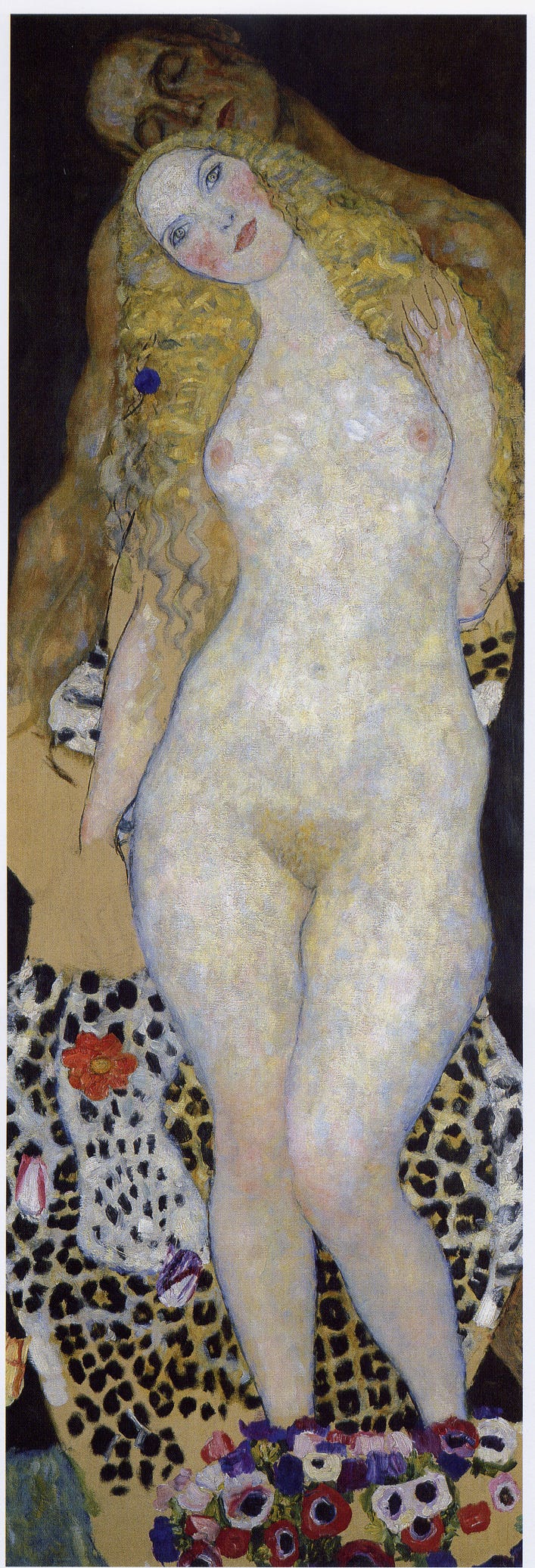
The gentlest answer is the usual one, and the Belvedere gives it in its strongest form. The man sleeps, so the scene must be the making of Eve from the side of the sleeping Adam, the second chapter of Genesis, before anything has gone wrong; and Franz Smola, writing for the museum, goes further still, holding that Klimt cared little for the episode at all and wanted only a timeless Eve, the mother of life, standing outside the story. Both readings lean on one fact, that Adam’s eyes are closed, and a closed eye carries almost no weight. A man can sleep the deep sleep of his bride’s making, or he can sleep through her ruin, or he can simply be the dormant thing behind her while she does what he does not see. The sleep does not name the chapter. Nothing else corroborates the creation reading. There is no wound in the man’s side, no rib, no gesture of making, no God reaching down. The single detail that reading must explain away is the woman’s left hand, cupped and lifted, holding nothing because the canvas was never finished, but cupped exactly where the apple goes. And here the gentle reading betrays itself. The same writers who call this the making of Eve are the ones who reconstruct an apple in that hand, the Boston museum saying it almost certainly would have held the fruit, the Belvedere conceding the apple is indicated under the unfinished paint. They have placed a fruit from the third chapter inside a scene they date to the second.
Run the sequence and the contradiction dissolves. Ask of each chapter what it would need on the canvas. Creation needs a sleeping man and a woman newly made who holds nothing and knows nothing, and the lifted hand and the knowing face are wrong for it. The temptation needs the serpent, and there is no serpent. The eating needs only Eve and the fruit, and it gives the man behind her nothing to do. Shame needs fig leaves and a flinching woman, and there are no fig leaves and no flinch. The garments need God and skins worn as clothing, and the skin in this picture is worn by no one. The expulsion needs the sword and the gate, and neither is here. One instant alone accounts for everything present: after Eve has eaten and before she gives the fruit to Adam. She stands knowing and unashamed, her hand still cupped where the fruit went, the man behind her not yet fallen and so still passive, the serpent’s work already done and so the serpent already gone. Genesis 3:6, the half-verse between her eating and his.
The same instant is the only one confirmed by what the picture leaves out. The missing serpent, the missing fig leaves, the missing God, the missing sword are not the failures of an unfinished canvas. They are the signature of that half-verse, because not one of them belongs to the interval between her bite and his. The sparseness is the argument. A painting that folded several moments together, creation and fall and judgment at once, would carry more of these markers, not fewer. This one carries the markers of 3:6 and no others.
The flowers settle where the couple is standing. At Eve’s feet Klimt painted anemones, and the readings agree, rightly, that the flowers are the flora of the garden itself. That fixes the timing. Flowers under her feet mean the ground is still Eden. They have eaten, and they have not been put out; the sin is done and the sentence has not come. The garden is the proof that we are inside the narrow window the half-verse opens, after the act and before the expulsion. Nothing in the picture has yet been taken away.
The ground does a second thing. It is the flowered ground of The Kiss. There the two figures kneel at the edge of a meadow thick with blossom, a paradise garden by every account, and Klimt has set his Adam and Eve down on the same bed of flowers. The reuse is not decoration. It tells you which family of his own pictures this one belongs to.
That family is the one this cycle has been tracing: the dark, dominant male who takes the bright woman from behind, in Love, in the Beethoven Frieze, in the Stoclet Embrace, in The Kiss, in Death and Life. In each of them the man is the active power and the woman gives herself up. Klimt put himself in that position again and again, the overtaking male, and Vienna read him there as well, the seducer painting the wives that other men had commissioned, the man who left some fourteen children and no marriage, the rumored lover of the Adele Bloch-Bauer whose husband paid for the portrait. The position was his, in paint and in reputation both.
See what becomes of it here. The composition descends straight from The Kiss, and the studies prove it, but the power is turned inside out. In every Kiss the man dominates. In this one Eve is brought to the front and the man falls back into the dark until he is barely separable from it. The slot Klimt had always occupied, the overtaking male, is now filled by Adam, and Adam is doing nothing. His eyes are shut. His arms close around her to no purpose. He is present and blind. This is the husband of Genesis 3:6, the one the text places with her, immah, at the decisive moment, and on the reading Milton took, at her side through the temptation itself: saying nothing, doing nothing, eating last and only because she hands it to him. Milton drew the same man out at length in Paradise Lost, an Adam not deceived as Eve was deceived, who falls knowingly, overcome by his attachment to the woman holding his ruin. Klimt’s Adam is that figure asleep at his post, the protector who is present and useless at once.
Which forces the question the picture will not answer inside its own frame. The serpent is gone, and its absence is not a thing only I have noticed; the museum readers see it too, and they close the gap by dissolving the tempter into Eve herself, into eros and knowledge, temptation with no tempter. But the painting offers a more exact answer. In the half-verse Klimt has chosen, only one other party was ever present. The serpent. Its work is finished, so it has stepped out of the scene, but it has not gone far. Follow Eve’s eyes. She is not looking at Adam. She has not turned to him; the turn is the next breath, and the canvas stops just before it, and in that pause her gaze has already left him and gone straight out of the frame. She is looking at someone. The only one she can be looking at, in that instant, is the creature that talked her into the fruit her hand still cups. The serpent is not absent from this painting. It is standing where she is looking, in the one place the composition holds open, which is the place in front of the canvas. While the paint was wet, that place was occupied by Klimt. It is occupied now by us.
I do not put this forward as Klimt’s stated plan. He left no word of it, and the man’s dissolving face will not carry a portrait identification. I put it forward as the reading the picture makes available once the rest is set. A painter who implicates his own standing-place through a sitter’s outward look is doing something with a long pedigree, the thing Velazquez does in Las Meninas, the address of the frontal gaze; and the drawings show Klimt working that gaze deliberately, testing how directly she would meet the eye. What is strange here is how little metaphor it costs. Klimt really was the man these women faced down from the easel. And in the imagination of Vienna he was already cast in the part, the painter of other men’s wives, the seducer in reputation whatever the truth of any single case. He painted the husband asleep, the woman turned outward over the fruit, and left the tempter’s place exactly where he himself stood.
And she is not ashamed, which is the detail that shows Klimt read his Bible more closely than his gentler interpreters did. Shame arrives in the next verse, 3:7, when the eyes of both are opened, after Adam eats. In the half-verse before it, a knowing and unashamed Eve is not a violation of the text but the one thing the text licenses. Klimt found the single permitted instant for an Eve who has eaten and feels no guilt, and he filled it with everything the license allows and the tradition fears. Her cheeks are flushed a bright red, and Milton’s Eve in this same instant is heightened as with wine. Behind her hangs a leopard’s pelt, which the Belvedere’s own reading names the skin of the maenad, the woman drunk on the god, the body carried past chastity into ecstasy; and her head tips back on her neck in the same Dionysian arch, and her mouth lifts. This is not the chaste mother of life the wall label promises. It is the ecstatic at the height of her indulgence, set in the one frame of the story where Scripture has not yet brought the shame down. That seam is what this whole project is about: the pagan reading of the fall as liberation, laid precisely over the Christian text, in the gap the text itself leaves open.
Hold the plumb line against it. The picture gives you the first Adam whole, the husband who sleeps while his bride is ruined, present and blind, the man who eats what is handed to him rather than stand between the woman and the thing that has come for her, while the tempter watches from the front of the frame wearing, if you like, the painter’s own face. This is the failure the gospel was written to answer, and it answers by exact inversion. The second Adam does not sleep in his garden but stays awake in it while his friends do not, and sweats. He is offered bread in the wilderness by the same tempter and refuses it; he is offered a cup he would rather not drink and takes it. He is not taken from behind; his side is opened from the front, and the bride is drawn out of the wound. And the covering at the end is not the skin of a slain beast, draped in the corner of Klimt’s canvas and worn by no one, but his own body, given to the woman he did not sleep through.